



In the summer of 1941, at Thermopylae, Nazi Alpine troops staged a profoundly unsettling ceremony. Having just crushed the heroic Greek resistance, the victors assembled at the site of Ancient Greece’s most famous last stand. Yet, they did not gather to honor a conquered nation.
Instead, they orchestrated a bizarre propaganda stunt, boldly claiming the legacy of King Leonidas and his three hundred Spartans for the Third Reich. Standing where the legendary Greek defenders once held the line against the Persian Empire in 480 BC, the German occupiers aimed to cast themselves as the rightful heirs to Sparta’s martial glory. In other words, they saw themselves as the modern reincarnation of these heroes. To the world, they were anything but heroic.
The rationale behind this display stemmed from the Nazi regime’s intense fixation on classical antiquity. Adolf Hitler and his inner circle viewed Ancient Sparta as the absolute pinnacle of racial purity and military discipline. Relying on a heavily distorted version of the Dorian invasion theory, German race theorists argued that these early Greeks were actually displaced Nordic Aryans. Furthermore, the Third Reich admired the Spartan model of a brutal, eugenicist society that discarded its weak in favor of the collective war machine.
The ceremony at the Hot Gates (Thermopylae), therefore, was organized for a distinct political purpose. By hoisting the swastika over the battlefield and laying wreaths on conquered soil, the elite Gebirgsjäger cemented their racial mythology that had supposedly been revived. They cast themselves as the modern vanguard of European civilization, conveniently ignoring the reality that they were an imperial force terrorizing a sovereign state.
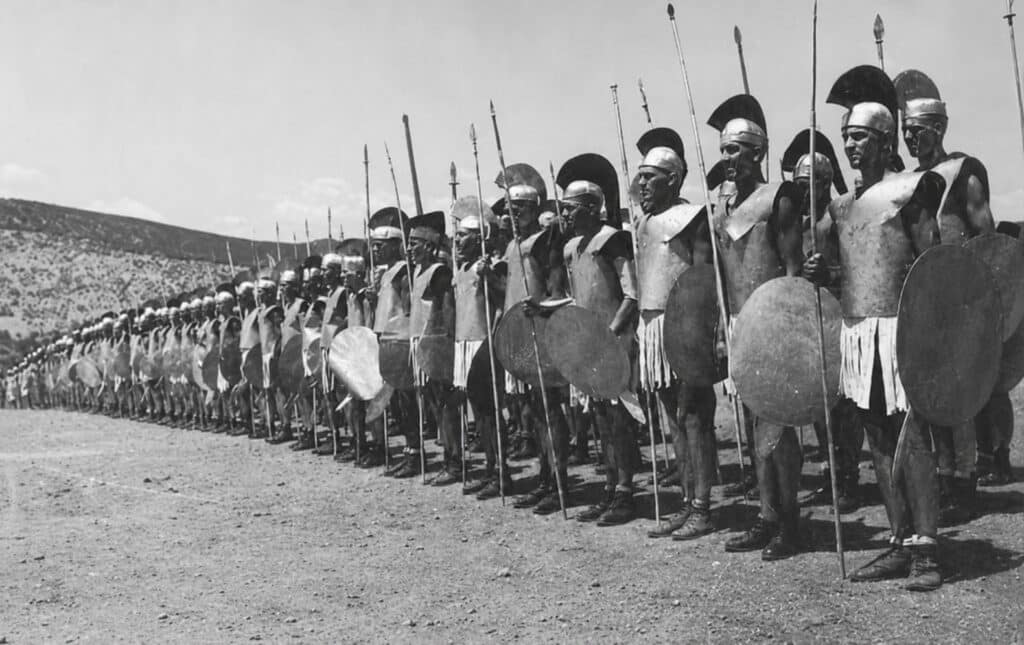
Thermopylae and propaganda of Nazi Germany
The event itself was a highly choreographed political theater, aimed at bolstering morale back in Germany while projecting an image of invincibility abroad. Following their grueling campaigns breaching the Metaxas Line and seizing the island of Crete, men of the Sixth Mountain Division halted at the historic gorge. Archival photographs and historical accounts show disciplined columns of soldiers enacting somber rites that mimicked Ancient Greek military traditions. German commanders delivered impassioned addresses, drawing direct comparisons between the historic discipline of the Spartan hoplite and the zealous loyalty of the Wehrmacht.
Experts have highlighted the danger of this specific brand of historical revisionism that Nazi Germany was so keen on. It violently stripped the Spartans of their genuine Greek psyche, reducing them to convenient fascist symbols. The sheer absurdity of a massive totalitarian empire identifying with a small, besieged band of Greek defenders eluded the Nazi leadership of this psychological campaign entirely.
Tragically, this distortion of classical Greece outlived the collapse of the Nazi regime, continuing to infect contemporary political culture. Extreme right-wing factions today frequently hijack Spartan imagery to legitimize radical ideologies.
From the torchlit rallies of Greece’s Golden Dawn party to Western alt-right factions wielding the Spartan lambda and chanting Molon Labe (“come and take them”), the weaponization of Greek history is still very much alive. These modern movements rely on the exact rhetorical frames pioneered by German forces in 1941 and promote a highly sanitized, mythical account of Spartan society to fuel authoritarian and xenophobic agendas.
The dark spectacle staged at the Hot Gates during the Second World War remains relevant to this day. It was the arrogant display of an occupying force, which declared itself the champion of liberty on the very land it had just subjugated, and exhibited the immense, terrifying power of state-driven propaganda.
See all the latest news from Greece and the world at Greekreporter.com. Contact our newsroom to report an update or send your story, photos and videos. Follow GR on Google News and subscribe here to our daily email!

