



In the years before World War II, the Nazis embarked on a search for an ancient Roman manuscript they believed would prove the existence of a superior race from Atlantis, the legendary advanced ancient civilization said to have sunk beneath the ocean. They thought this proof would give them the right to rule Europe.
Adolf Hitler believed that the Germans were descendants of a superior race, the Aryans, who originated from Atlantis. He claimed that when Atlantis sank, these people migrated north and settled in what is now Germany. The existence of these “superhumans” was supposedly confirmed in an ancient Roman manuscript.
Nazis, Atlantis, and the ancient Roman manuscript
The book was called Germania and was written by Cornelius Tacitus, a Roman historiographer who was probably born in 54 CE and died after 117 CE. Tacitus was a contemporary and friend of younger Pliny.
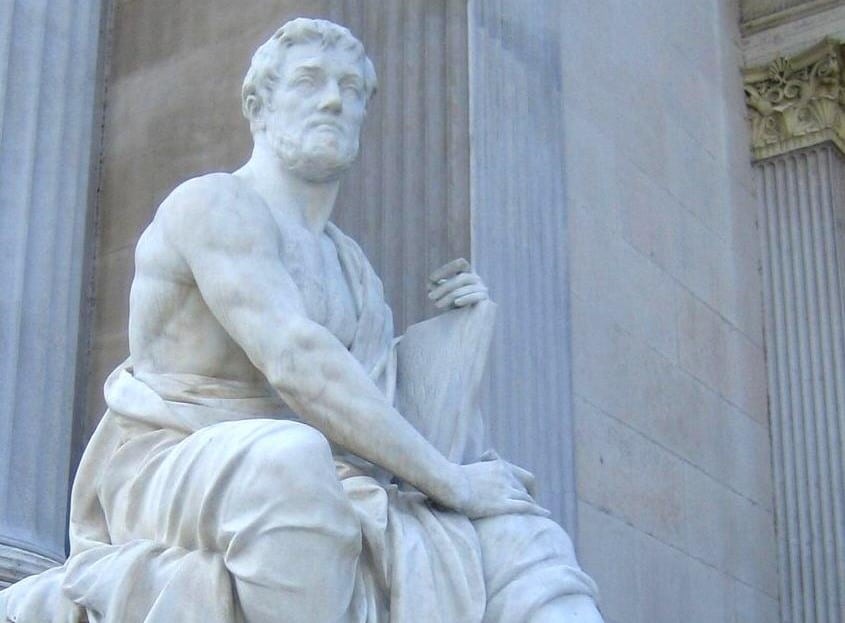
In the manuscript, the Roman historian wrote an account of Germania (modern day Germany): its location, its inhabitants, their character and customs. His description of the Germans of the time was that of a people who were fearsome warriors for whom defeat was a disgrace to the point that they killed themselves in shame. Most importantly to Hitler, they were of pure race, not intermixed with any other.
Agricola (Agriculture) and Germania are two important writings of Tacitus that belong to the Codex Aesinas, a collective manuscript of the 15th century that was the private property of the prestigious Baldeschi Balleani family from the Italian town Jesi in the Ancona region. The Codex Aesinas was discovered by accident in 1902.
In 1935 the Nazis established a band of specialists, the SS-Ahnenerbe, a pseudoscientific organization under the command of SS chief Heinrich Himmler and Hermann Wirth. Their aim was nothing less than to prove the superiority of the Aryan race, and with it the unique right of the German people to rule Europe. In order to empower themselves they even resorted to the occult and unsubstantiated legends.
For the Nazis, finding the original manuscript became the most important quest. When found, it would be used as proof that the Germans were Aryans, a supposedly superior race that by right should rule Europe and enslave or eliminate inferior races.
The race for proof of superiority
By the mid-1930s the new National Socialist order in Germany started an unprecedented search for proof of Aryan superiority. The Nazis turned to Germania, the ancient Roman text written by Tacitus nearly 2,000 years ago. Himmler, a stout Nazi, believed the manuscript described an idealized Germanic warrior society—pure, noble, and superior to all others.
His plan was to use Germania to justify the Third Reich’s racial policies, twisting its content to fit their world view and propaganda. The Nazis would claim to be the descendants of the Germans, the superior settlers of what is today northern Germany. They believed that this narrative would rally all contemporary Germans behind Hitler and the Nazis.
In the book, Tacitus describes the Germans as a race of fearless, invincible warriors led by a strong Germanian chief with the stereotypical characteristics of 20th century Germans: Blonde hair and blue eyes. These warriors destroyed the Roman legions, spreading fear to the northern part of the empire. They were allegedly a pure race, as Tacitus described them. In the minds of Hitler and the Nazis, they were the ideal Aryans, the perfect race, their ancestors.
In contrast, Nazi propaganda vilified the races that did not look like the people Tacitus described in Germania: the Jews, the gypsies, the Arabs, and others that did not fit with the image of the intrepid Germans and the new order the Nazis were planning to establish.
Himmler wanted to have the book as a “proof” of the Aryan superiority. However, Count Aurelio Baldeschi Balleani would not part with it. Himmler asked Hitler to have Benito Mussolini intervene and convince Baldeschi Balleani to give the book to the Germans, but to no avail. The count finally decided to let an emissary of Himmler come to Rome and look at the precious manuscript.

Germania: the Roman manuscript Nazis used to link their race to Atlantis
The English translation of Tacitus’ ancient Roman manuscript on the Germans paints a picture of a Spartan-like people who didn’t care about possessions and whose life revolved around war. A description that would fit the Nazi narrative of Aryan superiority, leaving out the barbaric traits parts of the primitive German tribes, of course:
“The Germans, I am apt to believe, derive their origin from no other people; and are nowise mixed with different nations arriving amongst them.
They have a tradition that Heracles also had been in their country, and him above all other heroes they extol in their songs when they advance to battle.
I concur in opinion with such as suppose the people of Germany never to have mingled by inter-marriages with other nations, but to have remained a people pure, and independent, and resembling none but themselves.
Hence amongst such a mighty multitude of men, the same make and form is found in all, eyes stern and blue, yellow hair, huge bodies, but vigorous only in the first onset. Of pains and labor they are not equally patient, nor can they at all endure thrift and heat. To bear hunger and cold they are hardened by their climate and soil.
. . . in Germania no vein of gold or silver is produced; for who has ever searched? For the use and possession, it is certain they care not.
They carry javelins or, in their own language, framms, pointed with a piece of iron short and narrow, but so sharp and manageable, that with the same weapon they can fight at a distance or hand to hand, just as need requires.
Nay, the horsemen also are content with a shield and a javelin. The foot (soldiers) throw likewise weapons missive, each particular is armed with many, and hurls them a mighty space . . . All naked or only wearing a light cassock . . . With coats of mail very few are furnished, and hardly upon any is seen a headpiece or helmet.
The most glaring disgrace that can befall them, is to have quitted their shield . . . many who had escaped in the day of battle, have hanged themselves to put an end to this their infamy.
A “dangerous book”
Towards the end of the war, when the allies were marching in Europe heading towards Italy, Hitler sent an SS unit to steal the precious ancient Roman book. But to no avail.
In 2011, Harvard Classics professor Christopher Krebs wrote the story of the ancient Roman manuscript the Nazis were after. A Most Dangerous Book: Tacitus’s Germania from the Roman Empire to the Third Reich describes the relentless quest for the book they could use to support and justify their plan to rule Europe and extinguish the so-called undesirable races.
The National Socialists elevated the coveted manuscript to a Holy Grail. For Himmler, the engineer of the Holocaust, it would resurrect an imaginary Germany of pure, powerful people fit to rule Europe.
The writer describes how Germania impacted people as early as the 16th century and onwards, to the days of the Third Reich. However, when the Himmler emissary returned empty-handed to Germany World War II was about to start, and the Nazis were unable to use the ancient Roman manuscript as the propaganda tool they wished.
When the ancient Roman historian Tacitus wrote Germania almost 2,000 years ago, he could not imagine what an impact his words would have in the distant future, or how the description of a barbaric people of his time could be used by a group of elitist National Socialist warmongers as a “bible”.
See all the latest news from Greece and the world at Greekreporter.com. Contact our newsroom to report an update or send your story, photos and videos. Follow GR on Google News and subscribe here to our daily email!

