



In Ancient Greece, gyms—known as gymnasia—were spaces where the core of what it meant to be a Greek man was forged, defined by olive oil, dust, and complete male nudity.
The Ancient Greek gymnasium was where friends and strangers alike gathered, in stark contrast to modern fitness centers, where individuals are often sealed off from their surroundings and focused solely on personal physique.
More than a place of training, the gymnasium formed the vibrant heart of male communal life. There, elite men from cities such as Athens, Sparta, and Corinth, stripped of clothing and pretense alike, followed a demanding program of mental and physical exercise that disciplined the mind as rigorously as the body. To truly understand the classical world, it is essential to recognize that the gymnasium stood as one of the foundations of citizenship, clearly separating insiders from the rest of society.
Social climbing and status
Access to a gym was the ultimate status symbol for men in Ancient Greece, drawing a clear line between the aristocracy and the working masses, who lacked the energy or means to participate. Manual laborers, slaves, and freedmen were strictly barred, making gym membership a defining privilege of the Ancient Greek elite. Within this exclusive environment, young men, the ephebes, were initiated into the rites of citizenship.
Entry came at a high cost—not in membership fees, as today, but in the expensive olive oil used to coat the body before training and, perhaps more importantly, in time that a working man could not afford. Leisure hours were required for wrestling, discus throwing, and socializing while the rest of society labored. As a result, Ancient Greek gyms became hubs of social advancement. Much like modern business deals struck on the golf course, political alliances in Athens were often cemented between bouts of wrestling or running.
A young man seeking to rise in a city-state in Ancient Greece would attend gyms known for their high-profile patrons. These spaces equated kallos—physical beauty—with moral excellence, a principle the Greeks called kalokagathia, meaning the harmonious combination of physical and moral virtue. The logic was straightforward, if unforgiving: those who excelled athletically and displayed a sculpted physique were assumed to possess the leadership qualities necessary to guide the state.
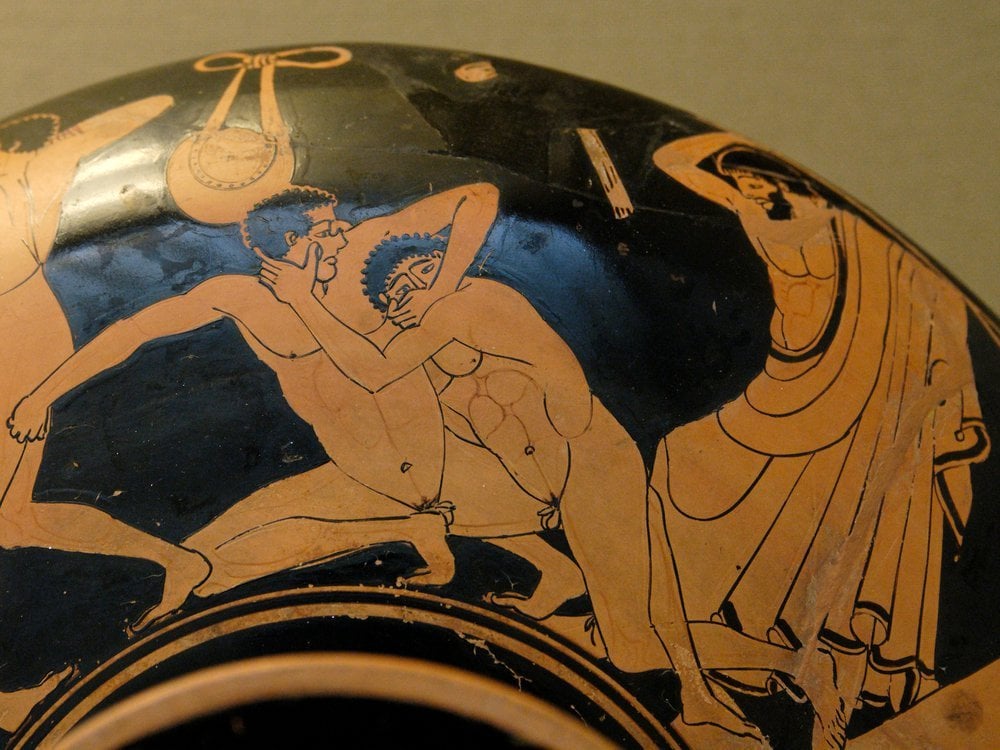
Gyms and philosophy in Ancient Greece
While unusual to modern readers, it is impossible to separate the intellectual legacy of the West from the gyms of Ancient Greece. Within these colonnaded courtyards, philosophy truly took root, and it is no coincidence that the names of history’s most famous philosophical schools are linked to the gymnasiums where they were founded. Plato established his school at the Academy, a gymnasium dedicated to the hero Hekademos, while Aristotle lectured at the Lyceum, a space sacred to Apollo Lykeios.
These thinkers treated physical education as inseparable from intellectual development, believing that an unfit body inevitably led to an unfit mind. Socrates himself was a familiar presence in these spaces, famously engaging handsome youths in dialectic conversations as they caught their breath. The gym in Ancient Greece offered a unique, captive audience for philosophical discussion. Between bouts of exercise, men would gather in the exedrae—the seating areas—to debate ethics, rhetoric, and the nature of the universe.
This integration reflects the Greeks’ holistic view of human existence, one that the modern world has largely fractured. Today, we tend to compartmentalize life: driving to a gym to exercise the body and attending a university to exercise the mind. In Ancient Greece, these were inseparable aspects of paideia, the cultivation of the ideal citizen.
The naked male body as a societal norm
The most striking difference between modern fitness culture and the classical tradition was, of course, the mandatory nudity. The term gives it away: gymnasium derives from the Greek word gymnos, meaning naked. While this was a practical measure to allow freedom of movement, it was also a culturally loaded declaration of Greek identity. To exercise naked was to be civilized, whereas shame over one’s body marked the “barbarian,” someone who could not appreciate its significance.
Public nudity served as a great equalizer among the Greeks. It removed the visible signs of rank or wealth that clothing might convey, yet it simultaneously subjected the body to intense scrutiny. In this environment of complete exposure, the male body became a public monument. The meticulous ritual of scraping sweat, oil, and dust from the skin with a bronze strigil was an art in itself, often immortalized in works such as the famous Apoxyomenos statue.
This focus on the visible self resonates with modern “gym bro” culture, where physical aesthetics are often paramount. However, unlike the contemporary pursuit of muscle hypertrophy for social media approval, the ancient ideal was deeply communal. A perfect body was not merely a personal accomplishment but a gift to the city and gods.
The legacy of the Ancient Greek gyms invites reflection on our own relationship with fitness. While we have retained the equipment and the relentless drive for physical perfection, we have largely lost the communal and intellectual spirit that once animated these spaces. For the Greeks, the pursuit of strength was never a solitary endeavor—it was a social responsibility that bound society together.
See all the latest news from Greece and the world at Greekreporter.com. Contact our newsroom to report an update or send your story, photos and videos. Follow GR on Google News and subscribe here to our daily email!

