



The issue of who was considered Greek during the era of ancient Greece has been a matter of broad scholarly debate for centuries.
The question of who qualified as “Greek” in antiquity is truly fascinating and involves many parameters to consider.
For the ancient Greeks the issue of identity was an important one that was not simply based on issues such as geography or ancestry but involved a series of other important factors.
These were normally deeply rooted in aspects such as shared cultural heritage, linguistic similarities and religious beliefs, and traditions that shared common ground.
The issue of who was Greek in ancient Greece is a complex one
This self-perception of what it meant to be Greek did not get its shape and form overnight. It was something that evolved over centuries and it was heavily affected by historical events and interactions with other-than-Greek civilizations and cultures.
In ancient times, the Greeks referred to themselves as ”Hellenes” and their land as Hellas, names that are still used by the Greeks to this day.
However, ancient Greeks did not see themselves as a unified nation, probably because they never existed under the same state roof. Instead, they identified primarily as citizens of their city-states, known in Greek as ‘poleis.’ Examples of these poleis include the well-known city-states of Athens, Sparta and Corinth, among many others.
Despite this widespread localization, a broader sense of a common Greek identity emerged through important issues such as shared language, religion and customs.
Prominent ancient Greek historian Herodotus famously defined what is takes to be Greek through four key criteria: common descent, shared language, worship of the same gods and similar customs.
This collective identity became very important and prevalent in most of the Greek cities during external threats and conflicts with civilizations that were clearly ”foreign.”
The common enemies
These include the Persian Wars in the 5th century BC, where the Greeks united to confront the common enemy, who spoke differently, believed in different gods and had different customs and traditions.
When faced with a common enemy, the Greeks put aside their internal differences and showed their unity as ”Hellenes” in contrast to the “barbarians,” such as the Persians for example. This dichotomy between Greeks and non-Greeks (or “barbarians” as the Greeks used to call them) showed a clear belief on behalf of the Greeks in what they perceived as their cultural superiority over others.
The Greek language was one of the most—if not the most—critical markers of the Greek identity. Dialects, obviously, varied significantly across the regions of the ancient Greek world.
For example, one would hear Doric in Sparta and Ionic or Attic in Athens. Nonetheless, all were recognisably Greek and mutually intelligible.
The traditional participation in common religious practices also made the Greeks understand and appreciate more deeply their shared identity.
Pan-Hellenic (all of Greece) sanctuaries like Delphi and Olympia hosted rituals and games that brought together people from different city-states in a gesture of unity and pride in their Greek heritage.
Notably, only Greeks could compete in the Olympic Games, something that demonstrates clearly that despite their many differences, the Greeks did understand that they belonged to the same family.
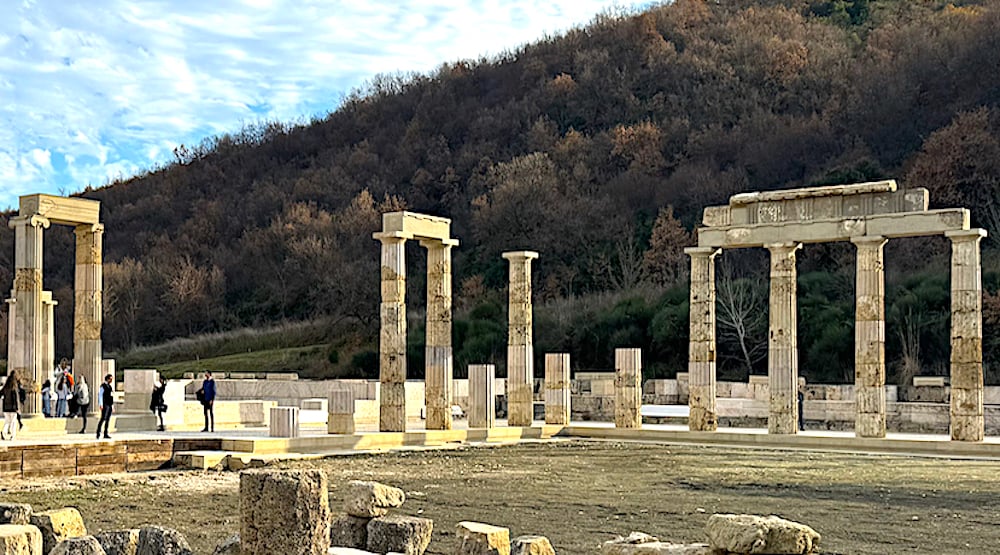
Interestingly, being a Greek was not entirely fixed by birth or ancestry as many believe.
For ancient Greeks, becoming Greek was something that could be achieved by those who embraced Greek culture, its language and its customs.
For example, during the Hellenistic period following Alexander the Great’s conquests across Asia and Africa, non-Greeks who spoke Greek and participated in Greek cultural practices were often considered part of the Hellenic world, despite their different ancestry.
However, even among themselves, ancient Greeks debated who truly belonged to their cultural sphere, showing that internal divisions among the Greeks are something that goes back millennia.
For instance, Macedonians were sometimes viewed by Athenians and their allies as semi-barbaric Greeks due to their austere monarchical system and distinct customs that were quite different to those one could find in southern Greece.
This was, obviously, more of a geopolitical and ideological argument rather than one of ancestry and identity.
Yet, the Macedonians spoke a Greek dialect and, according to them, they descended from Perdiccas, the son of Temenus, a descendant of Heracles (Hercules). This allowed them to participate in Pan-Hellenic institutions like the Olympics, proving their Greek origin.
In the 5th century BCE, King Alexander I (not to be confused with Alexander the Great) participated in the athletic competitions at Olympia. Additionally, in 328 BCE, there is a record of a man named Cliton winning the important running race. Based on the available records, he was the first non-royal Macedonian to win in the Games.
See all the latest news from Greece and the world at Greekreporter.com. Contact our newsroom to report an update or send your story, photos and videos. Follow GR on Google News and subscribe here to our daily email!

