



The word “barbarian” has a complex and evolving history that stretches back to the earliest days of Greek literature and thought. In its earliest uses, the word did not carry the harsh connotations it acquired in later centuries. Instead, it was initially simply a neutral or descriptive term.
Over time, however, historical events, cultural conflicts, and philosophical developments transformed the word into a symbol of opposition. From Homer to Aristotle, and from the Persian Wars to Alexander the Great, the meaning of “barbarian” reflected the shifting identity and worldview of the ancient Greeks.
Homer and the earliest use of “barbarian”
The roots of the term lie in the onomatopoeic expression “bar-bar,” which mimicked the incomprehensible speech of foreigners. Homer, one of the earliest surviving Greek poets, used the term “barbarophonoi” in reference to the Carians.
In the Iliad, he describes them not by their race or customs but by their unintelligible language. For Homer, “barbarophones” simply referred to those who spoke in a manner incomprehensible to the Greeks. The term had no inherent judgment or disdain attached. It was a linguistic label rather than a cultural condemnation.
The Trojan war and the birth of Greek identity
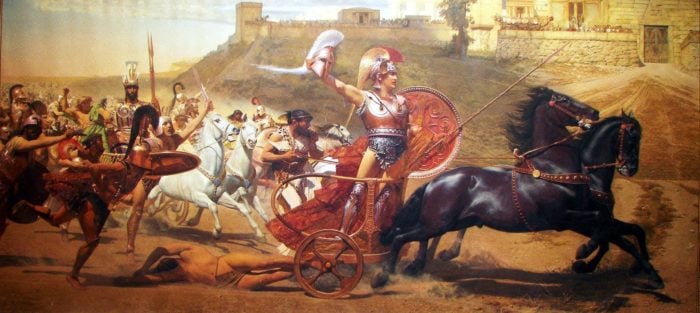
Thucydides, the historian writing in the fifth century BC, offered one of the earliest attempts to distinguish Greeks from non-Greeks in a political and cultural sense. In his History of the Peloponnesian War, he noted that the Trojan War marked a turning point. According to him, the war brought together for the first time a coalition of tribes that began to identify as Hellenes. Before this, there was no clear Greek political unity. The term “Hellene” itself derives from Hellene, the mythological son of Deucalion. It referred to the tribes that traced their descent from him and shared common religious and social customs.
At this early stage, the term “barbarian” merely meant someone who did not belong to these tribes. It described those who either lived outside of the Greek world or who, even if they lived among the Greeks, did not conform to Hellenic customs. Cultural practices, not race alone, defined the term. Yet until the Hellenistic period, Greekness was not purely cultural—it was both cultural and genealogical. One had to share in the ancestral lineages tied to Hellene and the tribes descended from him. However, even people with a similar bloodline could be labeled barbarians if they lacked the proper language and customs.
This boundary applied not only to foreigners but also to Greeks who adopted foreign customs. The Greeks described such individuals as having “barbarized.” The verb expressed a deliberate cultural shift away from Hellenic norms. To “barbarise” was to abandon the Greek way of life. The insult was scathing, for it implied a betrayal of one’s heritage and values. The use of the term reflected a growing confidence in Greek identity and a belief in its superiority.
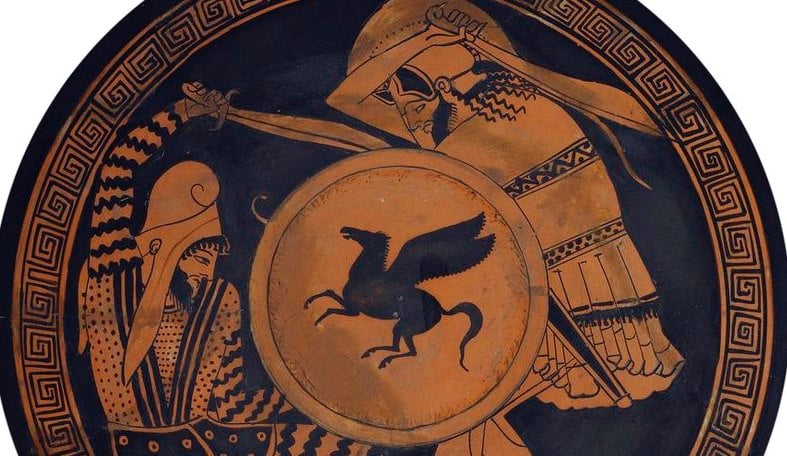
A “barbarian”: The cultural and genealogical other
Greek identity was also enforced through exclusive cultural institutions such as the Olympic Games and other Panhellenic festivals. Participation in these events was restricted to those who could prove their Greek descent. Genealogies were verified, and any suspicion of non-Hellenic ancestry could result in exclusion. These athletic contests served as more than sporting events—they reinforced a collective identity rooted in both lineage and shared customs. The requirement of Greek bloodline ensured that even acculturated foreigners remained outsiders in the eyes of the Greek world.
The Persian Wars transformed this cultural distinction into a sharp political and ideological divide. The wars, especially the invasions of 490 and 480 BC, placed the Greeks in direct conflict with the powerful Persian Empire. The Persians were wealthy, organized, and expansive. Yet their customs and political structures differed greatly from the Greek polis model. In defeating the Persians, the Greeks came to define themselves in opposition to their former enemies. The word “barbarian” now implied not only foreignness but also despotism, excess, and moral inferiority.
Greek philosophers helped reinforce this view. Aristotle, in particular, placed Greeks at the top of a cultural and natural hierarchy. In his Politics, he argued that Greeks alone possessed the balanced qualities necessary for virtue and good governance. He claimed that non-Greeks, by contrast, were either overly spirited or overly rational, lacking the harmonious blend characteristic of Greeks. This theory justified Greek superiority and even conquest. It placed the Greek way of life as the standard by which all others should be judged.
Eratosthenes, Alexander, and the Hellenistic shift
Yet not all Greek thinkers embraced this rigid view. Eratosthenes, as quoted by Strabo the geographer, challenged the notion that men should be distinguished between Greeks and barbarians since he believed there are both “good” barbarians and “evil Greeks.” He proposed that civilization and virtue rather than descent determine who counted as Greek. Both Strabo and the philosopher Plutarch later credited Alexander the Great with embodying this principle. According to them, Alexander called all civilized and virtuous people Greeks, regardless of origin. Conversely, he considered those who were ignorant, cruel, or immoral as barbarians, whether Greek or not. This marked a major shift in perspective.
Alexander’s conquests spread Hellenistic culture across a vast territory. Greek language, art, and philosophy flourished in Egypt, Mesopotamia, and Central Asia. The Hellenistic period did not erase local cultures, but it blended them with Greek elements. As a result, Greek identity became more inclusive. It became a matter of cultural participation rather than ethnic purity. The meaning of “barbarian” changed once again. It no longer referred strictly to non-Greeks but to those who remained outside this expanding civilizational web.

Rome and the final transformation
By the Roman period, the term “barbarian” took on a more negative and simplified meaning. Romans adopted the Greek term but applied it with less nuance. For them, barbarians were uncivilized, disorderly, and dangerous. They lived beyond the frontiers of the empire and posed a constant threat. The old Greek distinctions between cultured and uncultured blurred into a stark binary. Civilized Romans (and Greeks within the empire) stood opposed to the barbarian hordes beyond the borders.
This final stage marked the end of the word’s classical evolution. What began as a neutral descriptor of language had become a tool of exclusion. The Greeks first used it to define cultural boundaries. Over time, they employed it to express moral and political judgment. War, philosophy, and empire all shaped its transformation. By the time of Rome, the word was steeped in centuries of layered meaning.
The history of the word “barbarian” tells us much about how identity forms and shifts. It reveals how language can both reflect and enforce power. The Greeks used the term to distinguish themselves, assert superiority, and, finally, expand their cultural reach. Alexander’s more inclusive vision briefly broadened its meaning, but later empires narrowed it again. Through it all, the word remained a reflective of Greek self-understanding. Its journey from Homer to Rome traces the rise and transformation of Greek identity itself.
See all the latest news from Greece and the world at Greekreporter.com. Contact our newsroom to report an update or send your story, photos and videos. Follow GR on Google News and subscribe here to our daily email!

