



This article gets updated constantly, as new findings of the Alexander the Great-era tomb surface from the Casta hill in Amphipolis, Greece.
The recent archaeological discoveries of Amphipolis have become known across the world. At first, archaeologists wondered whether Alexander the Great was buried in the largest tomb that has even been discovered in Greece. However, that theory was ruled out and people started wondering what secrets lie deep under the Casta hill.
Here is the timeline of the latest Ancient Greek discoveries and the excavation progress, spearheaded by Greek archaeologist Katerina Peristeri:
-January 19, 2015 [Latest]
 Greece ‘s Ministry of Culture made an official announcement today saying that the laboratory results of the examination of the human skeletal material found inside the grave in the Amphipolis tomb show that four dead were buried in the tomb, along with the remains of a cremated dead. The ministry has also issued several pictures of the bone material found.
-November 12, 2014
 The new discovery of a grave made of limestone allegedly containing a wooden coffin with an integral human skeleton inside the Kasta Hill tomb in Amphipolis, Greece, brings archaeologists closer to solving the mystery of the person buried in the monument.
The grave was found 1.60 meters beneath the third chamber floor.
-October 31, 2014
 According to an official announcement by the Greek Ministry of culture, excavation works in the Amphipolis tomb continue with the removal of the backfilling earth from the fourth chamber.
The crew exposed a vault dug on the natural slate floor. The vault has a surface of 4X2.10 meters and its floor is sealed with limestone.
Also, a marble door that belongs to the third chamber with dimensions 2X0.90X0.15 meters, weighing 1.5 tons was found.
-October 21, 2014
 Another amazing discovery has surfaced on the Amphipolis dig, Greece. The missing head of the Sphinx “guarding” the tomb’s entrance was finally discovered inside the third chamber.
The Sphinx’s head is intact, with minimal breakage on the nose.
In addition, fragments of the Sphinx’s wings were discovered at the same chamber.
-October 20, 2014
Archaeologists trying to reach the next chamber in the Amphipolis tomb have hit a wall of dirt and reaching the next chamber will take longer.
Minister of Culture and Sports Kostas Tasoulas gave the Greek Parliament a cost analysis of the excavation works.
Specifically, 390,000 euros were allocated by the Ministry of Culture and Sports, 50,000 euros by the Ministry of Macedonia and Thrace, and the National Bank of Greece donated 150,000 euros
-October 16, 2014
 The Greek ministry of culture announced today that the rest of the Amphipolis tomb mosaic has been revealed and that there is a woman’s face completing the picture. Archaeologists are certain that the woman is Persephone.
In a series of impressive pictures released by the ministry, we see that the female figure has fiery red hair, wears a white robe held by a red ribbon over her breast. She raises her left hand and wears a bracelet. This leads archaeologists to the assumption that the 4.5X3 meters mosaic depicts the abduction of Persephone by Pluto.
-October 12, 2014
 Archaeologists have at last publicized photos of a stunning mosaic floor discovered in the second chamber of the tomb, the site of the Caryatids’ discovery. According to the Greek Ministry of Culture, the colorful floor was laid with white, black, grey, blue, red and yellow pebbles and depicts a chariot in motion. Hermes, the messenger of the gods, is pictured riding the chariot.
-October 7, 2014
Speaking to “Mega Channel” yesterday, Katerina Peristeri, head archaeologist of the Kasta tomb excavations, conjectured that the tomb’s occupant is a high-level Macedonian figure, possibly one of Alexander the Great’s generals. But the “secret of the tomb” will only be fully revealed in one month’s time, when the excavations are complete, she added.
Also speaking on “Mega,” Theodoros Mavrogiannis, professor of History and Archaeology at the University of Cyprus, reiterated his theory that Hephaestion, close friend of Alexander the Great, lies in the Kasta tomb.
Mr. Mavrogiannis agrees with Peristeri’s dating of the tomb to the last quarter of the 4th century BC. He added that the Caryatids discovered in the tomb’s second chamber may be a direct reference to Athens, Hephaestion’s hometown.
-October 2, 2014
After removing a section of soil from the third chamber, archaeologists have uncovered three fragments of a marble door, a door hinge and several bronze and iron nails. The new findings have archaeologists convinced that Casta Hill is in fact a tomb.
-September 30, 2014
 New photographs released by the Ministry of Culture show that the Caryatids rest on pedestals. They stand guard over the third chamber, lofting 3.5 meters above the ground. Their bases are each 1.4 meters in height. At two meters tall, the figures themselves stand larger than life; combined with their bases, each towers a total of 3.67 meters into the air. The floor of the second chamber is raised seven centimeters above that of the first. It appears to preserve traces of its original blue paint.
The third section of Andrew Chugg’s commentary on the baskets resting above the Amphipolis Caryatids’ heads argues that the baskets resemble those that were actually used in the worship of Dionysus.
-September 26, 2014
The head of the team excavating the Casta tomb at ancient Amphipolis, archaeologist Katerina Peristeri, told Athens News Agency yesterday morning that the excavation’s progress has started to slow. Entering the third and fourth chambers of the tomb is particularly difficult because it requires extended support work in order to prevent roof collapse. But Peristeri reiterated that the complete excavation of the tumulus “will be over in one month.”
-September 21, 2014
 The Culture Ministry releases official photographs of the caryatids guarding the Amphipolis tomb. Standing at 2.27 meters high, the statues are placed on marble pedestals, reaching up to 1.33 meters in length, 0.68 meters in width and, for now, 0.30 meters in height. They are both sculpted with great detail and are dressed in long chitons and long fringed dresses with folds.
Furthermore, it is announced that a door was found in the third chamber, which probably leads to another, fourth chamber. Archaeologists working on the site have noted that excavations in the fourth chamber are expected to be very difficult.
-September 20, 2014
Peristeri says that she is convinced the tomb was constructed between 300 and 325 B.C.
However, archaeology professor Olga Palaggia states her strong belief that the tomb is not Macedonian but Roman and that it is falsely associated with the time of the Amphipolis lion statue’s construction.
This on-going battle of whose remains are hidden in Ancient Amphipolis will not end until excavations reach the tomb’s main chamber.
 -September 17, 2014
In an article published on his blog, architect and painter Gerasimos G. Gerolymatos presents a detailed reconstruction of the mound and inner tomb chambers. His plans provide a careful analysis of the tumulus.
-September 16, 2014
At this stage, archaeologists are unable to remove soil from the third chamber until protective measures have been taken to support the tomb’s walls and ceiling in order to prevent collapse. Retaining walls and steel beams will be installed across the length and breadth of the chamber. Soil will be then removed in small sections at a time.
-September 15, 2014
 Archaeologists discover a third chamber after the soil was removed behind the Karyatids and an Ionic-style marble lintel gate was gradually exposed. A 13-meter long wall blocks the way to the third chamber.
-September 14, 2014
Archaeologists find out that the same marble from Thasos was used to construct not only the Caryatids but the rest of the tomb as well. It is believed to be most likely delivered from the same ancient Macedonian workshop.
-September 10, 2014 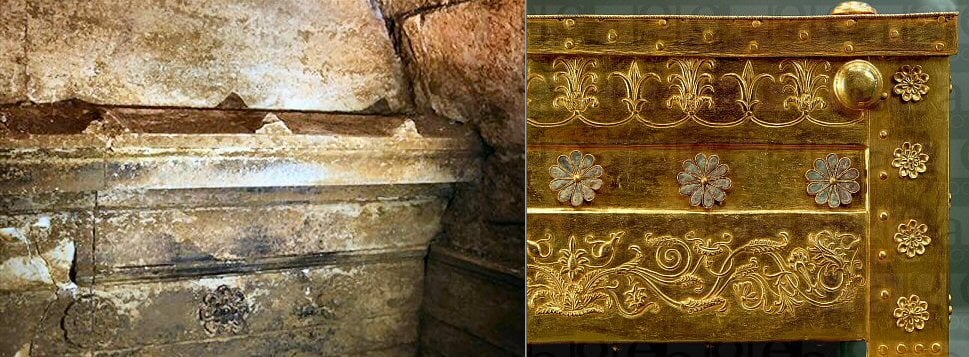 Three red and blue colored epistyles are discovered, approximately 80 to 100 centimeters long, with a height of 15 cm. They are found near the second diaphragmatic wall, behind the caryatids, covered in soil, and are quickly transferred to the Archaeological Museum of Amphipolis for security reasons.
-September 6, 2014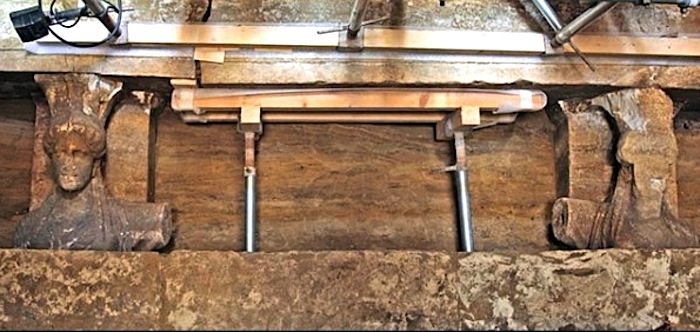 Two caryatids (sculpted female figures) of exceptional artistic value are unearthed. Specialists note that the new discovery further supports the view that the monument is of major Archaeological importance. According to a Culture Ministry announcement, the western caryatid’s face is saved almost intact, whereas the eastern’s face is missing.
-August 31, 2014
A floor section made of irregular pieces of white marble on red background is discovered in the antechamber behind the sphinxes’ wall. The floor section is in excellent condition. The remains of a fresco with traces of blue coloring are also found on the first diaphragmatic wall behind the sphinxes.
-August 26, 2014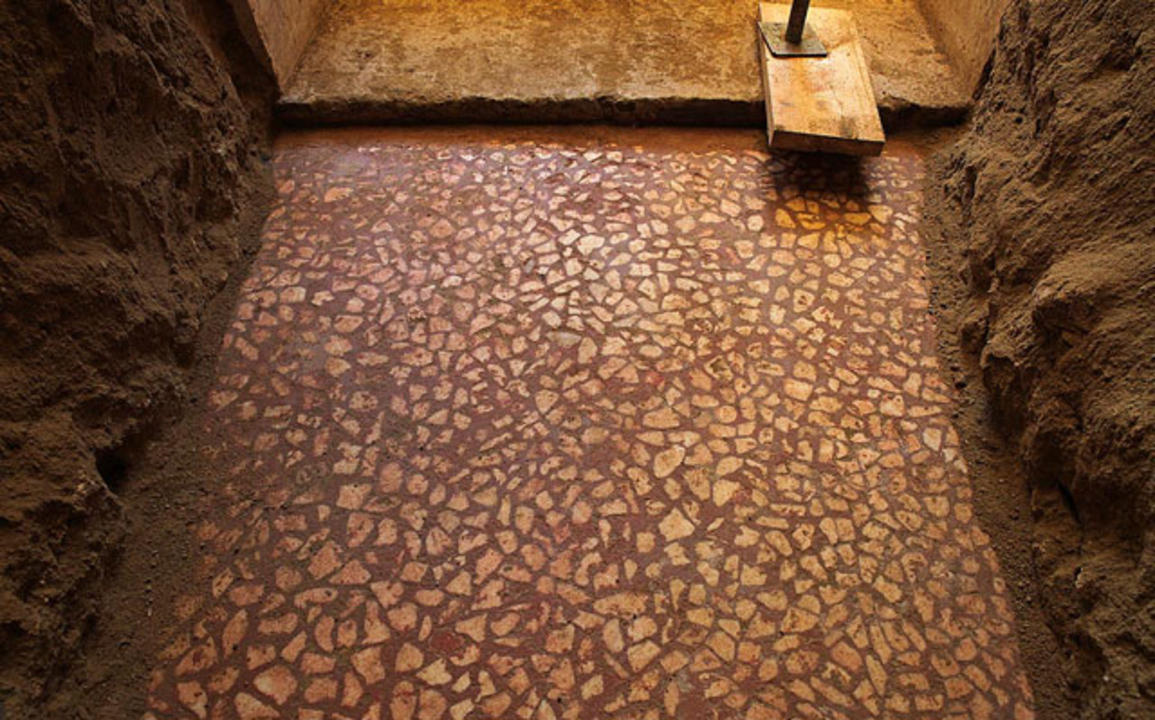 Part of the mosaic floor is revealed after the last piece of the sealing wall was removed. The floor is pebbled in front of the entrance, consisting of rectangular and square shapes, surrounded by black and white rhombs.
-August 21, 2014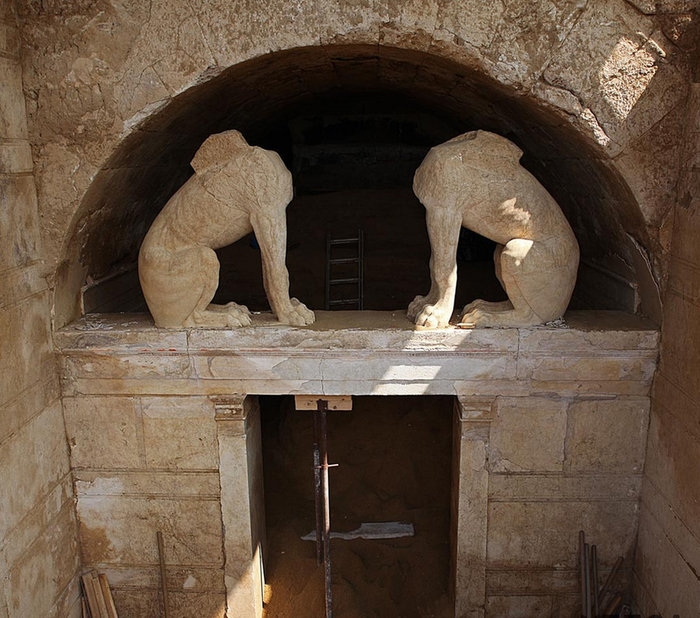
Under the sphinxes’ base, archaeologists find the upper portion of a marble doorway, covered with fresco, mimicking the Ionic epistyle, decorated with red, blue and black colors. It rests on two Ionic capitals, also painted with the same colors, crowning the pilasters that form the door frame. Culture Minister Konstantinos Tasoulas confirms that parts of the Sphinxes’ wings have also been found.
-August 20, 2014
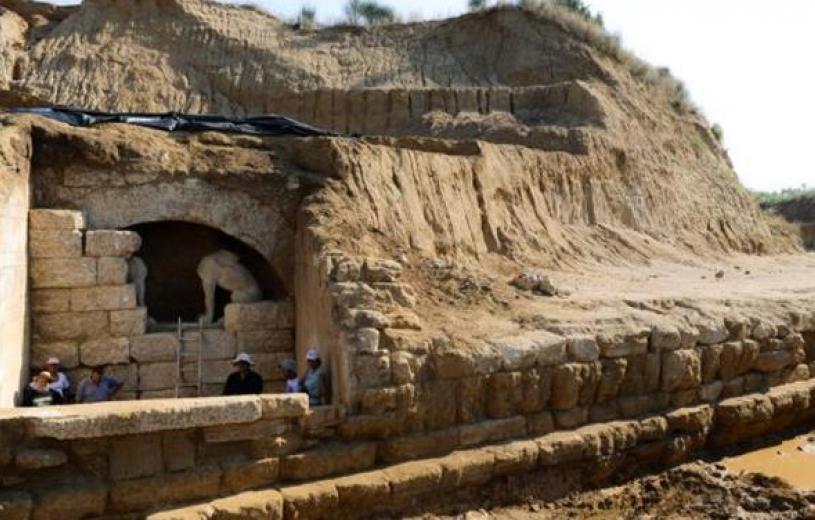 The Culture Ministry announces that the entrance is “guarded” by two marble sphinxes that have been completely unearthed. In addition they announce the discovery of another statue, a part of a Lion’s back, as well as a small part of the monument’s superstructure.
-August 10, 2014
Archaeologists locate, and reach, the entrance of the ancient Greek tomb.
-2012
Katerina Peristeri and her team brings the grand tomb circle to light, proving that Dimitris Lazaridis’ theory about Amphipolis was correct.
-2009
Katerina Peristeri and her team restarts excavations at the Casta Hill in Amphipolis, Greece.
-1956
Prominent Greek archaeologist Dimitris Lazaridis starts the first excavation at the site and later suggests that there is an important burial complex under the Casta hill. Lack of funds never allowed the operation to continue. However, by the time of his death in 1985, Lazaridis had discovered at least 70 ancient tombs in other locations.
(Featured Photo credit: RaptisCG)

Subscribe here to get Greek Reporter's latest news stories and content delivered to your inbox, once daily!

