



At the heart of Venice’s globally renowned St. Mark’s Square sits Biblioteca Marciana, a library filled to the rafters with the ghosts of a fallen empire and the intellectual soul of Byzantine Greece.
Beneath that Italian name we can hear a Greek heart beating, transplanted there thanks to the catastrophe that swallowed Constantinople in 1453 and the sheer will of one incredible man, who is, unfortunately, not as widely recognized as he should be. This incredibly beautiful place is an intellectual lifeboat carrying the precious cargo of Greek wisdom across centuries.
A Greek cardinal and his mission to save ancient wisdom
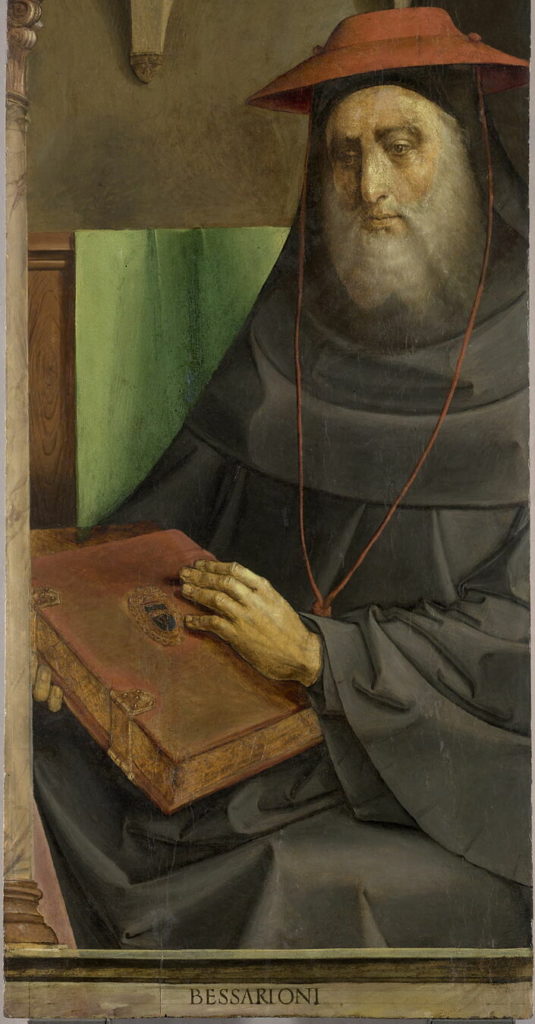
You can’t talk about the Marciana Library without mentioning Cardinal Bessarion. Born Basilios around 1403 in Trapezous (Trebizond)—a Greek city clinging to Byzantine life on the Black Sea—this figure was destined to take on a variety of important roles, including those of scholar, churchman and diplomat. The most important aspect of his personality, however, was that he was absolutely immersed in Greek knowledge and learning.
As the Ottoman tide rose, threatening to drown the last remnants of the Eastern Roman Empire, Bessarion threw himself into a desperate mission, knowing that the alternative would be for centuries of knowledge to go missing forever: he dedicated his life to trying to unite the Eastern and Western churches, estranged since the Great Schism of 1054. Maybe, just maybe, a united Christian front could save Constantinople, Bessarion thought.
Unfortunately, we all know how that heartbreaking story ended. The effort at reunification didn’t bear any lasting fruits and the “City of all cities” fell in 1453, leaving behind a wound still felt deeply in the Greek world. Bessarion decided to leave his motherland. Now a Cardinal living in Italy, Bessarion watched his world dissolve. But he didn’t just despair or give up, as so many others did; he acted.
He became a man possessed, hunting down and gathering every Greek manuscript he could find—philosophy, science, history, theology—literally everything. Then, in 1468, he did something amazing: he gave his entire collection, hundreds upon hundreds of priceless Greek and Latin texts, to Venice.

Why Venice? Well, they had ships, money, a degree of stability, a large and established Greek community, and, let’s be honest, a complicated past of love and hate with the Byzantine Empire. He insisted it be a public library, open to all, and not some sort of a semi-private collection for the few. And just like that, the Biblioteca Marciana was founded, quite literally on the rescued pages of Greek thought.
So, what’s actually in this collection Bessarion saved? We’re talking about foundational works. Some of the oldest, most vital copies of Homer, Plato, Aristotle, the great playwrights, the historians—the building blocks of Western and Byzantine civilization. Imagine the scenes: monks hunched over desks in remote monasteries centuries earlier, meticulously copying these texts, ink staining their fingers, preserving ideas that could easily have vanished.
Bessarion’s collection quite literally became a concentrated injection of Greek intellectual power right into the heart of Renaissance Italy. These texts landed in Venice just as Europe was waking up, hungry for knowledge of the ancient world. It’s almost ironic, isn’t it? Venice, the city that had once looted Constantinople, becomes the guardian of its deepest thoughts, thanks to a Greek cardinal.
Why the Biblioteca Marciana still matters today
The ripple effects from Bessarion’s gift to Venice, which formed the core of the Biblioteca Marciana, were huge. Suddenly, scholars in the West could read Plato in Greek, not just Latin translations. It helped kickstart new waves of thinking in art and science. Basically, it poured proper fuel on the Renaissance fire.

Fast forward to today. What does this Venetian library mean now? For Greeks, it’s complicated. It’s proof that the core elements of their culture survived the fall of Constantinople, finding refuge abroad. It is an actual reminder of the tragedy of 1453, but also a monument to the foresight of people like Bessarion. When you stand in St. Mark’s Square, think that you are steps away from a direct line to ancient Greece and the Byzantine Empire, holding keys to understanding Europe’s past with Greek history itself at its core.
See all the latest news from Greece and the world at Greekreporter.com. Contact our newsroom to report an update or send your story, photos and videos. Follow GR on Google News and subscribe here to our daily email!

