



Long before telescopes, space travel, or modern astronomy, the Ancient Greeks envisioned a cosmos alive with soul and activity, inhabited by gods and heroes, as well as alien life.
Their understanding blended mythology, poetry, and philosophy into a unified worldview in which morality, immortality, and the stars were inseparably intertwined. Contrary to modern misconceptions, the idea of extraterrestrial life was not a fringe curiosity among the Ancient Greeks. Instead, it was widely recognized by both metaphysical and natural philosophers.
Olympus and the heavenly gods
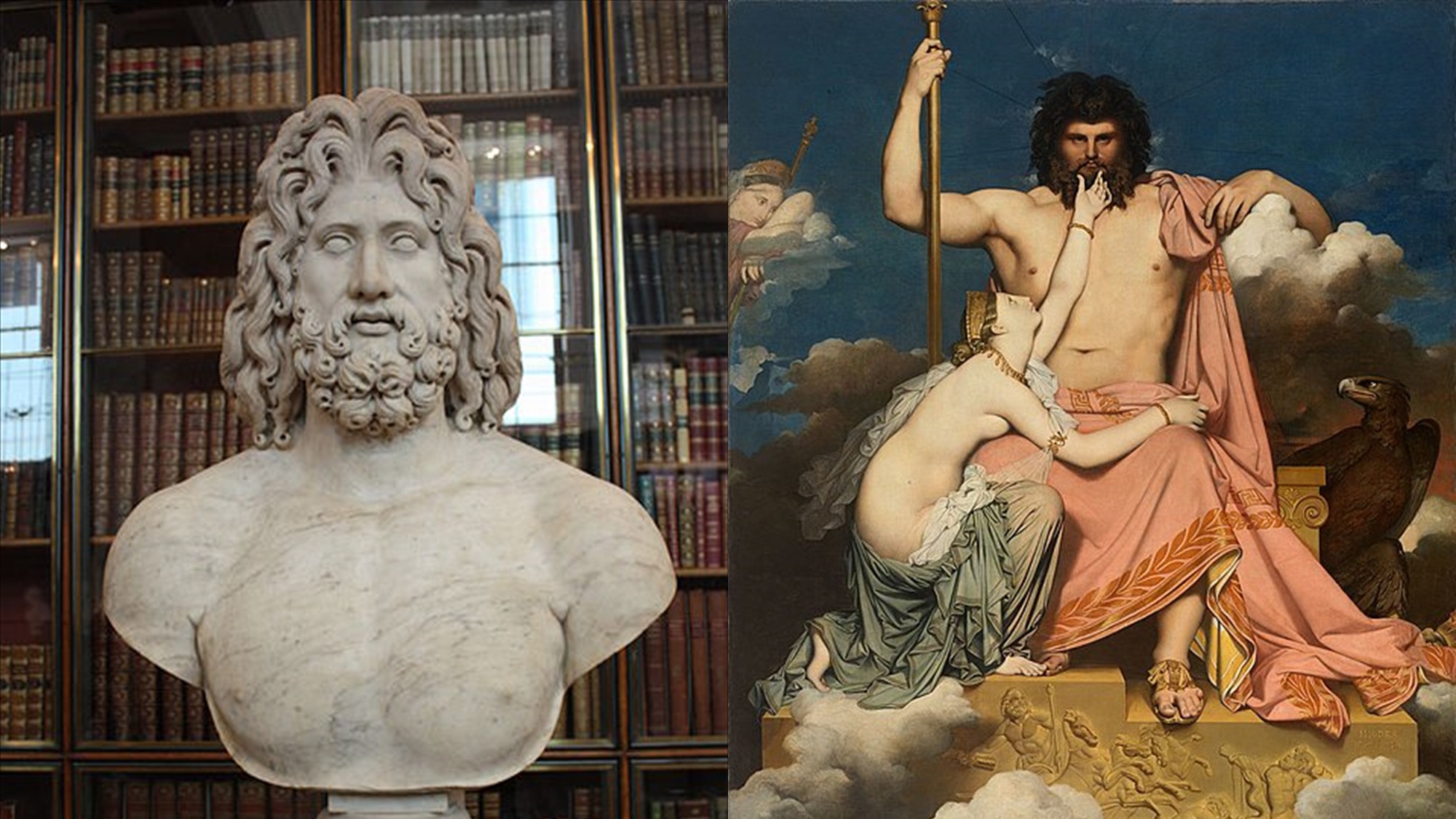
From the earliest Greek epics, poets describe the gods as heavenly beings, distinct from the earthly realm. Homer refers to them as the “heavenly gods” («οἱ θεοὶ Οὐρανίωνες»), signaling that their true abode lies in the skies. Contrary to popular belief, Olympus was not merely a mountain where the gods sat eternally. In the Iliad, mountain peaks serve as vantage points from which the gods observe human affairs, while their true dwelling remains distant, radiant, and unreachable. In the Iliad, Zeus underscores this separation:
“Whomever I wish to favor from afar, whether aiding Trojans or striking the Danaans, shall not come to Olympus at all…I could even hurl him to Tartarus, far below the earth, where gates of iron and bronze lie, as far beneath Hades as heaven is from the earth. There you shall see how supreme I am above all gods.”
Homer’s Odyssey further highlights the celestial nature of Olympus:
“The abode of the Gods in Olympus is neither shaken by winds, nor ever drenched by rain, nor does snow approach it, but a clear and cloudless sky stretches above, and a brilliant radiance spreads everywhere.”
For Homer, Olympus is a luminous realm bridging earth and the Heavens, a place where divine order prevails. Hesiod’s Theogony reinforces this vision, presenting celestial bodies such as Helios, Selene, the Pleiades, the Hyades, and Orion as divine beings. Heroes, too, can ascend to the stars. In Euripides’ Orestes, Helen is transformed into a star, attaining immortality. The Heavens, in this worldview, were both populated and profoundly significant.
The Ancient Greeks, the inhabited cosmos, and alien life
The possibility of alien life among the cosmos also piqued the interests of Ancient Greek poets. According to the poet Nonnus, Hera traverses the Heavens, visiting multiple civilizations, while Orphic fragments describe the Moon and stars as populated by souls: “But he (Zeus) fabricated another boundless earth, which the Immortals call Selene, but men Mene, which has many mountains, many cities, many houses.”
These texts portray the Moon not as a barren sphere but as a realm of activity and habitation. Nonnus also describes the infant Dionysus observing the “fatherly path of the stars” and underscoring the idea that the celestial sphere was both meaningful and inhabited.
Pythagorean philosophers shared this cosmology. For them, each star was a self-contained world composed of land, air, and ether. Heroes and virtuous souls could ascend to the stars, while the Milky Way functioned as a celestial road traveled by immortals. Even the Moon was believed to be populated, suggesting that within these metaphysical traditions, celestial life was widely accepted rather than viewed as a marginal idea.
Plato, Aristotle, and the cosmos
Greek philosophers systematized these ideas into fully developed ethical cosmologies. In the Timaeus and the Myth of Er, Plato describes souls traveling through the Heavens after death. The planets and stars contain souls whose fate reflects their ethical choices. Virtuous souls ascend to higher celestial realms, while others are reincarnated into earthly or animal forms. In this framework, life in the Heavens is inseparable from ethics and the soul’s eternal journey.
In the Timaeus, Plato further presents the planets and celestial spheres as divine and inhabited by individual souls. Those whose existence is defined by passion are reborn as animals, women, or lesser forms, while those who pursue philosophy and virtue return to their original celestial abode. “He that has lived his appointed time well shall return again to his abode in his native star, and shall gain a life that is blessed and congenial.” For metaphysical philosophers, Greek cosmology was inseparable from ethics and spirituality. Life beyond Earth was therefore meaningful rather than accidental. Plato and the Pythagoreans linked virtue to the stars, teaching that souls who lived wisely ultimately returned to the Heavens.
Aristotle, while maintaining that the world is one and finite, argued that the superlunary realm, composed of ether, must sustain forms of life appropriate to its elements. Fire and ether, he suggested, naturally support life in the Heavens, just as earth, water, and air sustain life on Earth. In his Generation of Animals, he wrote: “Plants inhabit the earth, water gives life to aquatic creatures, air to birds; the fourth element, fire, should be sought not on Earth but on the Moon.” For Aristotle, life beyond Earth was not mere speculation but a necessary consequence of the natural order. In his view, celestial realms themselves functioned as living organisms.

Plutarch on the Moon and celestial inhabitants
In On the Face of the Moon, Plutarch presents one of the most striking accounts of an inhabited cosmos. He describes the Moon as a realm inhabited by both benevolent and malevolent demons. According to his account, destructive beings such as the Typhons, Tityans, and Pythos originated there, exerting chaotic and violent influence over Earth:
“The Tityans and the Typhons—those who seized Delphi and shook the oracle with arrogance and violence—originated from those souls. They wandered, deprived of reason, and misused their passive powers blindly.”
In Plutarch’s view, the Moon is not an empty sphere but a world populated by entities with agency and significance. His account, alongside Plato’s depiction of the soul’s journey, reinforces the idea that Greek thinkers envisioned the Heavens as densely inhabited. Life beyond Earth, in this context, was not a speculative outlier but a widely accepted feature of Greek thought.

Metaphysical and physical philosophers
For the Greeks, stars often symbolized rewards for virtue and heroism. Homeric heroes and Hesiodic gods moved freely between heaven and earth, while in Euripides’ Helen, the heroine becomes a star, achieving immortality. Ascending to the Heavens was considered the ultimate reward. According to Ovid, the Milky Way serves as a divine road. He describes Olympus at the heights of “fire” (the Heavens) and notes that, when the sky is clear, a visible path—the Milky Way—appears. Immortals traverse this road to reach the magnificent palace of the God of Thunder.
While poets and myth-makers depicted populated Heavens in rich narrative detail, philosophers examined these ideas more systematically. The metaphysical tradition, represented by the Orphics, Pythagoreans, and Plato, regarded stars and planets as inhabited, morally active, and spiritually alive. Pluralist philosophers such as Anaxagoras, along with Democritus and Epicurus, approached alien life from a rational perspective. Diogenes Laertius records Anaxagoras as saying, “with men also cities are conjoined,” referring to other realms. He further asserted that these worlds contain suns and moons like our own—a revolutionary claim. If celestial bodies exist elsewhere, why would life not exist there as well? Democritus and Epicurus envisioned infinite worlds, some resembling our own and others entirely different, underscoring the Greek belief in a cosmos teeming with life.

Ionian philosophers’ views on alien life
Philosophers such as Anaximander, Anaximenes, and Diogenes Apolloniates envisioned a cosmos of infinite worlds. They imagined a universe extending far beyond Earth, filled with other realms, each with its own structure and order. According to Aristotle, Anaximander argued that these worlds were divine and alive in stark contrast to the atomists, who saw other worlds as random and accidental. Like his teacher Thales, he believed that water was the fundamental element of the universe.
Anaximenes also embraced the notion of multiple worlds, emphasizing air as the principal substance. In his view, the Heavens and all worlds arose from transformations of air, implying that life could exist wherever conditions permitted. Diogenes Apolloniates, Anaximenes’ student, expanded this cosmology, proposing that the universe contained countless inhabited worlds, each with its own structure and celestial activity. These ideas demonstrate that the concept of alien life was widely accepted among Ancient Greek natural philosophers.

The universal belief in alien life among the Ancient Greeks
Contrary to modern misconceptions, the belief in alien life and life beyond Earth in Ancient Greece was widespread and enduring rather than a series of isolated speculations. The Ancient Greeks collectively embraced the idea that extraterrestrials were real, challenging the modern notion that only a few eccentric thinkers considered the possibility.
For the Ancient Greeks, the universe was alive with life—from Olympus to the Moon and the stars beyond. Among metaphysical philosophers, heroes could ascend, gods intervened, and souls journeyed through the Heavens after death. At the same time, natural philosophers recognized that the cosmos contained infinite worlds, each inhabited and vibrant, reflecting a pervasive acceptance of alien life in Greek thought.
See all the latest news from Greece and the world at Greekreporter.com. Contact our newsroom to report an update or send your story, photos and videos. Follow GR on Google News and subscribe here to our daily email!

