



Xenocrates of Chalcedon (396–314 BC), a successor to Plato and the second scholarch of the Academy—which was located outside the ancient Greek city of Athens— stands as a critical bridge between the foundational ideas of his teacher and the later developments of Platonism in ethics and metaphysical precision.
Despite the scarcity of surviving texts, his philosophical legacy permeates ancient metaphysics, ethics, and epistemology. More systematic than Plato and more mystical than Aristotle, Xenocrates helped shape the contours of philosophical inquiry in the Hellenistic period.
Ethics rooted in harmony and order
Xenocrates saw ethics not as a set of abstract rules but as a disciplined way of life grounded in the soul’s harmony. He held that virtue was a form of order (taxis), and that ethical conduct aligned the soul with the rational structure of the cosmos. The soul, composed of rational and irrational parts, must be governed by reason. In Xenocrates’ view, virtue was not just about moderation but about participation in the cosmic order.
This ethical vision rested on the belief that the universe is rational and structured. A virtuous person reflects that structure in thought and action. Xenocrates defined happiness not as pleasure but as living according to nature and reason. He opposed the hedonistic tendencies of the Cyrenaics and anticipated Stoic ideals. For Xenocrates, true happiness comes from the cultivation of wisdom, courage, justice, and temperance.
He introduced a categorization of virtues into theoretical and practical types. Theoretical virtues, such as wisdom and understanding, guide the intellect. Practical virtues, such as justice and temperance, govern actions and desires. This distinction influenced the Stoic doctrine of the unity of virtue, while also prefiguring the philosopher Plotinus’ division between intellectual and practical aspects of the soul.
Moreover, Xenocrates emphasized the importance of education and discipline. He believed that the state had a moral role, promoting virtue among citizens. He saw laws not as constraints but as instruments that channel desire toward rational ends. The political implications of the ethics of Xenocrates foreshadowed aspects of Roman Stoicism and Neoplatonic civic ideals.
Metaphysics: Numbers, soul, and cosmic hierarchy
Xenocrates adopted Plato’s Theory of Forms but reinterpreted it through more of a Pythagorean lens. He assigned primary reality to numbers, not abstract Forms alone. For him, numbers were ontologically foundational. The One and the Dyad formed the basis of all existence: the One as the principle of unity and form and the Dyad as the principle of multiplicity and matter. This dualism influenced both Neopythagoreanism and early Neoplatonism.
He placed the Forms not in a separate world but in the divine intellect. This subtle shift brought Platonic metaphysics closer to later Hellenistic and Christian philosophical models. Xenocrates proposed a tripartite ontology: gods, daimons, and humans. Gods embodied pure intellect and perfection. Daimons served as intermediaries—some benevolent and others malevolent. Humans, caught between reason and desire, participated in both divine and irrational realms.
Xenocrates’ daimonology became influential in Neoplatonic metaphysics. He argued that daimons could influence human thoughts and actions, depending on the soul’s alignment with reason or passion. This moral dualism, while rooted in ethical psychology, extended into cosmology. It reinforced the necessity of spiritual discipline to ward off malign influences.
He also taught that the soul was a self-moving number. This metaphor fused Pythagorean and Platonic ideas. By referring to the soul as numerical, Xenocrates implied its inherent structure and immortality and supported the transmigration of souls. He viewed the soul’s purification as the purpose of philosophy. This outlook later shaped doctrines of spiritual ascent, particularly in Plotinus and Proclus.

Epistemology: Degrees of knowledge and mental ascension
Xenocrates developed an early theory of epistemological gradation, distinguishing between sense-perception, belief, and knowledge. For him, only rational cognition could access true knowledge. Sense-perception could mislead, while belief hovered between truth and error. Only the purified intellect could grasp the eternal realities of number and form.
He proposed that mathematics served as a bridge between opinion and knowledge. Geometry, arithmetic, and astronomy trained the soul to turn away from the world of flux and focus on immutable truths. This pedagogical view left a profound imprint on the Middle Platonists and the Neoplatonists. They too saw the mathematical disciplines as steps toward the vision of the Good.
Xenocrates believed that ethical conduct enhanced epistemic clarity. A disordered soul could not perceive truth. Rational life and philosophical living were inseparable. Knowledge was not merely intellectual—it was ethical and transformative. The philosopher did not just know the Good but became attuned to it through purification.
His emphasis on inner transformation through rational discipline echoed in later Platonism. Plotinus’ doctrine of the soul’s ascent builds on this premise. The notion that moral and intellectual virtues are interwoven came to define the spiritual epistemology of the Neoplatonists.

The attempt to enumerate all possible syllables
Xenocrates did not restrict his inquiries to metaphysics or ethics. He also ventured into linguistics and logic. One of his more curious pursuits involved an attempt to calculate the total number of possible syllables in the Greek language. This project, though seemingly trivial, reveals his fascination with structure and order in all domains.
According to Diogenes Laertius the doxographer, Xenocrates undertook this task as part of a broader effort to classify all forms of knowledge. He viewed language as a rational system, governed by mathematical principles. This endeavor aligned with his belief that all things, including speech, followed intelligible patterns.
Although the exact result of his syllable-counting effort remains unknown, his attempt prefigures later linguistic and logical systems. The Stoics, for example, developed propositional logic partly inspired by the structural analysis of language. Later Neoplatonists would continue to explore the relationship between logos (reason/speech) and reality, a theme that echoes through Xenocrates’ interest in language.
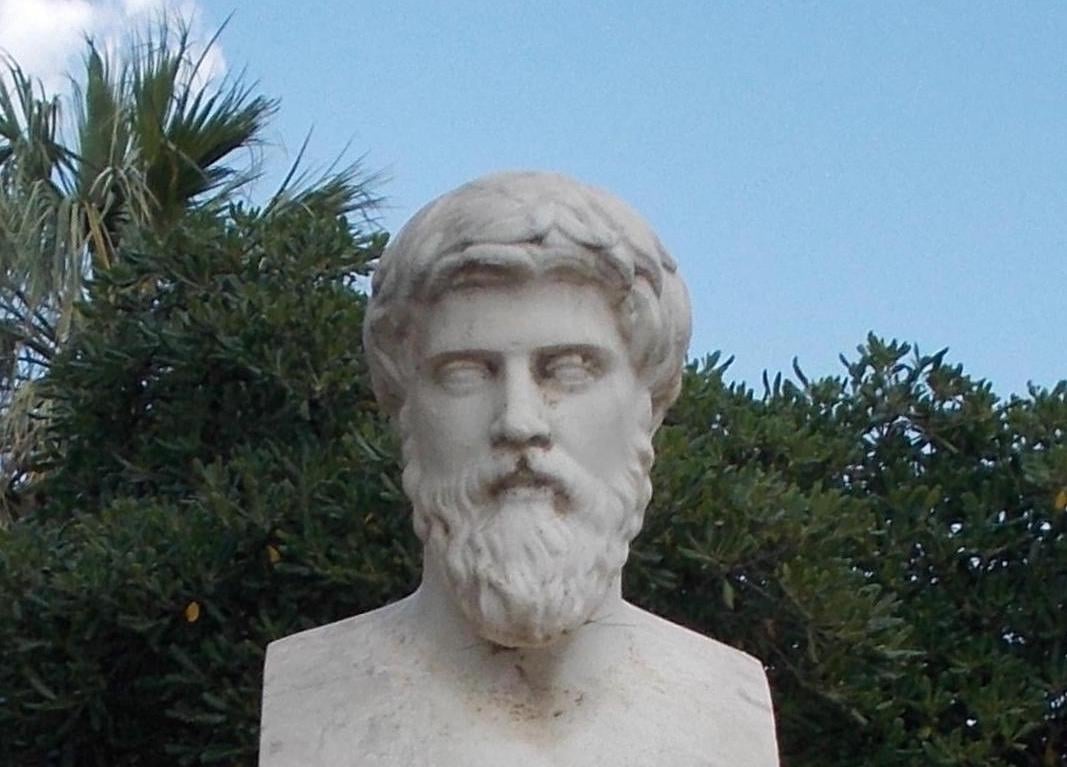
Influence on later Platonists
Xenocrates’ legacy spread through various channels. Middle Platonists adopted his hierarchical metaphysics and moral rigor. Alcinous and Plutarch, the Platonist philosophers for example, echoed his ethical dualism and emphasis on daimons. Neoplatonists like Plotinus, Porphyry, and Proclus drew heavily from his doctrine of the soul, his emphasis on intellectual purification, and his cosmological hierarchy.
Plotinus’ Enneads reflect Xenocratean influence in their moral psychology and metaphysical gradation. The soul’s descent and return to the One mirrors Xenocrates’ vision of moral purification and intellectual ascent. Proclus systematized many of Xenocrates’ ideas, especially the triadic structure of reality and the role of intermediaries.
Even Christian thinkers, such as Augustine, indirectly absorbed Xenocratean ideas through the Neoplatonic tradition. The concept of divine order, moral ascent, and the role of intermediary beings found resonance in Christian metaphysics and angelology.
He helped forge a vision of philosophy as a spiritual discipline. Furthermore, Xenocrates bridged the gap between the mystical and the rational, between ethics and cosmology. His synthesis of number theory, moral virtue, and epistemic clarity established a durable model for later Platonists and mystics alike.
Xenocrates may not enjoy the fame of Plato or Aristotle, but his contributions are no less foundational. His ethical theory emphasized the harmonization of the soul. The metaphysics of Xenocrates reimagined the cosmos as a structured, numerical order populated by divine and daemonic beings. His epistemology linked knowledge to moral purification. Even his interest in syllables reflects a desire to find rational structure in all things.
Through these pursuits, Xenocrates set the stage for centuries of philosophical development. He transformed the Academy from a dialectical forum into a moral and metaphysical school, and he showed that philosophy was not just argument but life— not just abstraction but order. In doing so, he became a true architect of Platonism.
See all the latest news from Greece and the world at Greekreporter.com. Contact our newsroom to report an update or send your story, photos and videos. Follow GR on Google News and subscribe here to our daily email!

