



Ancient Greek history is full of the names of great minds: philosophers, scientists, statesmen, generals, historians and artists. However, several of the greatest minds were discredited and persecuted, ending their lives in exile and poverty, or, worse, were executed.
Socrates, Pericles, Pythagoras, Thucydides, Themistocles, Anaxagoras, Demosthenes, Miltiades, Phidias, all names that shine in history books, on blackboards and computer screens to this day. Their works and feats are awe inspiring, they are taught in schools and universities, some of their ideas still serve as guides for a better life in the 21st century.
Yet all these great minds of Ancient Greece saw an end to their lives that they did not deserve. Instead of dying honored, they had to face their ungrateful or petty or sinister peers who did not measure up to their greatness.
Socrates drank the hemlock
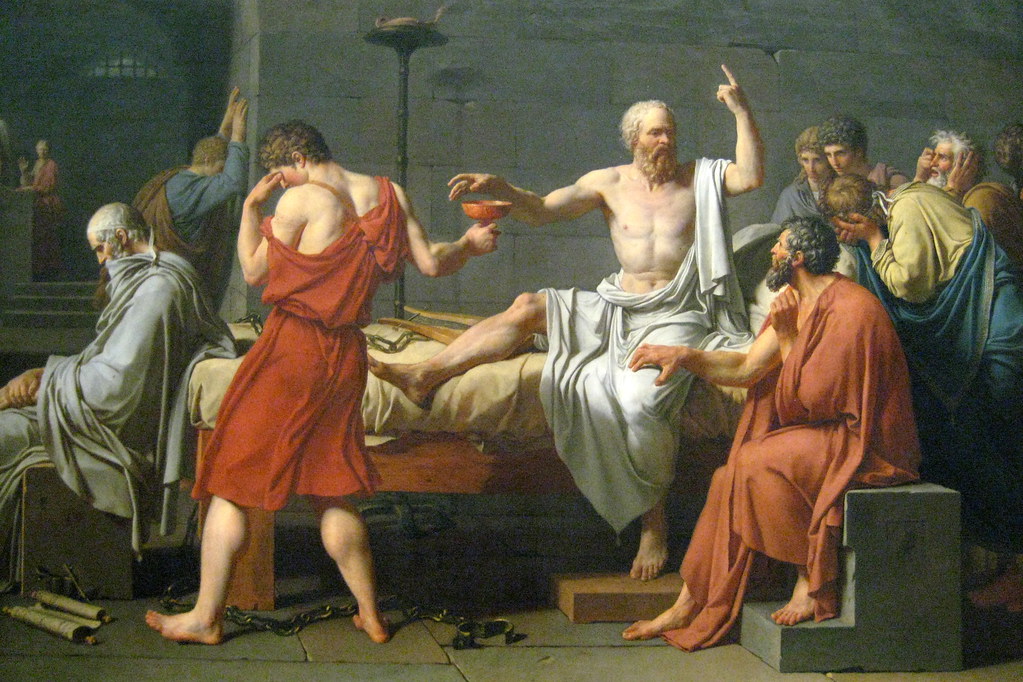
Socrates, the Athenian founder of Western philosophy, the first moral philosopher, was true to his beliefs and ideas to the very end. One of the greatest minds of Ancient Greece, he was the main influence on later outstanding philosophers—including his students, Plato and Xenophon—up to the present day.
Yet despite his work and prudent life, some of his peers did not like his ideas. In 399 BCE, at age 71, he was accused of corrupting the minds of young people and showing impiety to the gods of Athens.
At the trial, Socrates failed to defend himself successfully. The custom was for the defendant to choose the penalty himself. Socrates’ offer to pay pennies to the city of Athens was rejected by the jurors who sentenced him to death. He could have requested permission to flee Athens and live in exile, but he did not do so.
“Shall I then propose exile as my penalty? Perhaps you would accept that. I must indeed be possessed by a great love of life if I am so irrational as not to know that if you, who are my fellow citizens, could not endure my conversation and my words, but found them too irksome and disagreeable, so that you are now seeking to be rid of them, others will not be willing to endure them.” (Plato, Apology)
Even on his last day in prison when his students tried to help him escape, he refused and drank the lethal poisonous hemlock.
Pericles and the Golden Age of Athens

The name of Athenian statesman and general Pericles is intertwined with the Golden Age of Athens (480-404 BCE). Also known as the Age of Pericles, it was a period when the city-state reached its peak in the arts, architecture, social life and governance.
Pericles was the archon of Athens from 461 to 429 BCE. A great mind, he was not only a good ruler, but also an avid supporter of the arts and literature, making Athens the cultural and educational hub of Ancient Greece. He started the building of the Parthenon and commissioned the structures and statues of the Acropolis. As a general, he led the Athenian army in the first two years of the Peloponnesian War.
However, some Athenians were not happy with the works on the Acropolis, accusing him of spending too much and maladministration of public money.
More importantly, Pericles faced accusations of ambition and potential tyranny, with his enemies exaggerating his power and likening his political faction to the tyrannical Pisistratids. Additionally, his concentration of power and personal government led some to blame him for stifling the city’s capacity for self-governance, as they believed his leadership style left Athens overly dependent on his decisions.
For these reasons Pericles was almost ostracized from Athens, but eventually he was not. Nevertheless, his reputation was tarnished and he felt bitterness about the ingratitude of the Athenians. He died during the devastating plague that hit Athens.
The exile of the “Father of Scientific History” Thucydides
The brilliance of Thucydides as a historian and analyst of war and its effect on the human mind granted him the title of the “Father of Scientific History.” He was also instrumental in “fathering” political realism, according to modern historians.
The brilliant ancient Greek general and historian, was exiled from Athens after the Spartan general Brasidas captured Amphipolis during the Peloponnesian War. Thucydides had been entrusted with defending the city, but he arrived too late to prevent its fall, which led to his being held responsible for the failure.
Thucydides wrote about the Peloponnesian War after having fought on the side of Athens. His first-hand experience of the war and his contact with both sides gave him tremendous insight into the concepts of war, politics, power and its effects on the human psyche.
Yet his failure to predict Brasidas’ sudden attack in the middle of winter had him condemned by the Athenians. He spent twenty years in exile, only to return at the end of the war with the fall of Athens in 404 BCE. He died shortly after, probably a violent death, as his account of the history of the war ended abruptly.
Themistocles crushes the Persian fleet, then is ostracized
The great general and statesman Themistocles was the man who crushed the Persian navy with his great strategy at Salamis but was later accused of treason by the Athenians.
Today, the Themistoclean fortifications across the coast of Piraeus facing Salamis are a reminder of a great ancient Greek mind who died discredited by the men he fought for.
At Salamis in 480 BCE, the Greeks under the leadership of Themistocles faced the massive fleet of the Achaemenid Empire under King Xerxes. The Greeks were massively outnumbered, but the cunning Greek commander had an ingenious plan: to lure the Persian ships into the narrow strait between Piraeus and Salamis and use the wind in his favor. Once the Persian ships fell into the trap, it was easy for the Greek triremes to approach them and set fire to them.
The Persian forces retreated in humiliation and the allied Greeks later finished the work of kicking them out for good at Plataea a year later. Yet the Athenians turned against Themistocles, accusing him of arrogance. The Spartans were angry at him too, but that was because he had refortified Athens. He was finally ostracized for his supposed oppressive exercise of power.
Wandering around in exile, Themistocles ended up at the court of King Artaxerxes I, son of Xerxes I, pledging his loyalty and service in exchange for asylum. Artaxerxes accepted him and from then on there is no account as to whether he helped the Persians in any way that might have harmed his homeland. He died in Persia in 460 BCE. The circumstances of his death are unclear, but generated several myths and rumors that cannot be substantiated.
Anaxagoras’ blasphemy: the sun and moon are not gods
Anaxagoras (c. 500-428B CE) was a Presocratic natural philosopher, astronomer and mathematician, a great ancient Greek mind who became notorious for his materialistic view of the world. He delved in astronomy, an art requiring very careful, continuous observation.
His ideas were admired by later philosophers and he was the first to openly dispute the deity of the sun and a the moon, calling the former a “fiery rock.”
This led to charges of impiety and the Athenian court sentenced him to death. To avoid this harsh penalty, he left Athens and went into exile in Lampsacus.
A keen observer of celestial bodies, Anaxagoras formed theories of the universal order. Pliny credited him with predicting the meteorite that fell into the River Aegos in the Gallipoli Peninsula (in Eastern Thrace) in 467 BCE.
Anaxagoras’ most significant theory is that of Nous (Mind, Reason) as the initiating and governing principle of the cosmos.
Demosthenes: The Athenian master orator
Demosthenes (384-322 BCE) was an important Athenian statesman and a master orator. His orations are famous with “On the Crown” standing out for its historical significance.
The great ancient Greek orator was a contemporary of Plato and Aristotle, and he was instrumental in opposing the Macedon king Philip II and a little later his son Alexander whose plans were to rule the whole of Greece.
Demosthenes was a stout believer in democracy and urged the Athenians to remember their past belief in democracy, and how much they hated previous tyrants. He was instrumental in uniting the neighboring city-states in the fight against the Macedonian king.
Plutarch writes on Demosthenes: “When he had once taken as a noble basis for his political activity the defense of the Greeks against Philip, and was contending worthily here, he quickly won a reputation and was lifted into a conspicuous place by the boldness of his speeches, so that he was admired in Greece, and treated with deference by the Great King, Philip, too, made more account of him than of any other popular leader at Athens, and it was admitted even by those who hated him that they had to contend with a man of mark.”
After Philip’s sudden death, Alexander the Great demanded that Athens surrender Demosthenes and seven other orators. However, an Athenian embassy convinced Alexander to rescind his order, since he considered that Athens was not a military threat at the time.
Six years later, Demosthenes was accused of taking 20 talents deposited in Athens by Harpalus, a refugee from Alexander. He was found guilty, fined 50 talents, and imprisoned. Demosthenes escaped from prison but could not return to Athens. When Alexander died, the Athenians, believing they could revolt against the Macedonians, brought back Demosthenes and paid his fine.
However, one of Alexander’s successors, Antipater, took over the region, and the pro-Macedonian Athenians suggested the arrest and execution of Demosthenes and other orators. Fleeing Antipater’s soldiers, the great orator poisoned himself.
Miltiades, the Battle of Marathon hero dies in prison
The Battle of Marathon is one of the landmarks not only of Greek history but world history as well. It was the battle where the outnumbered Greeks triumphed against the invading Persians, protecting the cradle of Western Civilization. A battle that has been immortalized in the annual running race.
The central hero of the victorious battle was general Miltiades, an ancient Greek great military mind whose strategy triumphed against the mighty Persian empire that three decades earlier had conquered Egypt.
According to Herodotus, Miltiades surprised the Persians by suddenly attacking at dawn, something that the Persians considered “suicidal madness.” His heavily armored men with their long spears routed the unsuspecting enemy troops, forcing them to flee.
A year after the Battle of Marathon, the Athenians sent Miltiades with 70 ships to take back the island of Paros that the Persians had conquered. The brave general was seriously wounded in the attack and was forced to return to Athens with his men. There, his political enemy Xanthippus accused him of treason and the court sentenced him to death. The sentence was then reversed to imprisonment and a fine of 50 talents. Miltiades died from gangrene in prison in 489 BCE, a year after his victory at Marathon.
Phidias: The sculptor of the Parthenon and the gods
If there is a single symbol of the birth of Western Civilization, it is the Parthenon on the Athens Acropolis. Developed in its majesty during the Golden Age of Pericles, it owes much to the great mind of the scuptor Phidias, the creator of the most magnificent statues that adorned the Acropolis.
In 447 BCE, Pericles asked Phidias to oversee the work of making the Acropolis a monument to Athenian democracy and the city’s cultural grandeur. The sculptor worked on the Acropolis until the 430s. He created the ivory and gold statue of the goddess Athena Parthenos inside the Parthenon, and the bronze Athena Promachos at the Acropolis entrance. He also oversaw the making of the famous sculptures on the Parthenon frieze. In 432 BCE he sculpted the colossal chryselephantine Statue of Zeus at the Temple of Zeus in Olympia.
However, Pericles’ political enemies accused Phidias of embezzling some of the gold meant for the Athena Parthenos sculpture. Pericles had warned him about this, and Phidias had made all the gold parts detachable. When the gold was weighed, it was found that no quantity was missing. His detractors then accused him of sculpting his own face and Pericles’ on Athena’s shield, which was considered to be hubris in the Athenian moral code. It was apparently true and Phidias was imprisoned and died in jail, Plutarch writes.
See all the latest news from Greece and the world at Greekreporter.com. Contact our newsroom to report an update or send your story, photos and videos. Follow GR on Google News and subscribe here to our daily email!

