



A new study is reshaping historians’ understanding of the origins of the Ancient Greek Kingdom of Macedon that later gave rise to Alexander the Great. By combining a critical reassessment of ancient written sources with archaeological evidence from burial sites, researchers argue that Macedonia’s ruling dynasty emerged far later than long believed.
For more than a century, standard history books have placed the rise of the Argead, or Temenid, dynasty around 650 B.C. That date has framed how scholars viewed Macedonia’s early development before the reigns of Philip II of Macedon and his son, Alexander.
The new research, published in the academic journal Karanos, proposes a later foundation date of approximately 575 B.C., advancing the kingdom’s origins by nearly 75 years.
The study was conducted by historian William S. Greenwalt of Santa Clara University and archaeologist Vasiliki Saripanidi of the FNRS and the Université libre de Bruxelles. Their work relies on two independent lines of evidence: a critical review of ancient king lists and a systematic analysis of funerary practices in Lower Macedonia.
Questioning long-accepted timelines
Much of the traditional chronology rests on king lists preserved in a chronicle associated with Eusebius of Caesarea, a 4th-century A.D. Christian writer. These lists assign reign lengths to Macedonian rulers. By counting backward from Alexander’s death in 323 B.C., earlier scholars placed Macedonia’s first king, Caranus, in the 8th century B.C.

Greenwalt and Saripanidi argue that this approach is flawed. The chronicle was written centuries after the events it describes, and the lists likely absorbed legend and political propaganda over time. The first three rulers named—Caranus, Coenus, and Tyrimmas—are widely viewed as later additions created during dynastic conflicts in the early 4th century B.C.
Even when those figures are removed, the authors say the traditional timeline still depends on implausibly long reigns. Classical historians Herodotus and Thucydides both report that six Macedonian kings ruled before Alexander I came to the throne around 495 B.C. A foundation date of 650 B.C. would require those six rulers to govern for roughly 155 years, averaging nearly 26 years per reign.
Such stability, the researchers argue, does not match the realities of early political life, which was marked by disease, warfare, and violent succession. When more realistic reign lengths are applied, the dynasty’s beginnings shift closer to the late 6th century B.C., around 575 B.C.
What the graves reveal
Archaeology provides the strongest support for the revised date. Saripanidi examined burial customs in Lower Macedonia from the Iron Age through the Archaic period. Her analysis shows no sign of a centralized kingdom west of the Axios River before the early 6th century B.C.
Communities in the 7th century B.C. buried their dead much as their Iron Age ancestors had done. Social differences existed but were limited, expressed mainly through metal objects such as weapons or jewelry. There was no evidence of royal ideology, administrative control, or strong political centralization.
That pattern changed sharply around 570 B.C. Burial practices across the region shifted almost at once. Every adult grave now includes offerings. Exceptionally rich tombs appeared, some containing more than 150 objects.
Gold became common, including thin sheets used to cover faces or clothing. Imported vessels, armor, and symbolic items linked to long-distance contacts entered the burial record.
Power concentrates at key sites
The richest graves did not appear evenly across the landscape. Instead, they clustered at a small number of strategic locations, including Vergina, Archontiko, Edessa, Sindos, and Therme. According to the researchers, this concentration signals the emergence of regional centers of power.
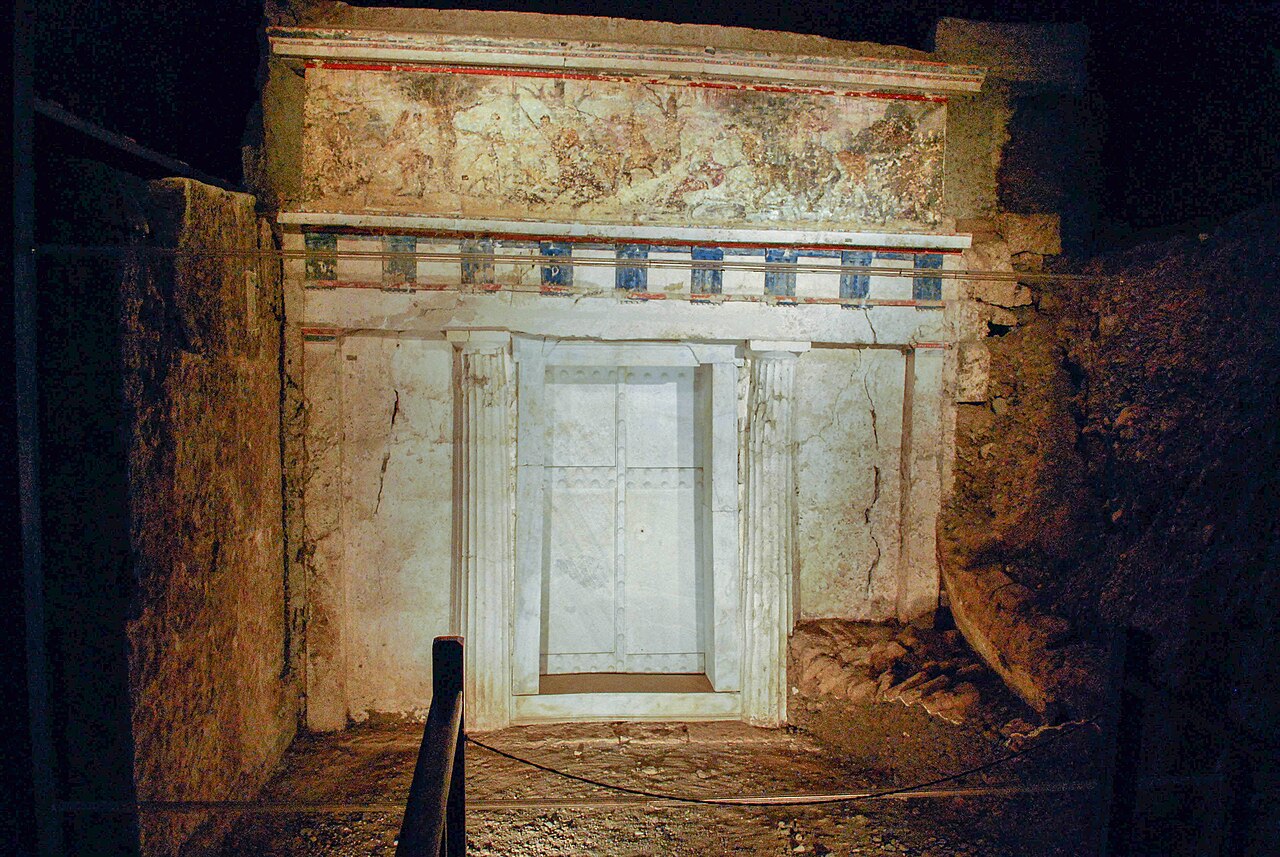
Vergina stands out among these sites. Only there were elite burials separated into distinct plots for men and women. The authors interpret this spatial organization as evidence of a ruling household with formal rules governing status, lineage, and gender, something difficult to explain without a central authority.
A kingdom in its earliest form
Taken together, the evidence points to the formation of a regional political entity centered at Vergina around 570–575 B.C., the study concludes. The authors caution that this early kingdom was not a fully developed state. It lacked bureaucracy, written laws, and permanent institutions.
Instead, they describe it as a complex chiefdom led by a paramount ruler whose authority rested on lineage, prestige, and the redistribution of wealth. The continuous range of burial wealth suggests power was real but still contested, rather than firmly centralized.
The findings challenge a long-standing narrative and place the rise of Alexander the Great’s dynasty in a new historical context. Rather than emerging slowly from the mid-7th century B.C., Macedonia’s royal power appears to have formed rapidly in the early 6th century B.C., leaving its first clear traces not in legend, but in the graves of the dead.
See all the latest news from Greece and the world at Greekreporter.com. Contact our newsroom to report an update or send your story, photos and videos. Follow GR on Google News and subscribe here to our daily email!

