



As the second Trump administration passes its mid-term mark in 2026, Greece finds itself walking a diplomatic tightrope. While its strategic military alliance with Washington has reached new heights, Athens remains resolutely committed to the European Union and the traditional NATO framework—institutions that currently face unprecedented hostility from the White House.
In the volatile arena of 21st-century power politics, Athens has managed to transform its geography and fiscal discipline into significant geopolitical currency. Yet, this newfound influence comes with a side of economic vulnerability caused by Trump’s “America First” policy, and at the expense of relations with Russia and certain Arab countries.
Greece’s defense: The Trump factor
The most visible strengthening of Greece has occurred within the framework of bilateral defense. In an era in which President Trump has viewed alliances through a “pay-to-play” lens, Greece emerged as the administration’s gold standard.
By consistently exceeding defense spending targets—reaching nearly 4% of GDP by 2026—Athens insulated itself from the “delinquent” rhetoric aimed at other European capitals. This fiscal commitment yielded high-tier rewards:
- The F-35 and beyond: Greece secured a privileged position in the queue for advanced US hardware, ensuring technological superiority in the Aegean.
- The base expansion: The expansion of the Mutual Defense Cooperation Agreement (MDCA) turned sites like Alexandroupolis and Souda Bay into indispensable hubs for US power projection. This has created a “tripwire” effect; by hosting more American assets, Greece has effectively tethered US security interests to its own territorial integrity.
- The Guilfoyle channel: The appointment of Kimberly Guilfoyle as US Ambassador to Greece marked a shift from institutional diplomacy to personal access. For the Greek government, this has been a source of strength. Having an ambassador with a direct line to the Trump inner circle allowed Athens to bypass the sluggish machinery of the State Department during regional crises.

However, this is a double-edged sword. While it has strengthened executive-to-executive bonds, it has made the relationship more dependent on personal loyalty than institutional history. For now, the “Guilfoyle Channel” has kept Greece at the forefront of the administration’s Mediterranean policy, but it leaves the relationship vulnerable to the shifting winds of Washington’s internal politics.
The Arab-Israeli pivot: Realism over romance
One of the most profound changes in Greece’s international profile is its strategic “re-centering” in the Middle East. For decades, Greece maintained a pro-Palestinian stance to secure its flank with the Arab world. In the second Trump era, that policy has been dismantled in favor of the “Abraham Logic.”
Greece has joined a powerful, US-backed regional bloc alongside Israel, the UAE, Saudi Arabia, and Egypt. By prioritizing undersea data cables, hydrogen pipelines, and the IMEC trade corridor over traditional ideological solidarity, Greece has:
- gained a seat at the table of the new Middle Eastern security architecture.
- secured military support from Gulf states (such as UAE jet deployments on Crete) to counterbalance Turkey.
While this has “weakened” its traditional ties with the Palestinian Authority and more radical Arab factions, it has “strengthened” its position as a bridge between Europe and the new “Moderate Arab” energy and trade markets.
The economic friction: A staunch EU loyalist in a trade war
The area where Greece has arguably been “weakened” is in its pocketbook. The administration’s “America First” trade policies and reciprocal tariffs have put Athens in an uncomfortable position. As a staunch supporter of the EU, Greece has had to navigate the crossfire of a U.S.-Brussels trade war.
Greek agricultural exports—the backbone of its regional economy—faced significant hurdles before recent stabilization efforts.
Furthermore, the pressure to meet escalating defense spending demands has strained the national budget, forcing a “guns vs. butter” debate in the Hellenic Parliament.
Athens has remained loyal to the EU’s institutional shield, but it has occasionally had to break ranks, such as its defiance of maritime “Net Zero” mandates—to protect its vital shipping industry from the collision of US and EU regulations.
Trump and Greek-Turkish relations
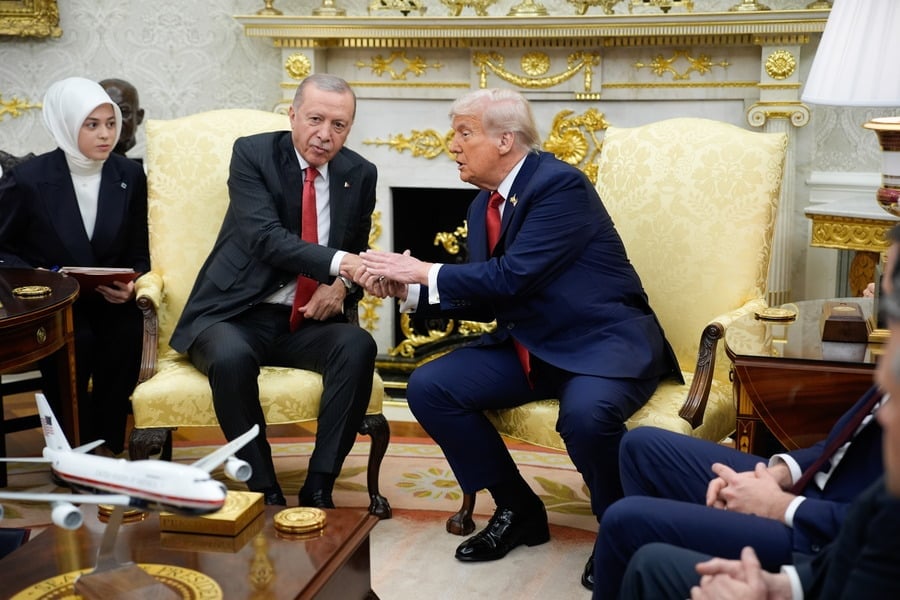
The relationship between Washington and Ankara during the Trump administration has become a defining feature of the Eastern Mediterranean’s security landscape, characterized by a return to personalized diplomacy. At the heart of this is the enduring personal rapport between the American President and Recep Tayyip Erdogan, a connection that has often bypassed traditional State Department channels.
President Trump has frequently expressed his admiration for the Turkish leader’s “strongman” style, famously stating, “I get along very well with Erdogan…he’s a tough guy, but I like him.” During his second term, Trump has doubled down on this sentiment, often praising Erdogan as a “world-class chess player” and a leader who “puts his country first.”
However, for Greece, this “friendship” is a source of strategic anxiety. The potential return of Turkey to the F-35 program in 2026 and the US pivot toward Ankara as a “strategic anchor” against Iran suggest that Washington views Turkey as a heavyweight ally that must be accommodated.
Trump era strengthens Greece’s strategic position but risks pile up
In the final analysis, the second Trump era has strengthened Greece’s strategic hand while increasing its economic and diplomatic risk. Athens is no longer a passive observer of Mediterranean affairs; it is a “pivotal state” that Washington relies on for energy transit and military stability. By being the “best-behaved” member of NATO and a key architect of the new Arab-Israeli axis, Greece has gained a level of relevance in the White House that belies its size.
However, this strength requires Greece to maintain an exhausting pace of defense spending and a delicate balancing act between its European identity and its American partnership. Greece has traded the safety of the status quo for the influence of a regional power—a trade that has, for now, elevated its status on the world stage, albeit at a higher cost of admission.
While not a scientific measure of national sentiment, a recent Greek Reporter poll on Facebook reflects a notable skepticism toward US foreign policy. Of the respondents, 52% believe that Donald Trump’s presidency has weakened Greece’s international standing, more than doubling the 26% who argue the relationship has been strengthened.
Related: Is Greece Replacing Turkey as the US’s Main Strategic Ally in the Region?
See all the latest news from Greece and the world at Greekreporter.com. Contact our newsroom to report an update or send your story, photos and videos. Follow GR on Google News and subscribe here to our daily email!

