



The first trailer for Christopher Nolan’s upcoming Odyssey movie has just been released. Along with general excitement, there has also been much discussion about the historical accuracy of this Hollywood production. Of course, the trailer only shows us a brief glimpse at the movie. Nonetheless, based on what we can see so far, how accurate does Nolan’s Odyssey look?
How accurate is Odysseus’ helmet?

A prominent area of discussion regarding its historical accuracy is the armor that we see the characters using. This has been hotly debated online ever since Nolan released the first official look at Matt Damon’s Odysseus. What has the trailer now revealed?
The trailer confirms that his appearance in that official image really is how Odysseus will look in the movie’s footage. It shows him wearing armour which is broadly similar to hoplite armour from the Archaic Era. In that sense, it is not too inaccurate to Homer’s Odyssey.
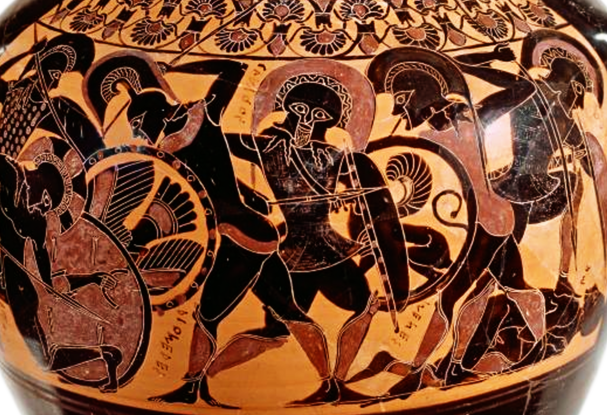
Although the events of the Odyssey are commonly believed to be set in the Late Bronze Age, Homer’s actual descriptions are strongly reminiscent of the Archaic Era, his own time period. He depicts the Greek soldiers as wearing what are almost certainly Corinthian helmets.
These were bronze helmets which covered the entire head and most of the face. They left just a small opening for the eyes and the mouth, with the metal stretching down between the eyes to provide protection over the nose. These helmets also had a crest and a plume of horsehair on the top.
In the trailer for the Odyssey, we can see that many of the helmets do look broadly similar to a Corinthian helmet. However, one inaccuracy is that they are much more open at the front than their historical counterparts. This is evidently so that audiences can see Matt Damon’s face more easily.
Historical inaccuracies in the rest of the armor
Not all the characters are shown wearing helmets that are so open at the front. One notable exception is Agamemnon, whom Odysseus is shown kneeling in front of in the trailer.
Agamemnon’s helmet is much more closed than Odysseus’s and therefore closer to a historically accurate Corinthian helmet. However, unfortunately, this part of Nolan’s Odyssey is also full of inaccuracies.
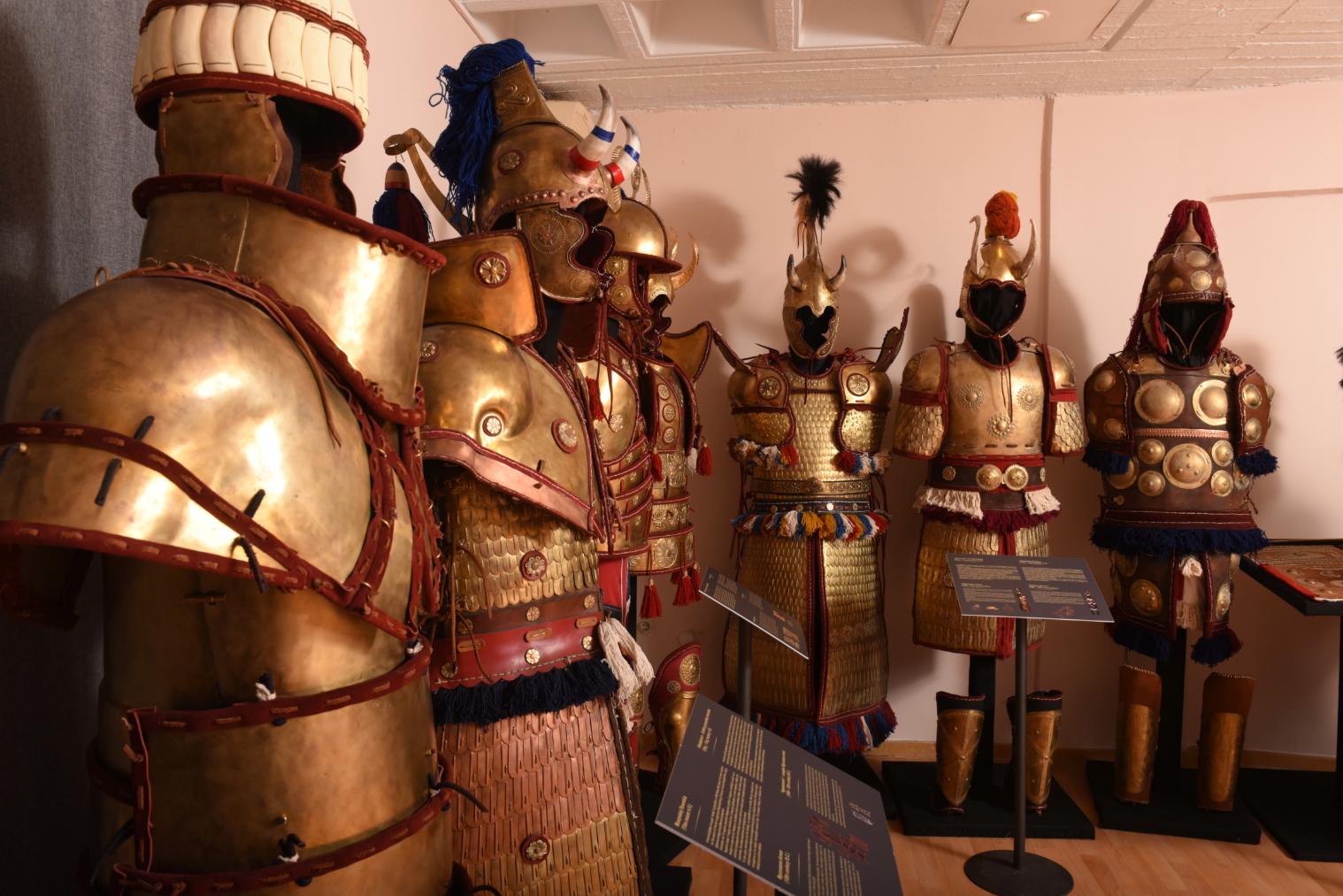
For one thing, the helmet itself is incredibly thick. A Corinthian helmet, like any other helmet made out of metal, obviously needs to be thin enough for the wearer to hold up its weight. They are no more than a few millimeters thick. In contrast, at least part of Agamemnon’s helmet looks about two or three times as thick as it should be, destroying the illusion of it being real bronze.
Furthermore, it has been designed to reflect the contours of the human face. This is completely dissimilar to an accurate ancient Greek helmet, which was much flatter. For this reason, some commentators have compared Agamemnon’s helmet to Batman’s cowl.
Additionally, the Iliad describes Agamemnon’s armour as being bright and full of colour. In contrast, Nolan’s Odyssey presents Agamemnon as wearing essentially all black.
Homer’s ships

Another notable area of inaccuracy in the trailer of the Odyssey is related to the ships. There are several shots of the ships, with one in particular providing a good look at several ships at once.
We learn a great deal about what Homeric ships were like from the Iliad and the Odyssey, as well as ancient depictions of ships on Greek pottery. These Homeric ships were mostly light galleys with single decks. They had just one sail and were black (likely from pitch), with some colour at the front (often red, but other colours were also used). They had a prominent steira, or cutwater, which jutted out from the bow.
There is also evidence that Homer may have referred to a bireme in once place. This would be logical, since we know that biremes were used in Homer’s time. Their key characteristic is that they had two decks, meaning there were two rows of oarsmen on each side.
In his Catalogue of Ships, Homer refers to the ships of the Boeotians as having 120 men each. This probably refers to a bireme, each side having two rows of 25 oarsmen, along with some additional crew members.
Inaccuracies in the ships of Nolan’s Odyssey

How does this compare to the trailer for Nolan’s Odyssey? In some aspects, Nolan’s galleys are accurate. For instance, they only have a single deck, a single sail, and they are more or less black.
However, in other details, we can see that Nolan’s Odyssey includes numerous prominent inaccuracies. One particularly notable issue is the lack of the steira, or cutwater, on the front of the ship. This is an iconic part of ancient Greek galleys, so its absence is conspicuous.
Furthermore, the front part of the bow in Nolan’s Odyssey is the same dark color as the rest of the ship. This contrasts with the colorful front part of the galleys described by Homer and known to history.
For these reasons, the ships seen in the trailer bear very little resemblance to the ancient Greek ships of the Trojan War. Due to these unfortunately inaccuracies in the ships of Nolan’s Odyssey, some commentators have pointed out that they look more similar to Viking ships than those from ancient Greece.
See all the latest news from Greece and the world at Greekreporter.com. Contact our newsroom to report an update or send your story, photos and videos. Follow GR on Google News and subscribe here to our daily email!

