



Walking into modern hotels in Athens today, one is welcomed by polished marble floors, seamless Wi-Fi, concierge services, rooftop pools, and menus crafted by renowned chefs.
In stark contrast, the earliest forms of hospitality in Ottoman-era Athens were humble and utilitarian. Merchants and wanderers slept in roadside hanis—primitive inns with shared courtyards, no furniture, and animals stabled beneath the very floors where guests lay on their own rags to rest. Even with the dawn of independence in the 19th century, when Athens began to modernize, travelers still contended with muddy streets, sparse amenities, and unpredictable lodging conditions.
By 1813, more structured inns appeared—simple square buildings with courtyards for animals, a well, and spartan upstairs rooms. Visitors brought their own bedding and ate modest meals if they paid extra.
By 1827, Athens had around thirty inns. The most renowned was Hani tou François, located near today’s Karaiskaki Street. Unlike others, it welcomed not just traders but general travelers, making it something of a local institution.
The first hotel in Athens
A key transformation occurred in 1832, with the opening of what’s considered Athens’ first proper hotel: Hotel d’Europe, run by an Italian couple, the Casalis, famously both one-eyed.
Initially intended for merchants, it offered cleaner and quieter quarters than inns. In 1835, it was renamed Albergo Nuovo, and later Royal, supposedly because the king had stayed there. By then, Athens was slowly transitioning from makeshift hospitality to more structured and comfortable accommodations.
A year earlier, in 1834, Athens’ first hotel-restaurant, Petroupolis, opened at the corner of Aiolou and Agia Irini Streets. Though far from luxurious (diners wiped their hands on waiters’ jackets), it marked the beginning of hospitality that included both lodging and meals.

The hotel boom in Athens begins
Soon after, other hotels followed. The Anatoli and Anglia hotels opened on Aiolou Street in the 1830s and 1840s. At this time, Athens was becoming a beacon for travelers and intellectuals, all drawn to its newly liberated status and ancient ruins.
However, Athens continued to face basic infrastructure issues. Roads were muddy, sewage flooded dirt streets, and internal cleanliness contrasted with external squalor. In 1836, a German-Greek couple established the Munich Hotel, offering modest but cleaner conditions near Ermou Street.
In 1837, Athens took a major step forward with the construction of its first purpose-built hotel, the Aiolos, designed by city architect Stamatis Kleanthis. Located at the junction of Aiolou and Adrianou Streets, it featured a basement, ground floor, two upper stories, twenty-five rooms, and an internal courtyard. Although its structure resembled a khan, it was far more refined. Remarkably, the building still stands today, restored and available through Sotheby’s.
As Greece stabilized, new hotels emerged—often converted neoclassical mansions featuring restaurants. With improved amenities such as beds, linens, and even rudimentary bathrooms, hospitality evolved. Restaurants were key to a hotel’s success. A newspaper ad for Hotel Byzantion in Syntagma boasted: “Dinner nine courses. Breakfast five courses.”
English travelers praised the Hotel of Europe’s fine restaurant and imported beer. In 1842, Vasilikon Hotel hosted a lavish banquet for Athens’ legal community. Yet challenges persisted. At the Beautiful France hotel on Solonos Street, customers had to request water a day in advance, as running water remained a rarity—even in luxury hotels—until late in the 19th century.
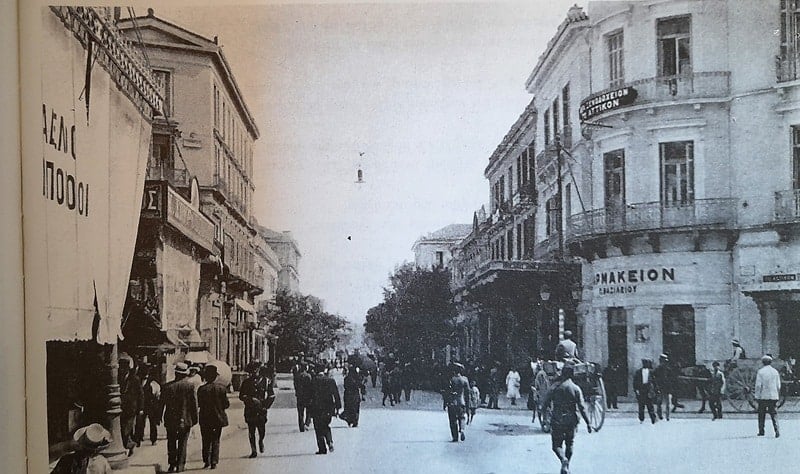
Othonos Square: The beating heart of Athens’ hospitality
As speculation swirled over where the royal palace would be built, hotels sprang up around Othonos Square (today’s Omonia). From 1835 until World War II, more than fifty hotels operated on Aiolou Street, thirty-seven around the square, and many others along Athinas Street.
Merchants lodging there boosted local commerce, creating a bustling hospitality ecosystem. While luxury developers waited for confirmation on the palace’s location (eventually Syntagma), Othonos Square flourished as a hub for budget hotels and travelers. To compete, the area needed more than volume—it needed grandeur. Enter the “twin jewels” of Athenian hospitality.

The Golden Age: The “Alexander the Great” and “Bageion” hotels in Athens
In 1889, the Alexander the Great hotel opened on Athinas Street, followed by its “twin,” the Bageion, four years later. Both were designed by renowned architect Ernst Ziller and ushered in a new architectural era. These were imposing structures with grand atriums covered by glass roofs, ringed by guest rooms.
Alexander the Great was originally intended as a private residence for national benefactor Ioannis Pangas, but its scale prompted him to repurpose it as a hotel. With 62 rooms, 129 beds, ornate lounges, and an elevator, it set a new standard. Even its 24-hour restaurant became famous for serving patsas (tripe soup) in mugs, no less.
Just across the square, the Bageion Hotel occupied land that once belonged to statesman Spyridon Trikoupis. It too became a symbol of luxury and innovation, completing the twin crown jewels of Athenian hospitality. From stables and dusty khans to grand, neoclassical hotels, Athens’ hospitality scene evolved rapidly in the 19th century. Driven by tourism, trade, and politics, the city transformed into a magnet for intellectuals and travelers.
Behind every inn or grand hotel lies a piece of modern Greek identity, woven through architecture, food, and the dream of comfort in a once-occupied land reclaiming its place in history.
This article draws on research by Tonia Maniatea, originally published by the Athens-Macedonia News Agency.
See all the latest news from Greece and the world at Greekreporter.com. Contact our newsroom to report an update or send your story, photos and videos. Follow GR on Google News and subscribe here to our daily email!

