



From the battlefields of India to the hills of Judea, the thunder of elephants once echoed under the banners of ancient Greek kings. After Alexander the Great’s march to the Indus, elephants became symbols of power, courage, and empire.
No longer beasts of the East alone, they became part of Greek ambition itself—towering instruments of conquest that carried the dreams of Alexander’s heirs across three continents.
Their story spans two centuries of history, from Alexander’s clash with King Porus to the Seleucid wars in Judea. These are the great battles during which the ancient Greeks fought with elephants.
These creatures, symbols of both terror and majesty, changed the course of many battles. Each Hellenistic ruler—from the Diadochi to Pyrrhus and the Seleucids—saw in them a way to recreate Alexander’s might. Their campaigns stretched from Persia to Egypt and from Italy to Judea, leaving behind a legacy of awe and ambition that shaped the military history of the ancient world.
Alexander the Great and his encounter with Porus
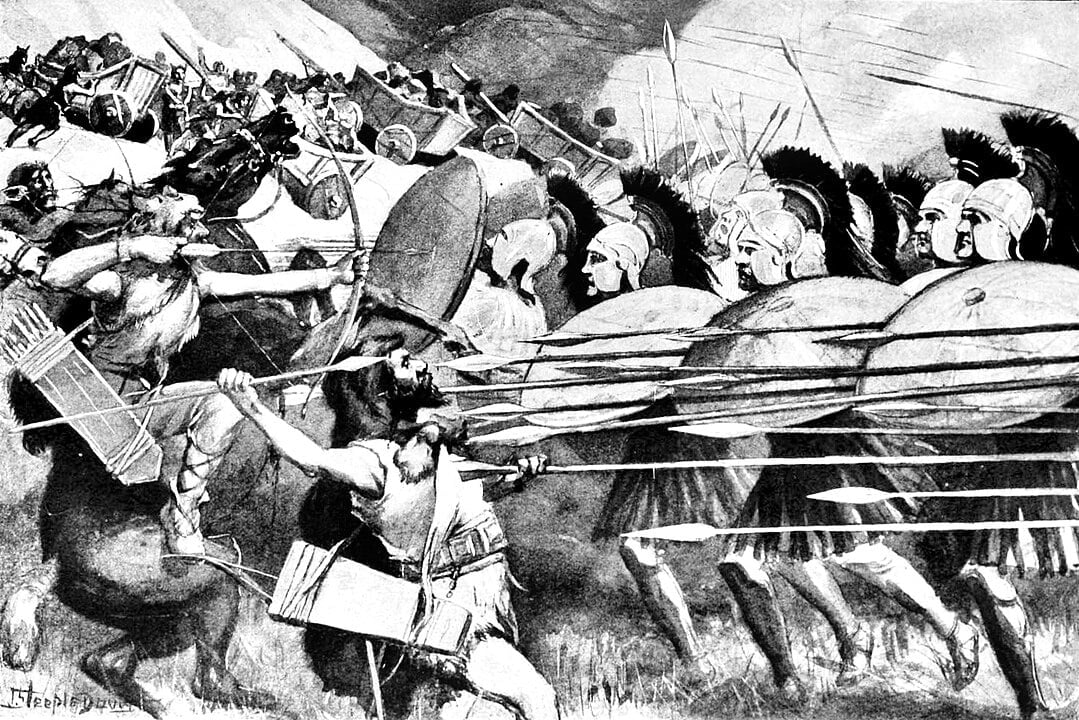
The story began in 326 BC, when Alexander the Great crossed the Hydaspes River to face King Porus of the Punjab. Porus’s army included over two hundred war elephants, towering over the battlefield like living fortresses. Their tusks were fitted with iron, their backs carried archers, and their charge scattered cavalry and infantry alike.
The Macedonians had never faced such a weapon. Yet Alexander adapted. Using agility and precision, he flanked Porus’s line, confusing the elephants and cutting them off from their handlers. The battle ended in victory, but Alexander never forgot what he had witnessed. At the same time, he admired Porus’s courage and took on many elephants into his own army.
From that moment on, elephants became royal symbols of his empire. Moreover, they marched in processions, guarded the royal pavilion, and led parades across Persia. When Alexander died in Babylon in 323 BC, his generals inherited not only his conquests but also his herd of Indian elephants.
First Diadochi War: Elephants divide the empire
After Alexander’s death in 323 BC, his generals—the Diadochi (successors)—fought for control of his vast empire and the prized elephants he had brought from India. Possessing these beasts meant inheriting not just his army but his royal prestige.
The first to wield them was Perdiccas, Alexander’s regent. Stationed in Babylon, he commanded the imperial herd that had once marched under the king himself. In 321 BC, Perdiccas led a campaign into Egypt against Ptolemy I Soter, hoping to reunite the empire under his rule. When he reached the Nile, he attempted to use elephants to slow the river and clear enemy defenses, but this ended in disaster. The animals panicked in the current, soldiers drowned, and the crossing collapsed. His own officers rebelled and killed him soon after.
Earlier, Perdiccas had displayed tactical ingenuity with elephants at the fortress known as the “Camel’s Rampart.” Facing Ptolemy’s well-fortified position near the Nile, he led the elephants at the forefront of his assault, followed by elite infantry and cavalry in reserve. The elephants smashed through the fort’s defenses, supporting the infantry’s escalade, and demonstrated their potential as both offensive and protective forces. Though the campaign ultimately failed, it marked one of the earliest creative deployments of elephants by a Greek commander after Alexander’s death.
In 319 BC, at the Battle of Orkynia, Antigonus Monopthalmus defeated Eumenes of Cardia, who also commanded a small elephant corps. He used his elephants to break Eumenes’s lines and pursue his retreating troops across the plains of Phrygia. In 319 BC, at Cretopolis, Antigonus deployed elephants with striking effect. The elephants served both a psychological and tactical role, terrifying opponents and breaking their formations as effectively as they crushed men on the battlefield.
Elephants across the Wars of the Diadochi
During the Second Diadochi War (319–315 BC), elephants appeared across Asia Minor, Mesopotamia, and Syria. They guarded supply lines, bolstered sieges, and served as symbols of legitimacy. Antigonus, in particular, used them effectively at Cretopolis to surprise and overwhelm enemy forces, demonstrating the psychological and tactical power of these beasts.
The culmination of Hellenistic elephant warfare came decades later at the Battle of Ipsus in 301 BC. Seleucus I Nicator, allied with Lysimachus, brought hundreds of elephants from India, gifts from the Mauryan emperor Chandragupta. When Demetrius Poliorcetes led a sweeping cavalry charge, Seleucus deployed his elephants in a continuous wall, blocking Demetrius’s retreat and cutting him off from his father’s forces. The tactic was decisive: Antigonus fell, and his empire collapsed. Ipsus became the grand demonstration of elephants as strategic weapons in Greek hands—a legacy that echoed across the next two centuries of Hellenistic warfare.

The Ptolemies and the African elephant
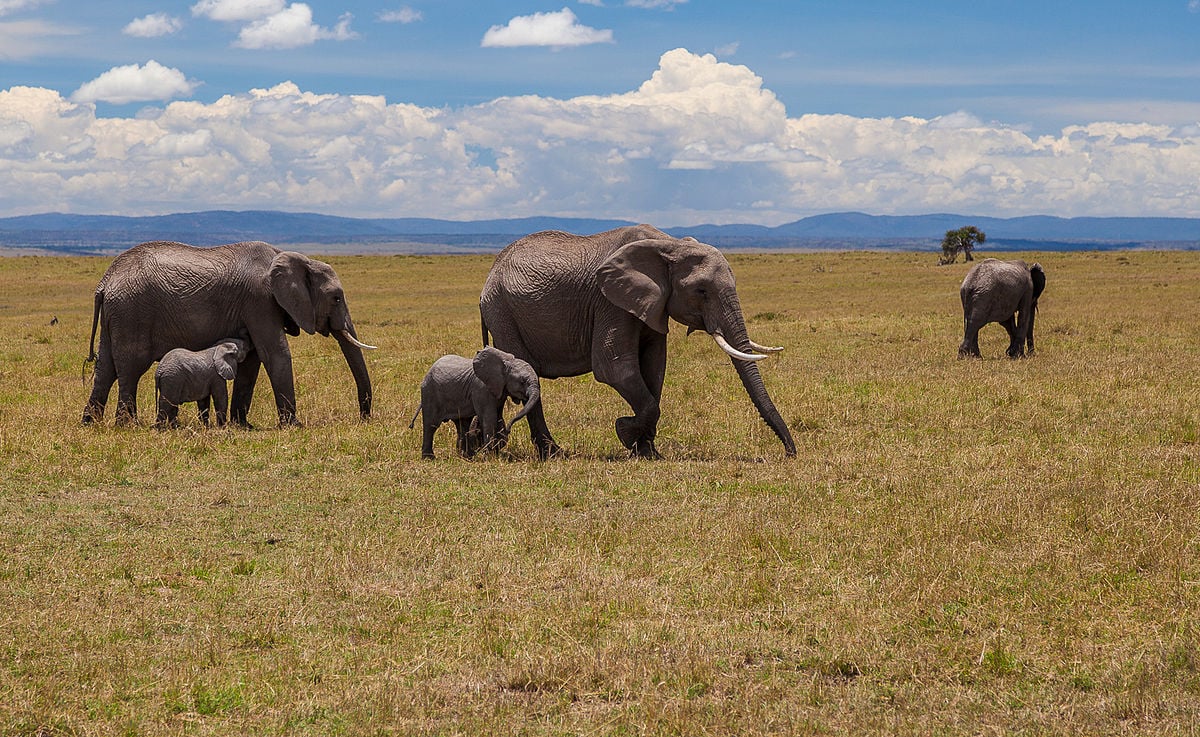
While Seleucus ruled Asia, Ptolemy I Soter established his kingdom in Egypt. Cut off from Indian trade routes, the Ptolemies turned south to Nubia and Ethiopia, capturing African forest elephants. Though smaller than their Indian counterparts, they became emblems of the Pharaohs’ Hellenistic grandeur.
Their great test came at the Battle of Raphia (217 BC). There, Ptolemy IV Philopator faced Antiochus III the Great, the ambitious Seleucid king. Antiochus deployed Indian elephants from the eastern provinces; Ptolemy used African ones from the south.
The historian Polybius describes the moment their lines met. The African elephants panicked and fled from their larger Indian rivals, throwing Ptolemy’s front into confusion. Yet his phalanx and Greek mercenaries stood firm. At the same time, the Egyptians triumphed, and Raphia became the largest battle between Hellenistic powers ever fought, with over 140,000 men and nearly 150 elephants on the field.
Pyrrhus of Epirus: Elephants in the West
Far from the Eastern empires, Pyrrhus of Epirus, the bold cousin of Alexander’s line, carried elephants westward to Europe’s new rising power: Rome. In 280 BC, Pyrrhus invaded Italy with twenty elephants obtained through his alliance with the Hellenistic kingdoms of the East—descendants of Alexander’s Indian stock.
At the battle of Heraclea (280 BC), his elephants broke the Roman cavalry, forcing a retreat. A year later, at Asculum (279 BC), he repeated the tactic, crushing the legions’ morale. Yet his losses were immense. “Another victory like this,” he is said to have remarked, “and I am undone.”
At Beneventum (275 BC), the Romans learned to counter the beasts. They used fire and javelins to terrify the elephants, turning them against Pyrrhus’s own men. The defeat ended his Italian campaign but immortalized his name—and gave the world the phrase “Pyrrhic victory.”

Antiochus the Great and his Eastern revival
Back in the East, Antiochus III the Great sought to restore Seleucid supremacy. Eventually, in the early second century BC, he marched deep into the lands once held by Alexander, renewing alliances with Indian rulers and securing a new corps of Indian elephants.
At Panium (200 BC), near the sources of the Jordan River, Antiochus faced Ptolemy V of Egypt. His elephants stood before the phalanx, supporting the cataphract cavalry. Moreover, the beasts’ charge shattered the Egyptian line and decided the battle. Panium gave Antiochus control over Coele-Syria and marked the height of Seleucid power.
Yet his ambition did not stop there. A decade later, Antiochus clashed with Rome itself. At the Battle of Magnesia (190 BC) in Asia Minor, he deployed fifty-four war elephants alongside a vast phalanx. Additionally, the Romans, veterans of Pyrrhus’s wars, countered with discipline and missiles.
When Antiochus’s elephants panicked under the volleys of Eumenes II, they trampled their own lines. The chaos turned victory into disaster. Magnesia broke the Seleucid dream of restoring Alexander’s empire. Rome then ruled the West, and Antiochus’s elephants became relics of a fading age.

Antiochus IV Epiphanes and the elephants of Judea
The last dramatic use of elephants in Greek warfare came under Antiochus IV Epiphanes, the flamboyant successor of Antiochus the Great. During the Maccabean Revolt, his regent Lysias marched into Judea with a mighty force that included thirty-two armored elephants.
At the Battle of Beth-Zechariah (162 BC), the beasts terrified the Jewish defenders. The Book of Maccabees recounts that each elephant carried a wooden tower holding four soldiers and an Indian driver. The ground shook as they advanced through the narrow valley.
In a desperate act of valor, Eleazar Avaran, brother of Judas Maccabeus, charged beneath one of the creatures and struck it from below, killing it, but the animal collapsed on him, crushing him instantly. His sacrifice became a symbol of defiance. Though the Maccabees retreated, the battle marked one of the final appearances of elephants in Greek-led warfare.

The twilight of the war elephant
By the mid-second century BC, the age of the war elephant was over. The Romans, armed with discipline, engineering, and steel, rendered these living machines obsolete. Yet their memory endured—in sculpture, coins, and the legends of kings who sought to harness nature’s most powerful force.
From Alexander’s conquest of India to the Seleucid wars in Judea, elephants represented more than strength. Furthermore, they embodied the ambition, spectacle, and daring of the Hellenistic world. They were empires in motion—symbols of men who dreamed of ruling from the Aegean to the Indus.
Their echo faded, but their legacy remains: a reminder that even in the age of heroes, the greatest weapon could still be flesh and blood.
See all the latest news from Greece and the world at Greekreporter.com. Contact our newsroom to report an update or send your story, photos and videos. Follow GR on Google News and subscribe here to our daily email!

