


The wild horses of Mount Ainos on Kefalonia Island descend from the Pindos breed, historically sourced by residents from livestock fairs in Aetolia-Acarnania and Arta. Abandoned after World War II in the rugged terrain of Mount Ainos, they have since lived and reproduced entirely in the wild.
These animals have adapted spectacularly to the demanding terrain and harsh climate of the region. They thrive in a rocky environment with sparse pastures, enduring bitter winter cold, scorching summer heat, a chronic lack of water, and limited forage.
The horses occasionally visit the nearby villages, providing a stunning spectacle.
Horse population dynamics and seasonal migrations
The herd’s population has fluctuated heavily over the decades. Historically consisting of small, isolated bands, the herd is now systematically monitored by the Rangers and Guard Staff of the Natural Environment and Climate Change Agency (NECCA). The current population stands at approximately 40 to 45 individuals. Foals observed recently display dark coats, while adult coloration varies widely across white, grey, brown, and black.
During the high temperatures of summer, forage becomes scarce at lower altitudes. The horses migrate to the southeastern boundaries of the National Park’s core zone, rarely venturing into the dense interior. They cluster primarily near the Zoodochos Pigi Monastery.
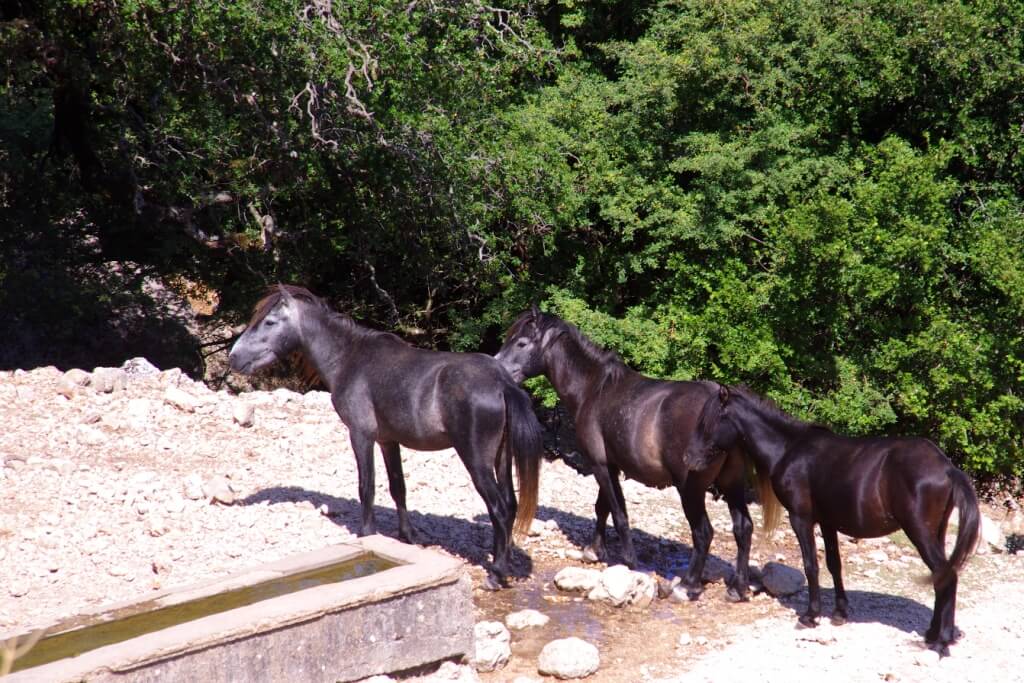
When sub-zero temperatures hit the peaks, the herd descends to the lower slopes of Mount Ainos, primarily near the settlement of Arginia. They are frequently spotted even lower near the villages of Markopoulo, Kremmidi, and Pastra, where they graze on lowland pastures. Due to the limited availability of winter forage, local residents note that the horses occasionally enter agricultural plots adjacent to the villages, causing minor crop damage
Mount Ainos is the highest point in Kefalonia and all the Ionian Islands. It is a National Park and Natura 2000 reserve and part of the UNESCO World Geopark of Kefalonia-Ithaca.
It is dominated by Kefalonian fir trees and is home to hundreds of species of plants and animals, which you can learn all about at the Environmental Centre on the mountain. Meanwhile, the Ainos International Dark Sky Park organizes star gazing nights during the year, with telescopes set up to observe the constellations of the night sky and teach you about the impact of light pollution.
Related: Kefalonia: The Greek Gem in the Ionian Sea – GreekReporter.com
See all the latest news from Greece and the world at Greekreporter.com. Contact our newsroom to report an update or send your story, photos and videos. Follow GR on Google News and subscribe here to our daily email!

