



Few symbols in human history have captured the imagination quite like the Gorgoneion—Medusa’s petrifying face, with her hair made of writhing snakes. Particularly in ancient Greece, it was regarded as a symbol of pure terror and fear, an apotropaic depiction used as a shield against the evil eye.
Beyond its ancient Greek mythical origins, the Gorgoneion was also used as an eternal cultural symbol by the ancient Greeks and the Romans later on.

Who was Medusa?
The most renowned of the three Gorgon sisters—Stheno, Euryale, and Medusa—born to the ancient sea deities Phorcys and Ceto, holds a central position in the piction of the Gorgoneion: Medusa.
Medusa was once the beautiful mortal priestess of Athena. But her life dramatically changed when Poseidon (the god of the see in Greek mythology) assaulted her in Athena’s temple.
Furious at this violation of her sanctuary, Athena was ready for revenge. However, for reasons that continue to puzzle readers of this myth, she decided to curse Medusa, transforming her into a terrifying creature with hair of living snakes and a gaze so deadly it turned those who looked at her into stone.
Medusa eventually died at the hands of Perseus, who was charged with bringing back her head. Equipped with divine strength and guided by the gods, he approached Medusa while she slept. Armed with a reflective shield from goddess Athena, he skillfully avoided looking directly at her, as her gaze would turn anyone who met her eyes into stone. Using the mirror-like surface of the shield to view Medusa’s reflection, Perseus was able to decapitate her without falling victim to her deadly power.
According to myth, Pegasus, the winged horse, and Chrysaor, a giant, sprang from her severed neck. However, even in death, the strength of Medusa’s gaze persisted; her head was used as a weapon that could paralyze enemies and was gifted to Athena for her aegis—a protective shield decorated with her head, the Gorgoneion.
Medusa Gorgoneion: The protective (and terrifying) symbol
The Gorgoneion became one of the most commonly used symbols in ancient Greece for good reason. It decorated shields, armor, coins, jewelry, and even architecture.
Its purpose? To ward off evil and guard its wielder from enemies and danger.
The earliest representations of the Gorgoneion—during the Archaic period, 6th century BC—were grotesque, featuring bulging eyes, fangs, and a protruding tongue that was nothing short of a monster. These exaggerated characteristics made its menacing nature even greater in an attempt to petrify opponents.
Medusa’s image softened during the Classical period (5th century BC). Artists began depicting her as a lovely but quirky beauty, framed in serpentine ringlets. This significant shift indicated a change in the public perception of Medusa, likely revealing elements of empathy for her tragic story.

Following the conquest of Greece, the Romans adopted the Gorgoneion, as they did with so many more ancient Greek symbols.
The Romans used the Gorgoneion of Medusa as a protective emblem and artistic motif for decoration. Archaeological evidence shows that the Gorgoneion appeared on mosaics, military standards, and household items throughout the empire.
Its power remained strong in the Byzantine period, even after the rise of Christianity and the subsequent demise of ancient Greek symbols. Nonetheless, Medusa’s influence didn’t stop there. She was a satirical subject for Renaissance masters like Caravaggio and Cellini, who used her as both a horrific and a sublime figure.
Fast forward to today and we can see her as a true cultural figure across the West. Versace, the Italian fashion house, famously made her face its logo—the ultimate tribute to her history as a symbol.
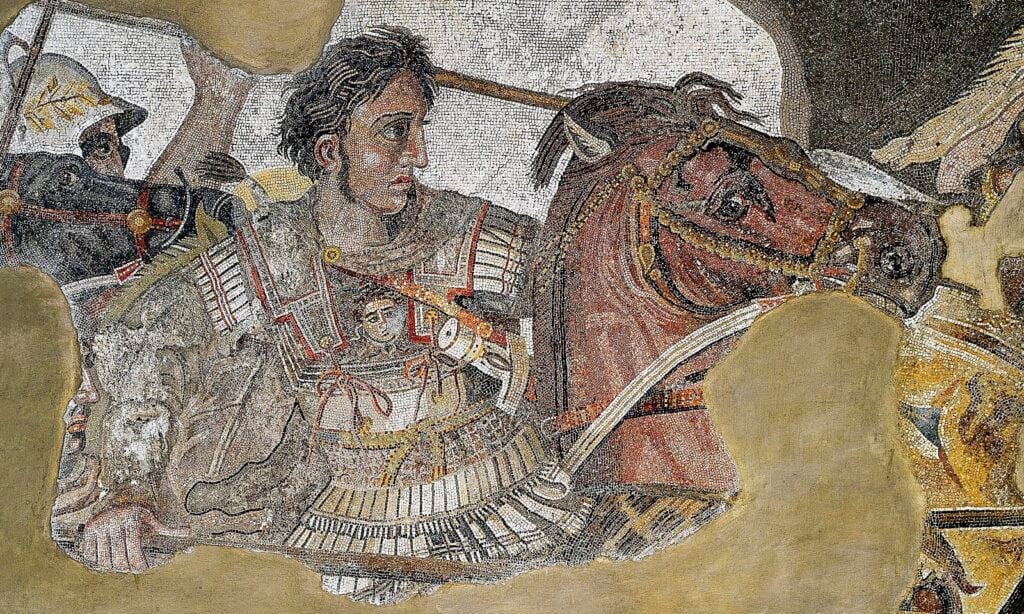
Alexander the Great and the Gorgoneion
Alexander the Great, another ancient Greek and a towering figure in ancient Greek history, utilized the Gorgoneion and Medusa’s image in his battles. He famously incorporated her into his personal and military iconography as a symbol of divine protection and invincibility. Most famously, Medusa’s visage adorned his breastplate, as depicted in the Alexander Mosaic, highlighting his traits as an unstoppable, godlike warrior. By wearing this emblem, Alexander also connected himself to the goddess Athena, who bore the Gorgoneion on her aegis, reinforcing his divine favor and legitimacy as a ruler.
See all the latest news from Greece and the world at Greekreporter.com. Contact our newsroom to report an update or send your story, photos and videos. Follow GR on Google News and subscribe here to our daily email!

