



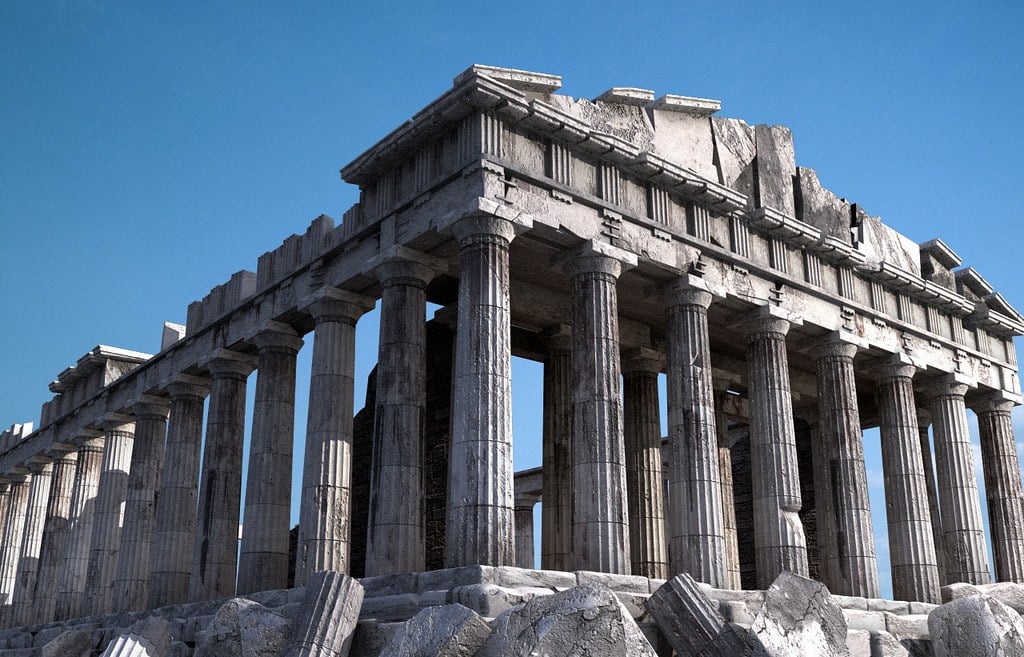
The fall of the Eastern Roman Empire in 1453 AD marked the end of one of history’s greatest civilizations. In the centuries that followed, a great number of nations have claimed to be the rightful successor to the legacy of ancient Rome. But what about Greece? Is the modern state of Greece the successor of the Byzantine and therefore the Roman Empire?
As we know, the ancient Greek world profoundly influenced Roman culture over the centuries. The Eastern Roman Empire, known in modern times as the Byzantine Empire, was centered around the Greek-speaking Constantinople. Thus, it became the epicenter of the “Romaeoi” or “Romioi,” a colloquial term that describes modern-day Greeks and links them directly to the Roman Empire.
Hence, does modern Greece have a unique claim as the heir of the Roman Empire? To answer that question, one must explore historical and cultural connections between modern Greece and the Roman/Byzantine Empire.

The Greco-Roman cultural connection
It is impossible to overstate the profound influence of Greek culture on the Roman Empire.
The Romans were truly and deeply fascinated by many aspects of Greek civilization, including Greek art, literature, philosophy, and mythology, among many other things. They adopted and consequently adapted Greek gods, renaming them and incorporating them into their own pantheon. Roman writers and poets heavily drew inspiration from Greek literary traditions, while other aspects of Roman life, including art and architecture, often imitated Greek styles that preceded Roman ones.
Educated Romans of the upper classes across the Empire and across the centuries were expected to speak Greek fluently, and many of those who could afford it studied in Athens. Although not as prestigious as it used to be during classical antiquity, Athens did remain the intellectual heart of the Greek world and therefore played a crucial role in the Roman Empire itself.
The Roman elite saw Greek culture as a symbol of sophistication and refinement and that was the reason they tried to incorporate it in their own way of life. This cultural borrowing was so extensive that we often nowadays speak of a “Greco-Roman” civilization—a fusion of Greek and Roman elements that the Roman Empire spread across the Mediterranean world and beyond, making the defining lines between what’s Roman and what’s Greek very blurry.

The Byzantine Empire—the Eastern Roman successor
One might say that the definition of what the Roman Empire really was is very broad and can incorporate many contradictory elements. However, some fundamental truths are difficult to ignore. For example, when we think of the fall of Rome, we usually picture the collapse of the Western Roman Empire in the 5th century AD.
However, the Eastern half of the empire, which was centered in Constantinople (modern-day Istanbul), endured for nearly a thousand years longer. This empire not only thrived but also preserved, adapted, and promoted Roman identity even further. This Eastern Roman Empire, which we now call the Byzantine Empire, saw itself as the direct continuation of the Roman state—and rightly so. To the very end of its existence, the Byzantine Emperors were nothing else but the Emperors of the Romans: “Autocrator ton Romaeon.”
The Byzantines, as some people might call them today, spoke Greek rather than Latin, and their culture was deeply influenced by Greek traditions. However, they firmly identified as Romans and maintained Roman political and legal institutions, effectively being the successors of the Roman legacy in the broader region. The Byzantine emperors saw themselves as the legitimate successors of Augustus, Constantine, and the other great Roman rulers, drawing no distinction between themselves and those who ruled in Rome centuries ago.
This Roman identity persisted until the very end of the Byzantine Empire in 1453, when Constantinople fell to the Ottoman Turks. Interestingly, the Ottoman sultans then claimed the title “Caesar of Rome” for themselves, seeking to position their Islamic empire as the new heir to the Roman legacy, adding an additional layer of interpretation as to who and what constitutes a true successor to the Roman Empire.

Alternative claimants to the Roman legacy
The Romans of the Byzantine Empire, as it is known nowadays, were not the only ones to claim the legacy of Rome. In Western Europe, a new entity known as the Holy Roman Empire emerged in the 9th century.
Despite its name, this empire was clearly more Germanic than Roman, but its rulers saw themselves as the successors of the Western Roman emperors, effectively becoming the claimants of Rome’s legacy.
Other European powers have also invoked Roman heritage at various times, proving that the topic remains controversial to this day. The Austrian Habsburgs, who held the title of Holy Roman Emperor until 1806, for example, later styled themselves as successors to the Holy Roman Empire and, therefore, the Roman Empire itself.
French kings on the other hand, especially during the Renaissance, drew parallels between their own rule and that of the Roman emperors, trying to add an additional aspect of legitimacy to their power.
Even the British Empire, at its height, was often compared to Rome in terms of its size and power, despite the lack of any official claim to being the successor of Rome. Perhaps the most intriguing alternative claim, however, comes from modern-day Russia.

After the fall of Constantinople, Russian leaders began to see Moscow as the “Third Rome”—the spiritual and political successor to Rome and Byzantium. This idea was undoubtedly tied to Russia’s Orthodox faith and its sense of imperial destiny. To many ordinary people, particularly those from the Orthodox East, Russia still feels like a true successor to the Byzantine heritage.
Nonetheless, the list of claims does not end there. Even the Catholic Church and the tiny state of San Marino have been described as preserving some aspect of the Roman legacy, something that could make them the “valid” successors of Rome.
The Pope, for example, as the Bishop of Rome, has sometimes been portrayed as the spiritual heir to the Roman emperors, while the tiny micro-state of San Marino claims to be the last surviving Italian city-state that has survived from the Roman era.
Is Greece the heir of the Roman Empire?
So where does Greece fit into this complex puzzle of potential Roman successors?
There is no denying that the immense cultural debt that Rome owed to Greece is true. The Roman Empire was indeed deeply and profoundly shaped by Greek influences to the extent that some have argued that Rome, due to the sheer amount of influences, was essentially a “Greek” empire, particularly in its later stages.
However, it’s important to remember that Greece itself was simply a subject province of the broader Roman Empire—not its ruler. While the Eastern Roman Empire, also known as the Byzantine Empire was Greek-speaking and centered in the former Greek city of Byzantium, it was still very much a properly Roman state in terms of its political identity and institutions.

But what about the modern Greek state? We should remember that modern Greece only emerged as an independent nation in the early 19th century. This was long after the fall of both Rome and Constantinople.
The Greek state that we know today is a product of the anti-empire movements of the 1800s and not a direct political continuation of the Roman Empire, despite the sentimental connection that the revolutionary Greeks had with the Byzantine past.
Moreover, modern Greece does not claim any special status as the heir to Rome. While Greeks are certainly proud of their ancient heritage, both ancient Greek and Byzantine, or Eastern Roman, they do not portray themselves as the modern incarnation of the Roman Empire in the same way that, for example, the Russian tsars did.
Even the fact that Greeks call themselves—particularly their ancestors who lived under the Ottoman occupation—”Romios,” the colloquial Greek term for “Romans,” never materialized as a national narrative of being the righteous successors of the Roman Empire.
In this sense, the relationship of Greece to the Roman Empire is rooted more in a sense of cultural succession and legacy rather than official political succession.
The Greeks created many aspects of the cultural forms and ideas that the Romans would later eagerly adopt and spread throughout their vast empire. Nonetheless, Greece itself remained a subject realm and never became the heart of the imperial metropolis.
In conclusion, while Greece played an undeniably important and fundamental role in shaping Roman civilization as we know it today, a potential claim to be the modern successor of the Roman Empire is relatively weak.
The Byzantine Empire, with its direct political and institutional continuity with ancient Rome, has perhaps the strongest case of being called a successor to Rome. But even here, the Greek character of the Eastern Roman Empire set them apart from the Latin-speaking Western Empire, drawing a clear distinction that only became stronger following the Great Schism of the Catholic and the Orthodox Churches in 1054.
Ultimately, the Roman Empire was such a vast, complicated, and long-lasting entity that its legacy cannot be easily and neatly contained within any one modern state or culture of Europe. Elements of the Roman heritage can be found in the languages, laws, religions, and political traditions of countries across Europe and the Mediterranean.
In this sense, perhaps it would be best to see the Roman Empire not as the possession of any one successor state but as a shared European inheritance. It has left its inedible mark on the Western world as a whole—and Greece—as the birthplace of so much of the culture that the Romans adopted and promoted. Hence, it certainly deserves its place in that proud and complex Roman legacy.
See all the latest news from Greece and the world at Greekreporter.com. Contact our newsroom to report an update or send your story, photos and videos. Follow GR on Google News and subscribe here to our daily email!

