



They have been around for millions of years, roaming the powerful seas and yet it wasn’t until the first seafarers started sailing that the first myths about these divine creatures started to emerge. Without a doubt, dolphins held an irresistible charm for people in ancient Greece, one of the world’s first and greatest seafaring nations. They were revered as demigods and thus, hold a divininity that has been immortalized through the millennia in ancient Greek art, mythology and writings.
Also known as “ieros icthys” (ιερός ιχθύς or sacred fish in Greek), dolphins depicted in sculptures, mosaics and beautifully engraved pottery tell us that they were beyond salient in ancient Greece. But without a detailed written record, it is difficult to determine what significance dolphins truly had. What we do know is that they were considered sacred animals due to their connection with gods such as Apollo and Poseidon, and it was believed that harming a dolphin was similar to offending the gods. A large number of indirect pieces of evidence point to the belief that in ancient Greece, killing a dolphin was punishable by death.
Scholars and historians have studied the depiction of dolphins in sculptures from the East, in art, and in Roman literature, and from these references they believe that dolphins in antiquity have a deep association with the processes of life, death and rebirth. Perhaps this is linked to the dolphin’s ability to pass between the air-breathing world of humans to the suffocating, terrifying world beneath the waves, which for Greek sailors could be easily identified with the world of the dead. Whatever the exact symbolism, it is clear that the dolphin is intimately associated with the fundamentals of human existence in ancient Greece.
If the dolphin is implicated in the transition between this world and the next in antiquity, it is no wonder it is associated with the god Dionysus, who himself dies and is reborn again each year and who was also worshipped at the Temple of Delphi.
There’s one surviving story today that links the dolphins with Dionysus in which, according to the Homeric Hymns, Dionysus was travelling in disguise aboard a pirate ship. When the sailors decided to sell him as a slave, the god retaliated by driving them mad with hallucinations, at which they jumped into the sea. They were saved from drowning because they repented of their evil plans, Dionysus relented and turned them into dolphins, allowing them to start a new life as friends of the sea.
This myth is often cited as the reason why for many ancient Greeks killing a dolphin was an appalling crime. Dolphins were once human and they retain human characteristics.

Dolphins, their connection to the god Apollo and the creation of the Temple of Delphi
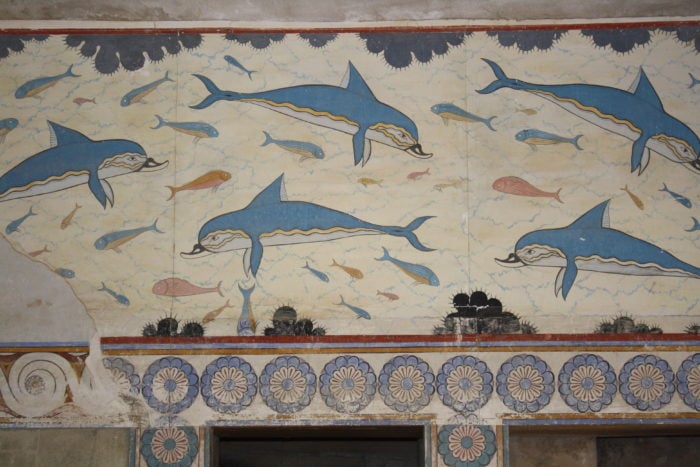
The appearance of dolphins in frescoes on the bathroom wall in the Palace in Knossos on Crete, which date to 1,600 BC, suggest that the dolphin already had a place in oral Minoan mythology. However, one of the oldest, written stories about dolphins in ancient Greece is the one that connects them with god Apollo, featured in Homer’s poem Hymn to Apollo, telling the myth of the founding of the oracle in Delphi after a journey all over Greece in search of a suitable site.
According to Homer, Apollo initially chose a lonely cave nestling at the foot of Mount Parnassos in central Greece, which was guarded by the dragoness Python, whom he slew with an arrow from his silver bow. Then Apollo set off to hijack a Cretan merchant ship, leaping aboard disguised as a dolphin. Terrified, the crew huddled below deck while the dolphin Apollo directed the winds to blow the ship right around the Greek coast and into the harbor below Delphi. Then, according to Homer’s poem, the sun god instructed his hostages to live in the new temple and serve him as priests.
And whereas I first, in the misty sea, sprung aboard the swift ship in the guise of a dolphin, therefore pray to me as Apollo Delphinus.
Apollo, as the god of light and prophecy, by transforming into a dolphin showed his power over nature and communication with a world beyond understanding. This makes him the protector of Delphi and the name Apollo Delphinus means “lord of Delphi” but also “the one who has a connection with the dolphin.”
After the founding of the temple at Delphi many of Apollo’s virtues came to be attributed to dolphins. As Apollo became by association also the god of music, from this the dolphin of Greek mythology gained a reputation as a music lover. (Modern experiments have proven that dolphins are attracted to the high-pitched frequencies of several musical instruments, including the flute and a high-pitched singing voice.)

One of the oldest records of love between humans and dolphins
The ancient Greek historian Herodotus tells the myth of Arion, a famous poet and lyre-player from the island of Lesvos. His talent had made him very rich and while sailing back home to his native Corinth after a lucrative tour of Italy his crew turned on him, threatening to throw him overboard and take his money.
Arion tried to bargain for his life but the sailors gave him no choice. He asked to play his lyre one last time. As the last note died away, Arion leapt into the sea. As the ship sailed on, Arion, instead of drowning, was rescued by a school of dolphins that had been mesmerized by the beauty of his music and carried him to shore.
This image of dolphins rescuing humans recurs again and again in ancient Greek myth and folklore. According to ancient Greek historian and philosopher Plutarch, a native of the Greek island of Paros once found some fishermen about to kill some dolphins they had caught, and bargained for their release. Some time later, while sailing between Paros and the neighboring island of Naxos, his boat overturned in a storm. He was the only one who survived from the entire crew while a dolphin, according to Plutarch, carried him on his back to the shore.
Delphinus (the Latin version of the Greek word for dolphin) is also a small constellation associated with Greek mythology and the god Poseidon, the lord of the sea. According to the myth, Poseidon wanted to marry Amphitrite, a beautiful nymph. However, wanting to protect her virginity, she fled to the Atlas mountains. Poseidon then sent after her a number of searchers, including a dolphin, which found her and persuaded her to marry him. In gratitude, Poseidon placed the dolphin among the stars, recognized officially today as the constellation Delphinus.
In the words of the 2nd-century Greek poet Oppian: “Diviner than a dolphin is nothing yet created . . . Excellence and majesty attend them even when they perish, nor do they shame their glory even when they die.”
See all the latest news from Greece and the world at Greekreporter.com. Contact our newsroom to report an update or send your story, photos and videos. Follow GR on Google News and subscribe here to our daily email!

