


Pablo Picasso is most commonly remembered as the architect of Cubism or the brilliant creator behind Guernica, yet his relationship with Ancient Greece and classical antiquity was one of the most foundational elements of his career.
Rather than treating Ancient Greece as a distant archive of borrowed imagery, Picasso absorbed its artistic spirit at a deep level. He drew on its myths, craft traditions, and understanding of the human form to help make sense of a turbulent modern world. His work suggests that Ancient Greece functioned not as a static reference point but as a living resource.
As the First World War left Europe physically and psychologically devastated, Picasso turned to art in search of stability and permanence. A 1917 visit to Italy brought him face-to-face with Greco-Roman sculpture, an encounter that proved transformative. What followed, commonly known among art historians as the Neoclassical Return to Order, saw him produce figures of striking physical weight, their heavy limbs and stone-like presence recalling marble deities rather than flesh-and-blood subjects.
Works such as Three Women at the Spring (1921) and Women Running on the Beach (1922) place draped, monumental figures in frieze-like compositions reminiscent of the Parthenon marbles. The fluted folds of the ancient peplos inform their garments. In a Europe still defined by war and devastation, these paintings offered something classical Athens had long embodied—a sense of order. Picasso turned to Ancient Greece not only out of nostalgia but also as a means of restoring architectural gravity to modern painting.
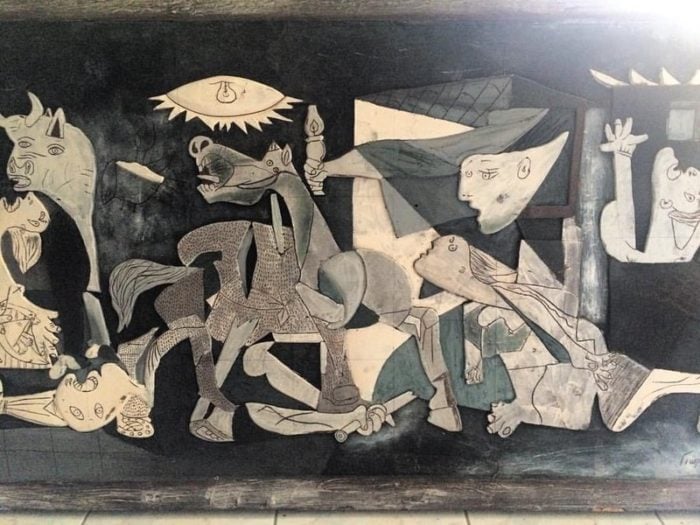
Picasso and his Vollard Suite and Guernica: Inspiration from the Minotaur of Ancient Greece
The Vollard Suite and Guernica reveal how deeply the Minotaur of Ancient Greece shaped Picasso’s artistic imagination. As fascism gained momentum across Europe during the 1930s, Picasso found a psychological counterpart in Greek mythology. The Minotaur—half-man, half-bull, condemned to darkness and defined by duality—became one of his most personal symbols.
Throughout the Vollard Suite, the full weight of human contradiction comes into view, including desire and violence, creativity and destruction, and intellect bound to instinct. In this sense, the Minotaur emerges as a distinctly modern figure of the 20th century.
This mythological language carries directly into Guernica. The bull that dominates the canvas draws on the full depth of Mediterranean tragic tradition, reframed through the devastation of modern war. Elsewhere, Picasso incorporated centaurs, fauns, and satyrs, figures that embody unchecked energy and a fragmented Mediterranean identity. By returning to these archetypes, he suggested that Ancient Greece’s exploration of inner conflict speaks just as urgently to modern questions of state violence and individual freedom.
After the Second World War, Picasso settled in Vallauris on the Mediterranean coast, where his engagement with antiquity became both physical and conceptual. He devoted himself to ceramics, working directly with terra-cotta in ways that consciously revived techniques used by Ancient Greek potters. Jugs, amphorae, and other vessels became his canvas, decorated with adaptations of the black-figure and red-figure styles perfected in Ancient Athens. Bulls, fish, owls, and wrestlers—icons of the Aegean world—appeared across the surfaces of his works.
A similar economy of line shaped his earlier interwar illustrations for classical texts, including Ovid’s Metamorphoses (1931) and Aristophanes’ Lysistrata (1934), with flowing contours recalling the engraved precision of Greek bronzes.
Taken together, Picasso’s engagement with Ancient Greece reflects a creative practice in constant dialogue with the past. For Picasso, Ancient Greece was an inexhaustible source, reinforcing the idea that looking back can often be the most reliable way of moving forward.
See all the latest news from Greece and the world at Greekreporter.com. Contact our newsroom to report an update or send your story, photos and videos. Follow GR on Google News and subscribe here to our daily email!

