



When we talk about ancient Greek colonies, most people think of the familiar spots across Europe, such as Syracuse in Italy or maybe some cities along the Mediterranean coast of France and the Black Sea.
But the Greeks actually stretched their reach much, much further than many realize. Imagine a Greek outpost not in the sunny Mediterranean, but deep in the rugged, arid landscape of Central Asia—specifically, what we know today as Afghanistan, Tajikistan or Pakistan. Greece and its civilization’s influence extended to the very fringes of the known world of antiquity, to a place rich with stories of old empires and, let’s be honest, quite a few modern-day issues.

Was Alexandria on the Oxus the furthest Greek colony?
Can you even begin to imagine how disoriented a Greek soldier, perhaps born and raised in the sun-drenched Peloponnese or the beautiful plains of Macedonia, would feel finding himself stationed thousands of miles from home, amidst a rugged, totally alien landscape, under a vast and unforgiving sky? This was the reality thousands of soldiers of Alexander the Great faced during his conquest of the East.
This was what the people who settled in Alexandria on the Oxus, later more famously known as Ai-Khanoum, experienced more than 2000 years ago. Ai-Khanoum, meaning “Lady Moon,” was an ancient Hellenistic city in Afghanistan’s Takhar Province, likely founded by Alexander the Great or his troops. It became a key military and economic hub for the Greco-Bactrian Kingdom until its destruction around 145 BC.
Its ruins were rediscovered in 1961 and excavated by French archaeologists until conflicts halted the work in the late 1970s. This ancient settlement was a bona fide Greek city, complete with a gymnasium (because, of course, where else would a Greek be without one?), a theater, temples and even a library. All of it is constructed with a distinctly Greek flair in a region so distant from the architectural elements of the Mediterranean that still remains impressive.
Its modern Persian (or Turkic) name of Ai-Khanoum masterfully hides the fact that Alexander the Great‘s empire and his ambition to expand the Greek civilization to the ends of the world succeeded, as they reached these far lands on the border with China.
This Greek colony was a thriving urban center, a shining beacon of the ancient Greek world in a land sea of diverse cultures from the fertile plains where the Amu Darya (that’s the ancient Oxus) and Kokcha rivers converge.
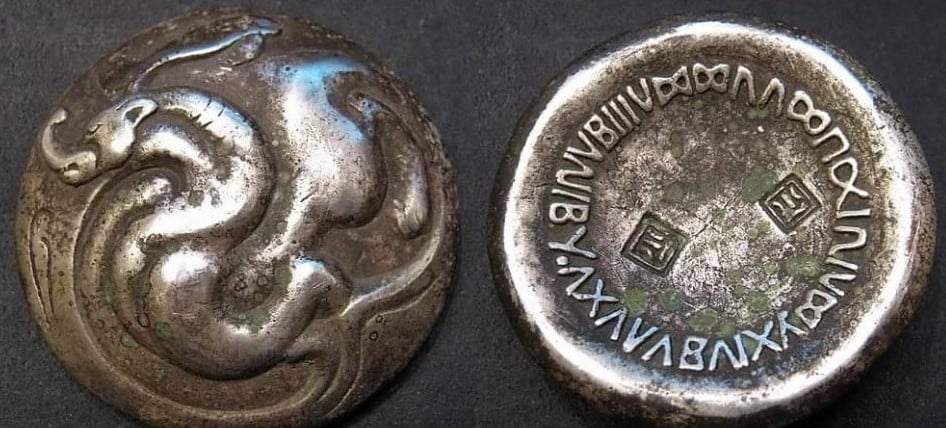
The story of Ai-Khanoum isn’t some isolated anomaly, though. It is inextricably linked to the rise and, eventually, the fall of the Greco-Bactrian Kingdom, the truly fascinating successor state in the East to Alexander’s original lands. Here, Greek rulers, far from the established centers of power like Alexandria in Egypt or the cities of the Greek metropolis, maintained a vibrant culture, minted their own coins adorned with Greek deities and heroes (imagine seeing Zeus on a coin dug-up in Afghanistan!), and engaged in active trade networks that stretched from China all the way to the Mediterranean.
Think about that for a moment: Greek kings, thousands of miles from the Acropolis and Pella, ruling over a diverse crowd of people in what is now Afghanistan, Tajikistan, and Uzbekistan.
Alexandria Eschate
However, despite its importance in the broader region, Alexandria on the Oxus was not the furthest Greek colony ever to be built. That was Alexandria Eschate, which literally means “Alexandria the Farthest” in Greek.
Alexander himself founded it in 329 BC on the Jaxartes River (today’s Syr Darya), near modern-day Khujand in Tajikistan. This Alexandria (the Macedonian General did his best to leave his mark everywhere he went) was established as a strategically crucial garrison, built to secure the Fergana Valley and keep nomadic tribes in check and away from the Greek ruling class. It marked the furthest extent of Greek territorial expansion of the Hellenistic era, a true frontier outpost at the very edge of their known world.
If you’re looking for it now, you’ll find its ancient ruins near Khujand (sometimes spelt Khojand) in modern-day Tajikistan.
While you won’t see the original Greek city perfectly preserved, its spirit definitely lives on in the broader area of Khujand. Archaeological excavations there have uncovered parts of Alexandria Eschate’s old fortification walls, stretching for miles, on top of all sorts of military gear, everyday household items and even architectural pieces dating back to the 4th century BC. The city kept going strong for centuries, holding onto its Greek traditions and becoming a key stop along the Silk Road.
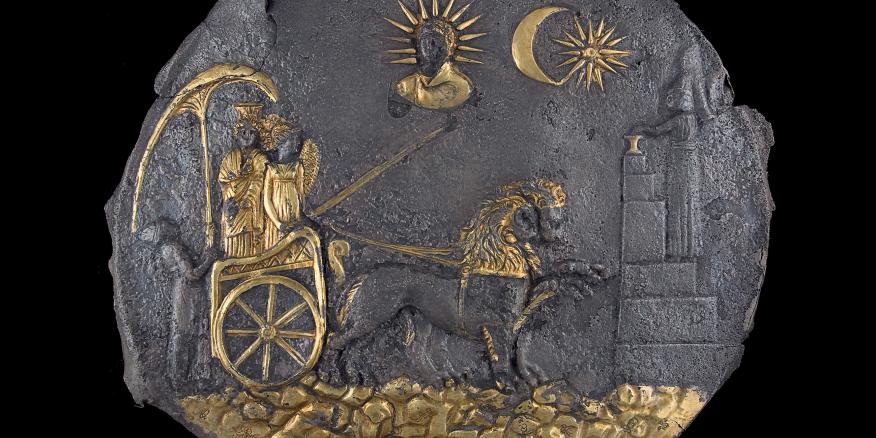
After Alexander’s death, Alexandria Eschate, along with the broader region of Sogdiana, became part of the vast Seleucid Empire. For a time, it continued to function as a vital strategic outpost and a center of Hellenistic culture, populated by Greek veterans, mercenaries and local inhabitants. However, the immense distances from the Seleucid heartland in the Near East made direct control challenging.
Over time, nomadic invasions, internal rivalries and the sheer distance from the center of the Greek world made Alexandria Eschate isolated and therefore more vulnerable, which led to its demise.
Related: The Unknown War Between Ancient Greeks and China
See all the latest news from Greece and the world at Greekreporter.com. Contact our newsroom to report an update or send your story, photos and videos. Follow GR on Google News and subscribe here to our daily email!

