



Julius Caesar reportedly said his last words in Greek: “And you, son Brutus” (Καὶ σύ, τέκνον Βροῦτε). But why did Caesar choose to speak these words in Greek?
The Ides of March and Caesar’s assassination
It was March 15, 44 BC, the infamous Ides of March, when Caesar attended the Senate for what would be his final assembly before departing for a military campaign. Ancient sources, particularly Plutarch and Suetonius, recount the dramatic events leading to his assassination. Upon Caesar’s arrival at the Senate, the conspirators divided into two groups. One positioned in front of him and the other near the bench where he would sit.
Tillius Cimber, supported by several senators, approached Caesar, pleading for his exiled brother’s return. When Caesar refused, Cimber violently grabbed Caesar’s robe, signaling the attack to begin. Casca struck the first blow to Caesar’s neck, though the wound was not fatal. In response, Caesar seized Casca’s knife and asked, “What are you doing?” Overwhelmed, Casca called for help, and the other conspirators took turns stabbing Caesar.
Brutus, a man Caesar reportedly regarded as a son, delivered the final of 23 stab wounds, striking Caesar in the groin. According to the physician Antistius, who examined Caesar’s body, only one wound—the stab to the chest—was fatal. Plutarch adds a poignant detail: Caesar collapsed at the base of Pompey’s statue. That was a symbolic moment as his great rival in the Civil War appeared to take posthumous revenge. Plutarch suggests Caesar either fell there because the conspirators dragged him, or he moved toward it deliberately in his dying moments.
The assassination of Caesar provoked the anger of the Roman populace, who rose up against the conspirators. Seizing control of the situation, Mark Antony agreed to Cicero’s proposal for a general amnesty. With the Senate’s consent, he appointed Brutus and Cassius as prefects.

Brutus and Julius Caesar: A complex relationship
At a young age, Caesar had a passionate love affair with Brutus’ mother, Servilia, who was married to another man at the time. Historians like Suetonius and Appian confirm this relationship. Plutarch however is more emphatic, suggesting that since Brutus was conceived during the height of their romance, Caesar may have believed himself to be Brutus’ father.
Brutus was one of Caesar’s protégés, held in high esteem by Caesar, who granted him significant political favors. For example, following the civil war between Caesar and Pompey, Caesar pardoned Brutus and appointed him to influential positions. These included the governorship of Cisalpine Gaul. Although Brutus initially sided with Pompey during the conflict, opposing Caesar, he forgave him after Pompey’s defeat at the Battle of Pharsalus in 48 BCE. Caesar’s clemency not only solidified their political alliance but also demonstrated Caesar’s trust in Brutus by welcoming him into his inner circle.
Despite their closeness, Brutus became one of the leaders of the conspiracy to assassinate Julius Caesar. Brutus likely believed that Caesar’s increasing power—culminating in his appointment as “dictator for life”—threatened the ideals of the Roman Republic. He justified his participation in the assassination as an act to preserve republican liberty against what he perceived as Caesar’s monarchical ambitions.
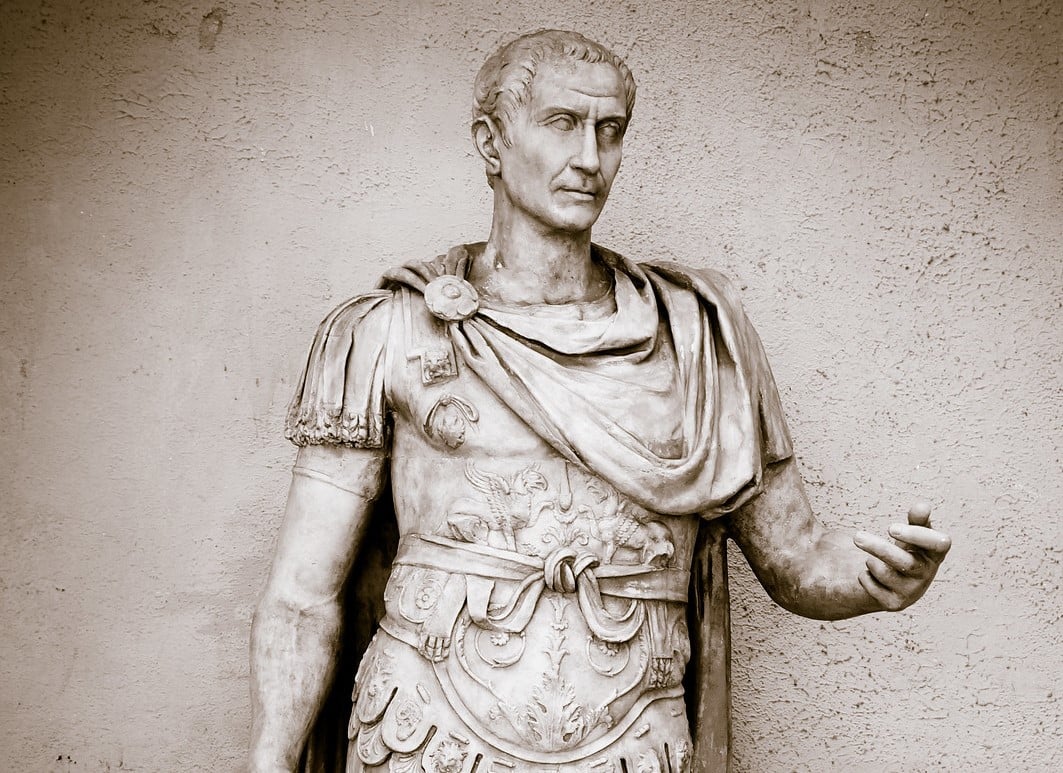
Julius Caesar’s last words and the role of Greek culture
The expression “And you, son Brutus” today signifies unexpected betrayal by someone close or trusted. The popular Latin phrase “Et tu, Brutus?”, rendered in Greek as “Καὶ σύ, τέκνον Βροῦτε” (Ke si teknon Brute), appears in William Shakespeare’s play “Julius Caesar.” In the play, Caesar addresses these words to his friend—and possibly his son—Marcus Junius Brutus when he recognizes him among his assassins.
While Shakespeare popularized the Latin phrase “Et tu, Brutus?” (“And you, Brutus?”), earlier accounts, such as those by Suetonius, suggest Julius Caesar might have said, in Greek, “Καὶ σύ, τέκνον?” (“And you, child?”). This version reflects a deeper sense of personal betrayal.
Suetonius implies that Julius Caesar’s use of the Greek phrase may have been spoken in a dramatic or ironic tone. Brutus was rumored—though without substantial evidence—to be Caesar’s illegitimate son. That way, the phrase could carry an additional emotional weight. Greek was often used by Roman elites for sophisticated or universal expressions. This made it an appropriate choice for conveying profound sentiments.
Julius Caesar, like most Roman elites, was well-versed in Greek culture and language, which were integral to Roman education. Greek was the language of diplomacy, philosophy, and the educated class. The Romans commonly used it even for dramatic or emphatic purposes.
See all the latest news from Greece and the world at Greekreporter.com. Contact our newsroom to report an update or send your story, photos and videos. Follow GR on Google News and subscribe here to our daily email!

