



Six cities in Greece, the cradle of Europe, are among the ten cities on the continent that remain continuously inhabited, with the oldest Greek city, Athens, established around 5000 BC.
The continent owes its name to Greek mythology. Europe (Ευρώπη) was a Phoenician princess and the mother of King Minos of Crete. According to myth, she was kidnapped by Zeus, who transformed himself into a bull and fathered three sons with her: Minos, Rhadamanthus, and Sarpedon.
Europe’s oldest continuously inhabited cities are not merely archaeological sites but living organisms, where modern life unfolds atop millennia of collective memory. From the Balkans to the Mediterranean, these cities have endured invasions, natural disasters, political upheavals, and profound cultural transformations, yet they remain inhabited. While they have adapted over the centuries, they have maintained historical core.
European streets, buildings, and monuments preserve layered testimony to the continent’s earliest urban civilizations. Among the most significant of these cities are Plovdiv, Argos, Chania, Thebes, Athens, Shkodra, Larissa, Nafplio, Cádiz, and Matera—each representing a distinct facet of Europe’s ancient urban heritage.

Plovdiv (Philipoupolis), Bulgaria – c. 6000 BC
Often regarded as the oldest continuously inhabited city in Europe, Plovdiv, also known as Philipoupolis in Greek, traces its origins to the Neolithic period, around 6000 BC. Archaeological excavations on Nebet Tepe Hill reveal successive settlement layers dating from the Chalcolithic era, followed by Thracian, Macedonian, Roman, Byzantine, and Ottoman phases. Known in antiquity as Eumolpias and later renamed Philippopolis after Philip II of Macedon, the city occupied a strategic position along major trade routes linking the Aegean Sea with the Danube.
The Roman historian Ammianus Marcellinus described Plovdiv as “one of the most splendid cities of Thrace,” praising its fortifications and prosperity in the 4th century AD. The city’s remarkable continuity is evident in its Roman theater, which remains in use today, and in its old town, where Bulgarian Revival–era houses stand alongside modern neighborhoods. Few European cities so vividly illustrate uninterrupted urban life spanning nearly eight millennia.

Argos, Greece – c. 5000 BC
Situated on the Peloponnese, Argos is among Europe’s oldest continuously inhabited cities, with settlement dating back to at least 5000 BC. In Greek mythology, the city was founded by Inachos, the river god, and it later emerged as one of the most powerful city-states of Mycenaean and Archaic Greece. By the 7th century BC, Argos rivaled Sparta in both military strength and cultural influence.
Homer frequently mentioned Argos in the Iliad, often using the name poetically to signify all of Greece: “Thus spoke Agamemnon, king of men, and all Argos listened” (Iliad, Book II). Archaeological remains, including the ancient theater and agora, attest to Argos’ long civic life. Despite periods of decline under Roman and Byzantine rule, the city never ceased to be inhabited and has continued to serve as a regional center in the Argolis Prefecture.

Chania, Greece – c. 4000 BC
Located on the northwest coast of Crete, Chania originated as the Minoan city of Kydonia around 4000 BC. As one of the principal cities of Minoan Crete, Kydonia is referenced in Linear B tablets and later in Classical Greek sources. The city remained continuously inhabited throughout the Mycenaean, Hellenistic, Roman, Byzantine, Venetian, and Ottoman periods.
The geographer Strabo described Kydonia as “one of the most notable cities of Crete” (Geographica, Book X). Chania’s old harbor, Venetian fortifications, and layered architecture reflect its long maritime history. Unlike Knossos, which became primarily an archaeological site, Chania evolved organically, absorbing each historical era into its urban fabric while remaining one of Europe’s oldest living cities.

Thebes, Greece – c. 3000 BC
Located in Boeotia, Thebes has been inhabited since at least 3000 BC and occupies a central place in Greek myth and history. As the legendary home of Cadmus, Oedipus, and Dionysus, Thebes was a major Mycenaean center, as evidenced by Linear B tablets discovered at the Cadmeia. In the 4th century BC, the city attained political prominence under the general and statesman Epaminondas, who led Thebes to victory over Sparta at the Battle of Leuctra in 371 BC.
The poet Pindar famously referred to Thebes as “the city of the seven gates,” a phrase later echoed by Aeschylus. Although repeatedly destroyed, most notably by Alexander the Great in 335 BC, the city was rebuilt each time, preserving its continuity of habitation. Modern Thebes stands upon these ancient foundations, less monumental than Athens, yet equally ancient in origin.
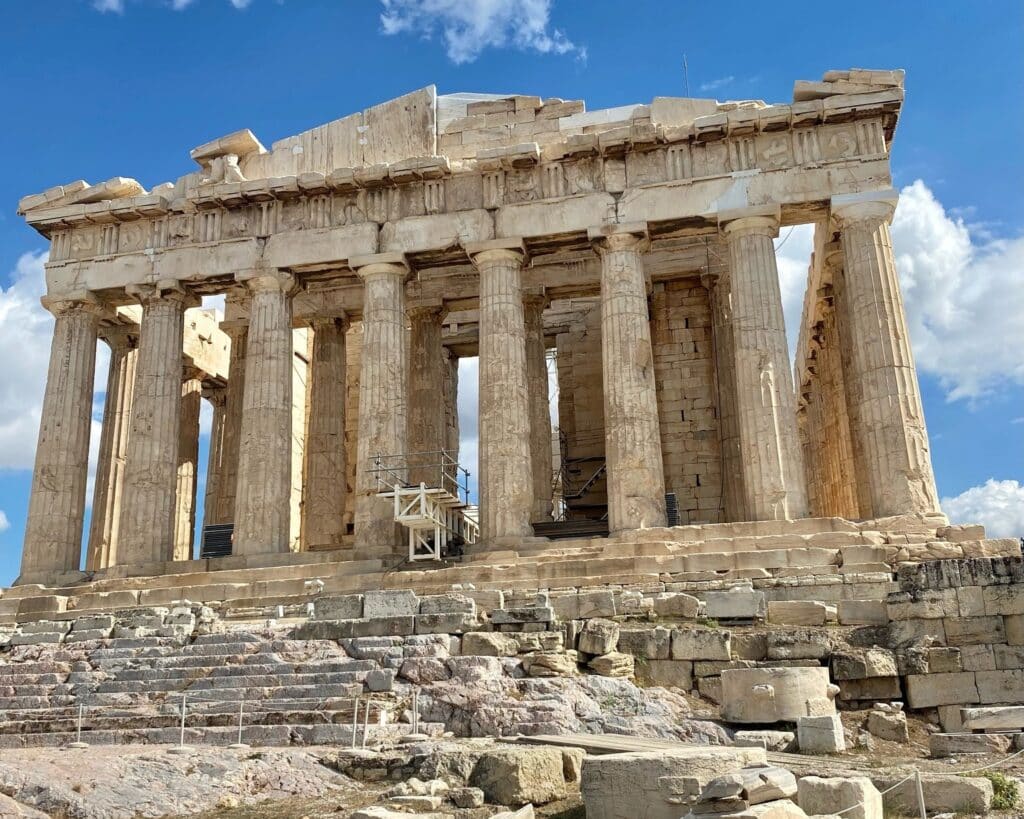
Athens, Greece – c. 5000 – 3000 BC
Athens has been inhabited since at least 5000 BC, with permanent settlements emerging around 3000 BC, centered on the Acropolis Hill and its surrounding areas. From a Mycenaean stronghold to the birthplace of democracy in the 5th century BC, Athens became one of the oldest and most influential cities in human history. Its philosophical, political, and artistic achievements profoundly shaped Western civilization.
Thucydides referred to Athens as “the school of Hellas” (History of the Peloponnesian War, Book II), emphasizing its cultural leadership. Despite Roman conquest, medieval decline, and Ottoman occupation, Athens has never ceased to be inhabited. Today, the modern metropolis coexists with its ancient past, where daily life unfolds amid temples and monuments over 2,400 years old.

Shkodra, Albania – c. 4000 BC
Shkodra, located near Lake Shkodra in northern Albania, traces its origins to around 4000 BC. Known as Scodra in antiquity, it was a significant Illyrian settlement and later became the capital of the Kingdom of Illyria under King Gentius in the 2nd century BC. Its strategic location made the city a focal point throughout Roman, Byzantine, Venetian, and Ottoman periods.
The Roman historian Livy described Scodra as a fortified city of great importance during the Illyrian Wars. Rozafa Castle, overlooking the city, reflects both the continuity of settlement and the legends associated with it. Today, Shkodra remains one of Albania’s cultural centers, preserving its ancient urban heritage.

Larissa, Greece – c. 4000 BC
Larissa, in Thessaly, has been continuously inhabited since at least 4000 BC. It emerged as a significant Mycenaean settlement and later developed into a prominent Classical city, serving as the center of the Thessalian plain. The region is linked to Achilles, whose homeland, Phthia, lay nearby.
The geographer Strabo described Larissa as “the most prosperous city of Thessaly.” Its fertile surroundings supported ongoing settlement, while its strategic location maintained the city’s political importance through Roman and Byzantine periods. Today, modern Larissa preserves its ancient theater and reflects a seamless blend of antiquity and contemporary Greek life.

Nafplio, Greece – c. 1400 BC
Nafplio traces its origins to the Late Bronze Age, around 1400 BC, when it served as a port for Mycenaean Argos. Known in antiquity as “Nauplia,” the city later became an important Byzantine and Venetian stronghold. Its well-preserved fortresses, including Palamidi and Bourtzi, reflect its strategic and historical significance.
Pausanias mentions Nafplio as an ancient harbor town associated with the mythic hero Nauplius. The city has been continuously inhabited since antiquity and rose to modern prominence as the first capital of independent Greece (1828–1834). Nafplio’s uninterrupted habitation connects its Bronze Age maritime heritage to its role in modern nationhood.

Cádiz, Spain – c. 1100 BC
Cádiz, founded by Phoenician traders around 1100 BC as Gadir, is considered the oldest continuously inhabited city in Western Europe. Established as a trading post near the Strait of Gibraltar, it served as a vital link between the Mediterranean and Atlantic worlds.
The Greek historian Herodotus mentioned Gadir when describing the limits of the known world. Later, under Roman rule as Gades, the city became renowned for its wealth and cosmopolitan character. Despite earthquakes, invasions, and economic changes, Cádiz has remained inhabited for over three millennia, preserving its enduring maritime identity.

Matera, Italy – c. 7000 BC
Matera, in southern Italy, stands apart due to its unique form of habitation. The Sassi di Matera, cave dwellings carved into limestone ravines, show evidence of continuous human habitation since the Paleolithic era, around 7000 BC. This makes Matera one of the oldest continuously inhabited settlements in the world.
Carlo Levi famously described Matera as “a place where history stopped,” capturing its timeless quality. Once a symbol of poverty, Matera is now recognized as a UNESCO World Heritage Site and a testament to human adaptation and continuity.
These ancient cities aren’t just relics—they’re living testaments to Europe’s earliest urban beginnings. Their uninterrupted habitation shows resilience, adaptability, and the enduring human drive to build, rebuild, and belong. Together, they create a living map of European civilization, where modern streets follow routes first traveled thousands of years ago.
See all the latest news from Greece and the world at Greekreporter.com. Contact our newsroom to report an update or send your story, photos and videos. Follow GR on Google News and subscribe here to our daily email!

