



On June 5, 1947, US Secretary of State George C. Marshall stood before a Harvard University commencement crowd. He proposed a radical blueprint for the survival of post-war Europe—the European Recovery Program, famously known as the Marshall Plan.
Conceived in a climate of escalating Cold War anxieties, Marshall famously declared:
“Our policy is directed not against any country or doctrine but against hunger, poverty, desperation and chaos. Its purpose should be the revival of a working economy in the world so as to permit the emergence of political and social conditions in which free institutions can exist.”
While the resulting Marshall Plan is celebrated globally for sparking Western Europe’s golden age of growth, its application in Greece was uniquely volatile. It acted as an economic accelerator for a nation on the brink of collapse. Still, the cure arrived with heavy-handed strings that permanently altered Greek sovereignty, escalated an internal civil war, and drew fierce resistance from the country’s left-wing factions.
Greece in ruins
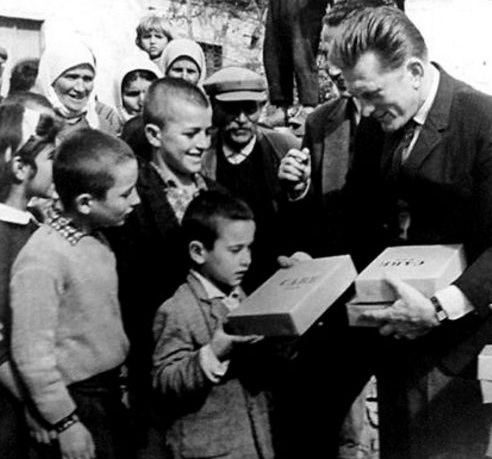
By 1947, Greece was a landscape of absolute ruin. The brutal wartime Axis occupation had destroyed its railways, burned hundreds of villages, and decimated the merchant marine fleet. Infrastructure such as the vital port of Piraeus serving Athens and the three-mile-long Corinth Canal lay unusable.
Compounding this physical tragedy was a bitter, bloody civil war between the royalist government and communist-led insurgents of the Democratic Army of Greece (DSE).
Starvation was an immediate threat. Appealing to Congress for immediate intervention, President Harry S. Truman painted a grim picture of the Greek reality: “Greece is today without funds to finance the importation of those goods which are essential to bare subsistence…the people of Greece cannot make progress in solving their problems of reconstruction. Greece is in desperate need of financial and economic assistance to enable it to resume purchases of food, clothing, fuel, and seeds.”
The American response was unprecedented. Between 1947 and 1951, Greece received roughly $2 billion in Marshall Aid and related Truman Doctrine funds—an astronomical sum worth more than $21 billion today. At its peak, US aid financed 67% of all Greek imports and constituted a staggering 25% of the nation’s gross national product.
Marshall plan rebuilds Greece’s infrastructure
The economic injection quite literally rebuilt the country’s shattered spine. Over 6.5 million tons of American food, clothing, and medical supplies flooded into Greek ports, staving off a humanitarian catastrophe.
American engineers and funding dredged and reopened the blockaded Corinth Canal, completely reconstructed the Port of Piraeus, and paved thousands of miles of modern highways that connected isolated rural provinces to urban markets.
In the fields and factories, the money drove rapid modernization. Thousands of American tractors, advanced irrigation pumps, and high-yield seeds were imported, shifting Greek agriculture from primitive subsistence farming to a competitive export industry.
Furthermore, the plan financed the establishment of the Public Power Corporation (DEI), laying the initial brickwork for a unified national electrical grid.
The cost and institutional decay
Yet, this massive economic lifeline had a darker, counterproductive underside. Unlike in Great Britain or France, where aid was managed by robust local governments, the United States viewed the unstable, war-torn Greek administration with deep suspicion.
Consequently, Washington established the American Mission for Aid to Greece (AMAG), an oversight apparatus that wielded extraordinary, direct control over the country’s domestic affairs. Dwight Griswold, the head of AMAG, made it very clear to the Greek government that the money came with absolute American leverage: “We are here to help Greece, but we must be sure that the help is used effectively. If the Greek government does not take the necessary steps to stabilize its economy and clean up its administration, we will have to reconsider our position.”
American administrators held functional veto power over the Greek state budget, tax legislation, and currency issuance. Greek cabinet ministers routinely had to clear basic administrative policies with US advisers. This heavy-handed intervention saved the state from collapsing into communist hands—Washington’s primary geopolitical goal—but it severely eroded Greek political autonomy.
Prominent Greek intellectual and novelist Giorgos Theotokas captured the growing local resentment in his diary during the late 1940s: “The Americans have become our true masters. Ministers do not dare make a move without asking the permission of some American adviser. We have been saved from the rebels, but we have lost our independence.”
Furthermore, because aid was distributed through a centralized state apparatus during a civil war, funds and import licenses were frequently weaponized. Capital was often allocated based on political loyalty to the right-wing government rather than economic merit, inadvertently reinforcing a rigid system of political patronage and favoritism.
Konstantinos Karamanlis, a rising political figure who would later become Prime Minister, looked back on how the rush of money warped the country’s institutional health:
“The aid was a blessing, but the way it was managed taught Greeks to look to the state for salvation rather than their own productivity. It fed a system of dependency and favoritism that outlived the docks and roads we built with it.”
Marshall plan opponents in Greece
Because Marshall Aid was fundamentally tied to Washington’s anti-communist containment strategy, it faced fierce, violent opposition from the Greek Left, primarily spearheaded by the Greek Communist Party (KKE) and its military wing, the DSE.
To the communists, the Marshall Plan was not a humanitarian gesture but a textbook example of “American imperialism” designed to turn Greece into a strategic military outpost for the United States. KKE propaganda aggressively painted the American administrators as the “new conquerors,” succeeding the German occupiers.
They argued that the economic restructuring pushed by AMAG was explicitly designed to restrict Greek industrial self-sufficiency, forcing the nation to remain a dependent market for American manufactured goods and agricultural surpluses.
This opposition extended far beyond rhetorical propaganda into active physical resistance and domestic warfare. Communist circles actively orchestrated plans to paralyze American reconstruction work. Guerrilla cells launched targeted bombings and acts of sabotage against critical infrastructure projects, focusing on the newly restored Piraeus docks and the Corinth Canal to disrupt the flow of American supplies.
An ambiguous legacy
Ultimately, the Marshall Plan in Greece achieved its immediate, vital objectives. It prevented mass starvation, facilitated the defeat of the communist insurgency, and laid the concrete physical foundations for the country’s mid-century economic expansion.
However, the sheer velocity and volume of the aid left a profoundly ambiguous legacy. It demonstrated how foreign aid can simultaneously rescue a nation’s people from chaos, while binding its political institutions and sovereign decision-making to the strategic whims of an external superpower.
The ideological battle over the economic recovery is captured visually in the following historical archival footage, which illustrates the intersection of American material aid and public relations efforts during the height of the reconstruction program. The “Story of Koula” Marshall Plan Film demonstrates how the US government utilized media to promote the agricultural modernization of the Greek countryside during this volatile era.
Related: What Has the United States Ever Done for Greece?
See all the latest news from Greece and the world at Greekreporter.com. Contact our newsroom to report an update or send your story, photos and videos. Follow GR on Google News and subscribe here to our daily email!

