



Byzantine philosopher Stephanos of Alexandria (also known as Stephanus of Alexandria) stands among the most fascinating intellectual figures of the late antique and early Byzantine world. His intellectual pursuits spanned philosophy, science, medicine, alchemy, and astronomy.
Living during the late sixth and early seventh centuries AD, Stephanos embodied the ideal Byzantine scholar. In her study Stephanos of Alexandria: A Famous Byzantine Scholar, Alchemist and Astrologer, historian Maria Papathanassiou presents him as a representative of a civilization in which disciplinary boundaries remained fluid and knowledge was understood as a unified whole.
Through her analysis, Stephanos emerges not merely as an alchemist or astrologer but as an encyclopedic thinker whose work reflected the cosmological and philosophical traditions of Alexandria while also shaping Byzantine intellectual culture.
Byzantine sources themselves describe Stephanos as a “practical philosopher” and an “ecumenical teacher.” These titles are especially revealing because they suggest he was regarded as an ideal scholar capable of bridging theory and practice. Papathanassiou argues that “philosophy, the arts, and technology in the past were not separated by clear boundaries in the way they are today.” In this sense, Stephanos belonged to a world fundamentally different from modern academic specialization. His writings on alchemy and astrology were not viewed as marginal superstitions but as legitimate branches of natural philosophy.
The life of Stephanos of Alexandria
Stephanos of Alexandria was active in the early seventh century. According to tradition, he was invited from Alexandria to Constantinople by Emperor Heraclius to teach at the imperial university, with the specific task of commenting on Plato and Aristotle, as well as teaching the quadrivium. This appointment suggests he was already widely recognized as an eminent scholar in Alexandria prior to his relocation to the Byzantine capital.
Stephanos lived and worked during the reign of Emperor Heraclius, a period marked by significant political and military crisis for the Byzantine Empire. According to tradition, he moved from Alexandria to Constantinople around AD 617 and became associated with the imperial court. Historian Maria Papathanassiou notes that he “taught the quadrivium,” the four mathematical disciplines of arithmetic, geometry, astronomy, and music. His arrival in Constantinople thus symbolizes the broader transfer of Alexandrian learning into the intellectual life of the Byzantine capital.
Papathanassiou also emphasizes the difficulty of reconstructing Stephanos’ biography and intellectual profile, given the scarcity of surviving biographical evidence and the wide range of works attributed to him. She observes that “Stephanos of Alexandria is a late-sixth/early-seventh-century Byzantine scholar known as a commentator of Plato and Aristotle; astronomical, astrological, alchemical, and medical works are also attributed to him.”
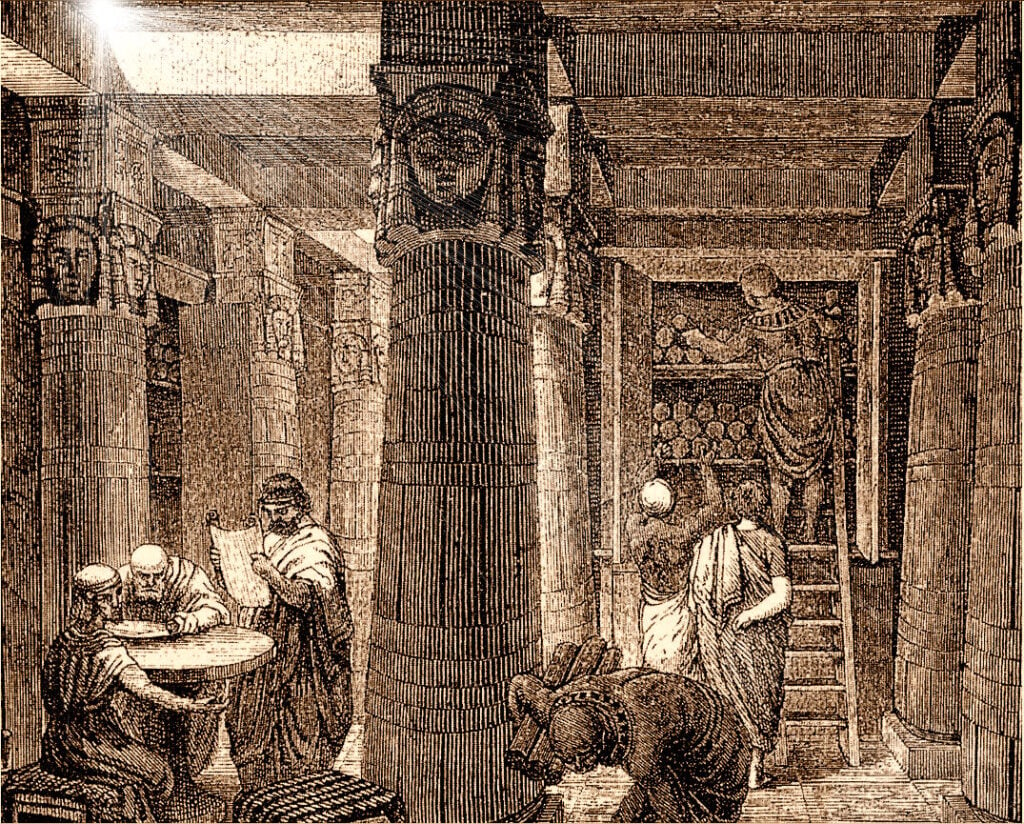
Stephanos was educated in Alexandria, one of the most important intellectual centers of the Mediterranean world. The city inherited and preserved the scientific and philosophical traditions of Hellenistic civilization, including the works of Aristotle, Plato, Ptolemy, and Galen. At the same time, Alexandria functioned as a meeting point for Greek, Egyptian, Christian, and Near Eastern intellectual traditions. Papathanassiou describes it as “a crossroads of various cultures and religions.”
Within this educational environment, such intellectual breadth was not unusual. In Late Antiquity, philosophy, medicine, astronomy, and what are now often called occult sciences were closely interconnected rather than separate fields of study. Stephanos therefore represents the continuation and transformation of the Alexandrian scholarly tradition within the Byzantine world.
Alchemical writings of Byzantine philosopher Stephanos of Alexandria
Maria Papathanassiou’s article, Stephanus of Alexandria: On the Structure and Date of his Alchemical Work, is a major contribution to the study of Byzantine alchemy and the broader intellectual history of Late Antiquity. The study re-examines the authorship, structure, and chronology of the alchemical writings attributed to Stephanos of Alexandria.
Stephanos’ most famous work, On the Great and Sacred Art of Making Gold, survives in the form of a series of lectures. The text reveals the strong influence of philosophical speculation on Byzantine alchemy. Rather than concentrating solely on the practical production of gold, Stephanos interpreted alchemy as a sacred science that disclosed the underlying unity of nature.
Papathanassiou argues that alchemy in Byzantium cannot be reduced to primitive chemistry or dismissed as fraudulent. Instead, it was grounded in philosophical ideas about matter, structure, and transformation. She observes that “alchemy was consistently related to philosophical ideas on the composition and structure of matter.” In this framework, Stephanos understood the transmutation of metals as a symbol of broader processes of change governing the cosmos as a whole.
Earlier alchemical writers often expressed their ideas in deeply symbolic and spiritual language. The influential alchemist Zosimos of Panopolis, who had a lasting impact on later Byzantine traditions, wrote that “the composition of waters, the movement, growth, removing, and restoring of bodily nature” reflected divine mysteries. For Zosimos, alchemical operations were both physical and spiritual transformations at the same time. Stephanos inherited this conceptual framework and reworked it within a Christian Byzantine intellectual environment.
Synthesis of ideas
One of the central insights of Maria Papathanassiou’s analysis is that Stephanos of Alexandria sought to synthesize multiple branches of knowledge into a single, unified worldview. She writes that “the loose structure of Stephanos’ lectures…is the result of his effort to synthesize various ideas originating in a wide array of disciplines into a logical system.” In his alchemical writings, the four elements, the zodiac, planetary motions, bodily humors, and chemical processes are all treated as interconnected systems that correspond to one another.
Stephanos consistently emphasized the analogy between the human body and the cosmos. In ancient and medieval philosophical thought, humanity was often understood as a “microcosm,” a smaller reflection of the universe itself. This idea is already present in Plato’s Timaeus in which the cosmos is described as a living being endowed with soul and intelligence. Plato famously wrote: “This world became a living creature truly endowed with soul and intelligence.” Stephanos adapted this Platonic framework and integrated it into his own alchemical cosmology.
Papathanassiou provides vivid examples of these correspondences. Stephanos linked the seasons and zodiacal signs to the four classical elements—air, fire, water, and earth—while also suggesting that celestial movements governed both natural processes on earth and physiological changes within the human body. He further extended these analogies into material practice, comparing alchemical apparatuses to cosmic structures and describing the vessel used in chemical operations as analogous to the heavens encircling the earth.
A further dimension of Stephanos’ thought concerns religion. Byzantine alchemy differed from earlier Greco-Egyptian traditions in that it increasingly incorporated Christian language and symbolism. Modern scholar Vincenzo Carlotta argues that Stephanos’ writings represent one of the earliest major attempts to “Christianize” alchemy. This intellectual synthesis reflects a broader feature of Byzantine culture in which pagan philosophical inheritance and Christian theology often coexisted and interacted within the same conceptual framework.
Importance of astrology
The intellectual atmosphere of Alexandria helps explain why astrology held such an prominent place in Byzantine scientific thought. In ancient cosmology, the universe was understood as an interconnected system in which celestial movements directly influenced events on earth. The astrologer Claudius Ptolemy, whose Tetrabiblos became the foundational text of later astrological tradition, argued that the stars exert natural effects on the material world. As Ptolemy famously stated, “the heavenly bodies have influence upon all things.” This framework made it possible for astrology to coexist naturally with medicine and broader natural philosophy.
Maria Papathanassiou discusses the specialized discipline known as iatromathematica, or medical astrology, which combined astronomical observation with diagnosis and healing practices. She explains that “already in antiquity the combination of the two led to the creation of a special discipline, ‘iatromathematica.’” Within this system, the physician-astrologer interpreted the human body through the movements of planets and zodiacal signs, linking physical health to cosmic rhythms.
Although such ideas may appear unusual from a modern perspective, in Late Antiquity, they were widely regarded as rational attempts to explain the harmony between the microcosm of the human body and the macrocosm of the universe.
Astronomy and alchemical symbolism in the work of Byzantine philosopher Stephanos
Maria Papathanassiou highlights the importance of astronomical observation in the work of Stephanos of Alexandria. One particularly striking passage in his alchemical writings records a planetary phenomenon dated to approximately June AD 617. Such references suggest that Stephanos was not engaging solely in abstract philosophical speculation but was also attentive to observable celestial events. In Late Antiquity, astronomy and astrology were closely intertwined disciplines, since precise observation of planetary motion formed the essential basis for astrological interpretation.
The astronomical sections of Stephanos’ work describe planetary positions and celestial configurations that are closely linked to alchemical symbolism. Papathanassiou interprets these passages not as vague metaphorical language but as references to real astronomical events that could be observed at a specific historical moment. By reconstructing these configurations, she concludes that the work was most likely composed during the reign of Byzantine Emperor Heraclius, probably in the early seventh century. This chronological framework strengthens the identification of Stephanos with the scholar known from other Byzantine sources as a philosopher and teacher active in Constantinople after the Persian conquest of Alexandria.
Her analysis further underscores the close relationship between astronomy and alchemy in Byzantine intellectual culture. The heavens were widely believed to exert influence over earthly processes, including the transformation of metals. Planetary cycles, zodiacal signs, and cosmic harmonies all formed part of the theoretical foundation of alchemical thought. Papathanassiou therefore argues that Stephanos’ work cannot be understood merely as early chemistry or proto-science. Instead, it belongs to a broader cosmological worldview in which religion, philosophy, astronomy, and natural observation were deeply interconnected.
Legacy of the Byzantine philosopher
The intellectual legacy of Stephanos of Alexandria extended well beyond the borders of Byzantium. His writings circulated widely across Greek, Arabic, and Latin intellectual traditions, reflecting the broad transmission of scientific thought in Late Antiquity. Maria Papathanassiou notes that medieval Arabic scholars were familiar with his work, while later Latin alchemists quoted him extensively. Even Isaac Newton, whose contributions fundamentally reshaped modern physics, owned texts associated with Greek alchemical traditions and engaged seriously with their conceptual frameworks. In this way, Stephanos’ influence stretched from Late Antiquity into the intellectual foundations of early modern Europe.
Modern historians increasingly recognize that figures like Stephanos challenge simplified narratives about the history of science. Earlier scholarship often dismissed alchemy and astrology as irrational pseudosciences. Contemporary approaches, however, emphasize their philosophical depth and cultural significance within their historical context. As Frances Yates famously argued, “the occult philosophy” formed a central component of Renaissance and medieval intellectual life. In a similar vein, Stephanos’ work illustrates how Byzantine scholars developed a comprehensive vision of nature in which philosophy, science, religion, and symbolic thought were deeply and continuously intertwined.
See all the latest news from Greece and the world at Greekreporter.com. Contact our newsroom to report an update or send your story, photos and videos. Follow GR on Google News and subscribe here to our daily email!

