



During the siege of a Mallian stronghold in India, Alexander the Great charged up the walls alone and jumped into the enemy city ahead of his army. In this most astonishing episode of ancient warfare, Alexander the Great blurred the line between brilliance and madness.
In that moment, he stood completely alone, cut off and vulnerable against a hostile force. What followed would become one of the most striking displays of courage in military history.
A daring campaign: Alexander and his dive into madness to face the enemy
In the winter of 327 BC, Alexander the Great launched one of the boldest campaigns of his career. Already the master of Persia and much of the known world, he set his sights on India. His earlier conquests had carried him across the rugged Hindu Kush and into the realms of powerful Indian kingdoms. After defeating King Porus at the Battle of the Hydaspes, Alexander’s army faced the prospect of even greater challenges.
Rumors swirled about the Nanda Empire, whose size and strength far exceeded Porus. Yet months of relentless campaigning and seventy days of unbroken rain had taken their toll. Morale faltered, and the soldiers mutinied at the Beas River. Even Alexander’s famed ambition yielded to reason—he paused his eastern advance in response to their pleas.
But he did not remain idle for long. Reinforcements arrived under Memnon: six thousand cavalry, seven thousand infantry, and twenty-five thousand suits of armor. Alexander merged these forces with his own and began a southern march along the Hydaspes River. Soon, intelligence reached him of a dangerous alliance forming between the Mallians and the Oxydracians, two tribes traditionally hostile to one another. Determined to strike before they could unite, Alexander raced toward their territory with precision and urgency.
The rivers of Punjab proved treacherous. Alexander’s fleet relied on specially designed vessels that could be dismantled and carried overland between waterways. Yet navigating the Hydaspes and Acesines was perilous. Warships ran aground, and double oars became entangled in mud and debris. Alexander narrowly escaped disaster when one of his ships began to sink. Still, despite these hazards, the Macedonians pressed on—and eventually reached the tribal lands.
The many battles to reach the Mallian main city
Upon reaching the region, Alexander first secured his lines of communication. The army struck the Sibea tribe to the west, reportedly forty thousand strong. The Macedonians destroyed the city, burned crops, killed the men, and enslaved the women and children. This was a sharp departure from Alexander’s usual policy of mercy, but the decision was practical. His supply lines, stretching from Babylon to the Punjab, could not risk attacks from hostile tribes. Every victory had to ensure the army could move and resupply safely.
Alexander then divided his forces with precision. He led one contingent himself, while Perdiccas commanded another. Craterus’ units, reinforced with additional troops and elephants, held key positions, and Nearchus sailed ahead to establish a base at the junction of the Acesines and Hydraotis, ready to intercept any fleeing Mallians. Hephaestion marched parallel to Craterus’ column, while Ptolemy I Soter followed Alexander to prevent any enemies from slipping northward.
The Mallians’ alliance quickly unraveled. Leadership disputes forced the tribes to retreat to separate strongholds, leaving them exposed. Alexander seized the opportunity, marching across the desert with minimal rest—forty-five miles in just twenty-four hours. At daybreak, he arrived near Kot Kamalia, catching the Mallians completely off guard. Many warriors were still outside the city when the Macedonians struck. Alexander personally led the cavalry, encircling the city and driving the remaining fighters inside.
When the infantry arrived, Alexander ordered Perdiccas to surround a nearby town without launching a siege, wary that premature action might alert neighboring settlements. Preferring to control each engagement personally, Alexander used large war machines, such as the revolutionary torsion catapult, to capture the first city, wiping out its two-thousand-strong garrison. Survivors from Perdiccas’ assigned town were relentlessly pursued and executed.
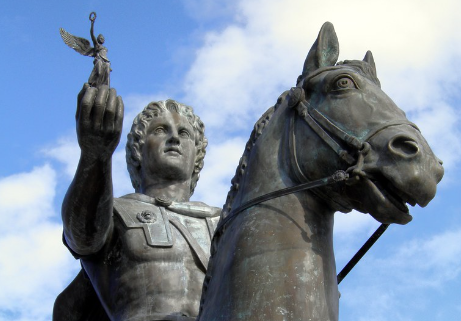
Alexander, the Great king climbs the walls alone
The Macedonians paused only briefly before pressing on. At Atari, Alexander faced a heavily fortified citadel. The inhabitants, now familiar with his tactics, abandoned the outer city and concentrated their defenses within the stronghold. Alexander led a siege, bringing his phalanx close to the walls and undermining their fortifications. Eventually, the citadel was set ablaze, and five thousand defenders perished.
After a single day’s rest, Alexander approached the main Mallian city—likely present-day Multan. But the Mallians had crossed the river to meet him on the western bank of the Hydraotis. Alexander dispatched his officers Peithon and Demetrius to subdue any holdouts, securing deserted towns and capturing refugees. On the western bank, the Mallians prepared for battle. Their forces reportedly numbered fifty thousand, yet fear of Alexander’s reputation caused hesitation. The Macedonian cavalry surged across the river, driving the enemy back five miles before the Mallians finally took a stand.
The cavalry clashed fiercely, circling the Mallians and striking from flank and rear. Alexander’s light infantry soon joined the fight, shattering enemy morale and forcing the survivors to retreat into the city. The army paused briefly, aware that the final assault on the citadel would demand every ounce of courage.
It was here that history immortalizes Alexander’s audacious recklessness. The Mallian citadel was enormous, with walls stretching roughly a mile. The Macedonians breached one gate and began undermining the inner defenses. Alexander the Great, growing impatient with the slow pace and overcome by madness, grabbed a ladder, climbed it and charged against the enemy alone. Only a handful of soldiers followed—Abreas, Peucestas, and Leonnatus, according to Arrian, though Plutarch lists only Peucestas and Limnaeus. Tragically, one companion died when the ladders collapsed under the pressing soldiers.

Alone against all: Alexander the Great at the Mallian stronghold
The Mallians recognized Alexander immediately. Arrows rained down upon him, yet he refused to retreat. His men shouted for him to seek safety, but, in his rage of madness, Alexander the Great invaded into the inner citadel alone to confront the Mallian leader and struck him down. In the chaos, an arrow pierced his lung, nearly ending his life. Meanwhile, the Macedonians feared for their king and prepared to unleash brutal vengeance on the defenders.
Alexander was swiftly carried away on a shield to a nearby tent. His main army, still four days away, believed him dead. Early rumors of his survival were dismissed as impossible. To reassure his troops, Alexander had himself displayed on a boat, visible to all, and only when he extended his hand did they realize he was alive.
The arrow remained lodged in his chest. Removing it was perilous, yet leaving it would have been fatal. Finally, either a physician or a trusted companion cut into the wound and extracted it, causing intense bleeding and nearly killing him outright. Accounts differ on how the arrow was removed. The historian Arrian notes that some sources credit Critodemus, a physician from Cos, while others claim Perdiccas used his sword to extract it, causing massive bleeding. Alexander lost consciousness, teetering between life and death for several days. For days, Alexander yet again hovered between life and death, the fate of his army hanging in the balance—the result of his madness in his quest to strike the Mallians.

The fall of the citadel
Finally, Macedonian troops broke through. Despite his critical condition, Alexander continued to direct the campaign. His companions warned him of the danger, but the assault pressed on. At last, the Mallians submitted, offering tribute: three hundred four-horse chariots, one thousand shields, lions, and one hundred talents.
The Macedonians stormed the citadel with overwhelming force. Seeing their king bleeding and near death, rage consumed them. They slaughtered the defenders without mercy, turning the battle into a massacre. The mere fear of Alexander’s death demanded vengeance. Amid the chaos, soldiers carried him away from the fighting. Blood loss left him severely weakened, and many believed he had already died.
The Mallian campaign showcased Alexander’s strategic genius, extraordinary bravery, and occasional madness. He demonstrated mastery of both psychology and logistics: the rapid marches of the Macedonians along with the clever use of interior lines and precise coordination of multiple forces left the enemy no chance to escape. At the same time, his personal audacity on the walls terrified opponents and inspired his soldiers. His life was nearly lost because of this recklessness, but his actions secured submission and tribute.
This campaign shows the extreme cases of the leadership of Alexander the Great. His army moved with remarkable precision and speed, executing complex operations across rivers, deserts, and fortified cities. Yet the defining moment remains Alexander’s leap into the citadel—a singular act of courage in the heat of madness that almost cost him his life.
See all the latest news from Greece and the world at Greekreporter.com. Contact our newsroom to report an update or send your story, photos and videos. Follow GR on Google News and subscribe here to our daily email!

