



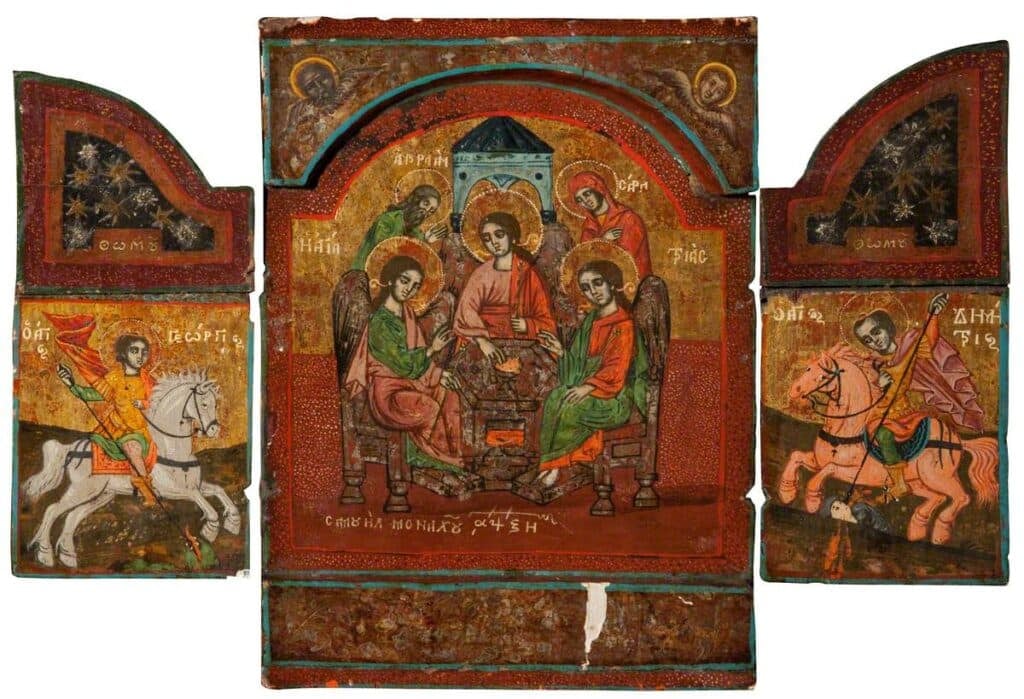
The “warrior saints” were Christian martyrs from the pre-Constantinian persecutions— although only three are described as Byzantine soldiers in early accounts of their lives. In the medieval Orthodox world, they were venerated as protectors of armies and defenders of the faith.
In the Byzantine Empire, faith and state were deeply intertwined. Sanctity was not confined to monks, martyrs, or ascetics withdrawn from society. It could also be embodied by figures who wielded swords against persecutors, led armies, and defended the Christian order.
These warrior saints were more than symbolic figures. They acted as powerful intermediaries between the earthly and the divine, protectors of cities, and models of a Christian ideal of courage. Their rise reflects the blending of Roman military tradition with Christian theology, producing a unique vision of sanctified warfare that shaped Byzantine identity for centuries.
Although Christianity teaches peace and humility, the persecution of Christians created a need for defenders of the faith. In Byzantium, defending Christianity also meant protecting the empire, since the two were inseparable. Violence against enemies of both faith and state was therefore considered righteous.
As the historian George Ostrogorsky observed, “the Byzantine state was, in essence, a theocracy in which the defense of the empire was inseparable from the defense of Orthodoxy.” Within this framework, soldiers could be seen as instruments of divine will, and those who demonstrated exceptional piety and courage in battle could be elevated to sainthood.
Saint George
The most prominent of the warrior saints is Saint George, perhaps also the quintessential warrior saint. Although historical details of his life remain sparse, his legend grew immensely during the Byzantine period. Born around 275-280, he was a soldier in the Roman Empire who refused to renounce his Christian faith and was martyred for it on April 23, 303. Immortalized in the tale of George and the Dragon, he became the patron saint of several countries and cities, including England, Georgia, Catalonia, and Moscow.
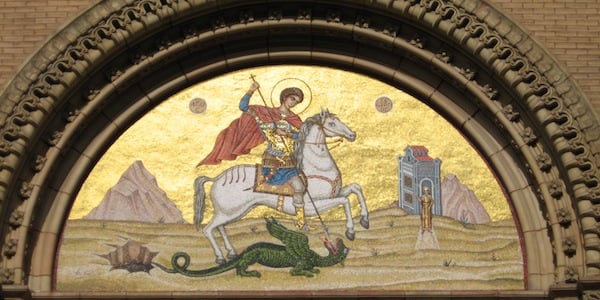
Over time, his image evolved into that of a mounted warrior slaying a dragon, a symbol often interpreted as Christianity’s triumph over evil. This transformation demonstrates how Byzantine society reshaped earlier martyr narratives to reflect its own values. As British historian Averil Cameron observes, “the saints of Byzantium were not static figures; they were continually reimagined to meet the spiritual and political needs of the empire.” In this way, Saint George became not only a martyr but also a celestial protector, invoked in times of war and crisis.
Since the 7th century, countless hagiographies have depicted Saint George as a defender against evil. As his icons show, creators of such Christian images of heroes and monsters drew upon dramatic postures and bodily movement observed in Greek and Hellenistic art. Although Christianity was the official religion throughout the Empire, its cultural practices were far from uniform.
The iconography of Saint George followed this general pattern. In the outer provinces and semi-autonomous states, there were notable deviations from the formal styles produced in Constantinople’s workshops, particularly in later centuries. Even in some nearby Balkan provinces, distinctive iconographic forms appeared. While the cult of the saint as a martyr-warrior remained as strong there as in the metropolitan center, these unique representations persisted and evolved over successive centuries.
The Byzantine warrior Saint Demetrius
Another central figure among the warrior saints is Saint Demetrius, the patron saint of Thessaloniki. Like George, Demetrius was believed to have been a soldier who suffered martyrdom under Roman persecution. Yet his role in Byzantine consciousness extended far beyond his earthly life, as he is regarded as the supernatural defender of his city and is credited with repelling invasions and safeguarding its inhabitants.
Medieval chronicles describe miraculous interventions attributed to him during sieges. As the historian Mark Whittow notes, “for the citizens of Thessaloniki, Saint Demetrius was not a distant figure of devotion but an active participant in the city’s defense.” This belief underscores the deeply personal relationship between Byzantine communities and their patron saints, who were seen as ever-present guardians.
The cult of warrior saints also reflects the militarization of Byzantine society, particularly from the 7th century onward, when the empire faced continuous external threats. As territories were lost and borders became unstable, the need for divine protection intensified. Warrior saints offered reassurance that God remained on the side of the empire, even in times of adversity. Their icons were carried into battle, their names invoked in prayer, and their relics treated as sources of supernatural power. In this way, they functioned as both spiritual and psychological support for soldiers and civilians alike.
Theodore Stratelates, the third Byzantine warrior saint
Theodore Stratelates (“the General” or “Military Commander” in Greek), also known as Theodore of Heraclea or Theodore of Arabia, was a martyr and warrior saint venerated in the Eastern Orthodox, Catholic, and Oriental Orthodox Churches.
He is said to have served in the army of Roman Emperor Licinius (r. 308–324) until the emperor decided to end toleration of Christians in his territories. At the command of the emperor, Theodore was tortured and ultimately either beheaded or crucified. He is highly venerated by the Orthodox Greek Church.
Theodore Stratelates was renowned for his many talents and striking appearance. For his charity, God is said to have enlightened him with the knowledge of Christian truth. His bravery became legendary after he, with God’s help, killed a giant serpent living on a precipice outside Euchaita. The serpent had terrorized the countryside, devouring people and animals alike. Armed with a sword, Saint Theodore vanquished the creature, glorifying the name of Christ among the people.
For his courage, Saint Theodore was appointed military commander of Heraclea, where he combined his military service with preaching the Gospel to the pagans under his authority. His gift of persuasion, reinforced by his personal example of Christian living, converted many from their false gods, and soon, nearly the entire city had embraced Christianity. However, the emperor ordered his arrest for these actions. He was tortured and crucified, becoming a martyr of the Orthodox Church.
Warrior saints embodied the ethical ideal
The significance of warrior saints cannot be reduced to mere morale‑building for persecuted Christians. They also embodied an ethical ideal. Unlike pagan heroes, whose glory often depended on personal achievement, Byzantine warrior saints were celebrated for their humility, faith, and obedience to God.
Their military prowess was secondary to their spiritual virtues. This distinction is crucial for understanding how Byzantines reconciled warfare with Christianity. As John Haldon explains, “the Byzantine soldier was not glorified for killing but for fighting in a just cause under divine sanction.” Warrior saints exemplified this principle, serving as models of righteous conduct in both war and faith.
The visual culture of the Byzantine Empire further reinforced the prominence of these figures. Icons of warrior saints were ubiquitous, often depicting them in military attire, armed with spears or swords and mounted on horses. These images were not merely decorative but were believed to possess spiritual power and act as conduits of divine presence. Venerating an icon was understood as a form of communication with the saint, who could intercede on behalf of the faithful. This belief gave warrior saints a tangible presence in daily life, bridging the human and the divine.
The concept of the warrior saint extended beyond individual figures to a broader cultural narrative. The Byzantine emperor was often portrayed as a divinely appointed leader, a defender of the faith who ruled under God’s guidance. In this context, the emperor could be seen as a living counterpart to the warrior saints, embodying the same ideals of piety and martial responsibility. This parallel illustrates how deeply the notion of sanctified warfare was embedded in Byzantine ideology and how it contributed to the empire’s endurance for more than a millennium.
See all the latest news from Greece and the world at Greekreporter.com. Contact our newsroom to report an update or send your story, photos and videos. Follow GR on Google News and subscribe here to our daily email!

