



The story of Constantinople, or modern-day Istanbul, is a fascinating one that dates back millennia to the time when this mega-city was a small Greek town known as Byzantium.
The relatively modest Greek settlement of ancient times underwent a stunning transformation that would influence not only the course of the settlement itself and the surrounding areas but also the course of history on a more global stage.
As we all know, Byzantium was destined to become the mighty Constantinople, one of the world’s most magnificent cities and the capital of the Eastern Roman Empire—otherwise known as the Byzantine Empire.
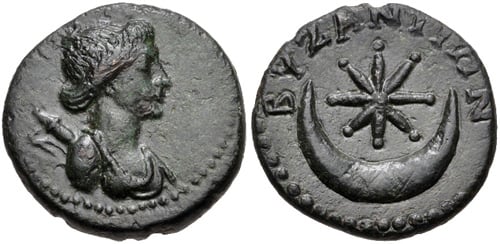
The beginnings of Byzantium
The story begins in the seventh century BC, when Greek settlers from Megara, a town near Athens, established Byzantium at the entrance of the Black Sea.
The name Byzantium stems from Byzas, the son of the King of Megara, Nisos. It was the former who led the group of Greek settlers to the modern-day area of Istanbul.
The Greek settlers decided to settle down there because it was strategically located along the Bosphorus Strait, connecting the Black Sea with the Aegean and Mediterranean.
This location proved to be especially strategic, as it was at the crossroads of Europe and Asia, with vital commercial routes connecting the Mediterranean and Black Seas. It was quite literally the epicenter of contemporary global trade routes.
However, Byzantium did not flourish instantly. The city’s fate changed radically in 324 AD, nearly a thousand years after its inauguration, when Roman Emperor Constantine I chose this historic place as the location for his new imperial capital.
Within a mere six years, the city transformed into Constantinople, thus named after the emperor himself. It was officially inaugurated as the new Roman capital on May 11, 330 AD, altering the history of the world. This defining move was far from arbitrary or random.
The position of Byzantium—later Constantinople—provided tremendous military and commercial benefits over other locations within the Roman Empire. The city had natural harbors, insuring a consistent supply of wheat and other essentials that guaranteed the population not only food security but also great trade opportunities for merchants of the time.
The city’s geographical location, surrounded by the Sea of Marmara and the Golden Horn Bay, made it inherently defendable too, something that proved invaluable on many occasions during the tumultuous history of Constantinople.
The Roman Emperor spared no expense in revamping the city and converting it from a small Greek town to the mighty capital of the Roman Empire.
Constantine ordered magnificent reinforced walls to be constructed, a massive hippodrome seating over 80,000 people, and a new central square known as the Augustaeum that would inspire awe both in its inhabitants and visitors.
The city also had a large imperial palace with an outstanding Chalke entrance, as well as numerous public sites appropriate for an imperial capital worthy of its fame.
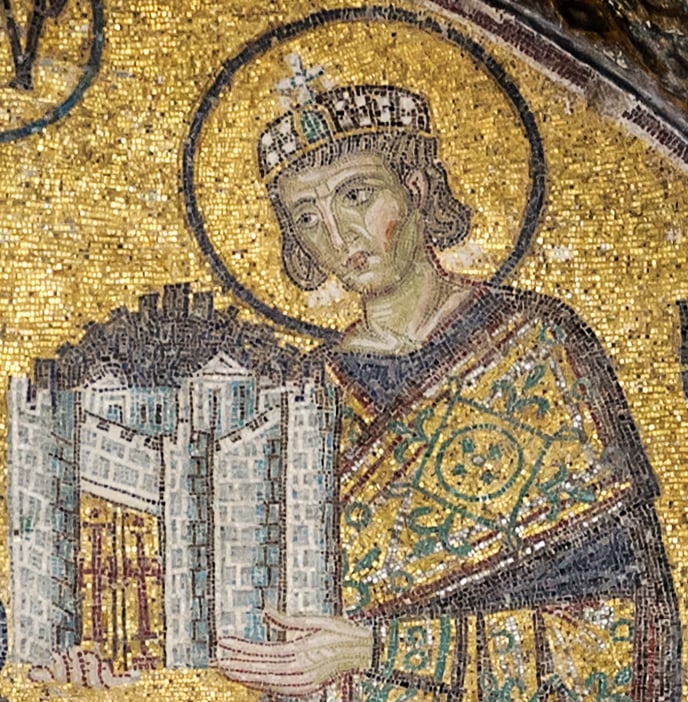
Detail of the southwestern entrance mosaic in the Hagia Sophia. Credit: Myrabelladerivative, Wikimedia Commons, Public Domain
Constantinople became the cradle of several historical firsts
Constantinople became the world’s first Christian capital, owing to Constantine’s momentous decision to personally convert to Christianity himself.
One could argue that the urban ideology of Constantinople was carefully planned out to combine religious elements through the symbolic establishment of Christianity as the official religion of the Roman Empire in conjunction with the mighty imperial power.
This is why Roman (Byzantine) emperors were referred to as the “Lord’s Anointed” and linked to biblical heroes, as they became the default defenders of Christ’s faith in this world.
The new Roman capital produced an extraordinary cultural synthesis that merged elements of antiquity with the emerging reality of Christian dominance.
By maintaining Greek cultural traditions and incorporating Roman political structures and Christian religious practices, the city flourished. The population of Constantinople quickly increased, amounting to almost 400,000 by the sixth century, a number unheard of at the time.
Constantinople and its establishment as the new Roman capital pushed the empire’s power center eastward and led to Greece’s first long-term union, as the empire was quickly Hellenized.
Furthermore, the city established a monetary standard through Constantine’s gold solidus, which remained in circulation for nearly a millennium. The concept of the divine right of monarchs as defenders of faith rather than solely divine rulers was also quite significant in the overall workings of the city.
Constantinople remained the beacon of civilization across the Eastern Mediterranean during the Middle Ages. Its libraries housed several ancient Greek and Roman manuscripts, while its workshops produced complex pieces of art and handicrafts that paved the way for later admirable masterpieces.
This new Rome would last for more than a thousand years prior to its eventual collapse to the Ottoman Empire in 1453.
See all the latest news from Greece and the world at Greekreporter.com. Contact our newsroom to report an update or send your story, photos and videos. Follow GR on Google News and subscribe here to our daily email!

