



Alexander the Great remains one of history’s most captivating figures, inspiring endless fascination with every aspect of his life. He has been called a visionary, a tyrant, a genius, a conqueror, and a dreamer, among many other things.
Yet the simplest and most persistent question people ask is: what did Alexander the Great actually look like? Are the depictions we have of him accurate? For more than two thousand years, people have been obsessed with his appearance, as if the shape of his nose or the color of his hair might somehow reveal the secrets of his destiny.
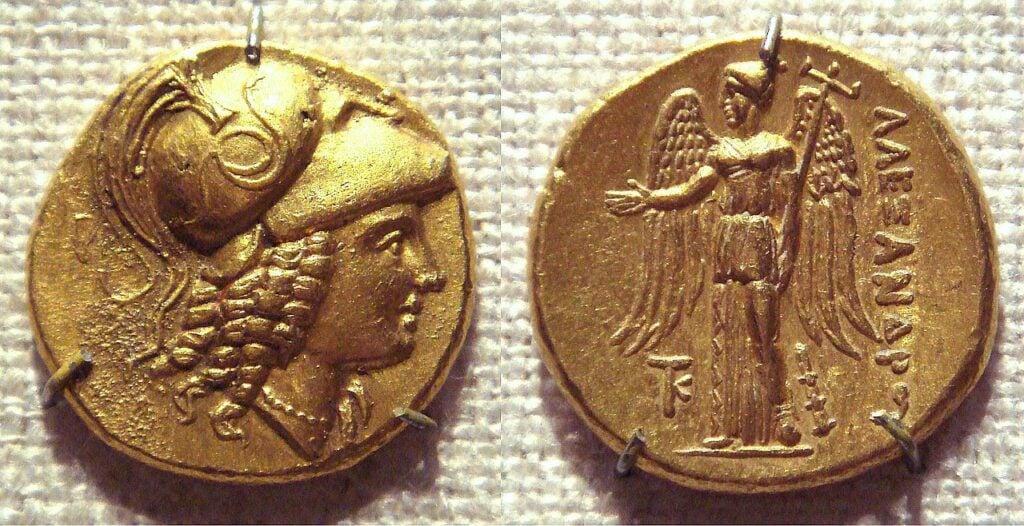
Trying to picture Alexander the Great
If you try to picture Alexander, you’ll find yourself wandering through a haze of myths and legends. The ancient writers were hardly objective biographers—their main goal was to please their leader or entertain their audiences rather than record the truth. They painted in mythic colors, blending fact with generous doses of flattery. Still, these embellished accounts are all we have, and they offer valuable clues. Plutarch and Arrian, for instance, describe Alexander the Great as being on the shorter side, which was typical for a Greek of his time.
He was also said to have a fair complexion and hair so light it caught the sun, curling slightly upward from his forehead in that distinctive way artists still try to capture. Observers noted that it gave him an air of untamed vitality—something between a lion’s mane and a halo. His personal hero, Heracles, was often portrayed the same way, and one can’t help but wonder whether the resemblance was purely coincidental or a deliberate nod to Alexander’s lifelong admiration for the demigod.
Then there were his eyes. Ancient sources mention that one was lighter than the other, suggesting he may have had heterochromia—a Greek word meaning “different color,” and a rare, striking feature even today. Imagine a young king with two differently colored eyes, staring down generals and monarchs, convincing men twice his age that he was marked by the gods. It’s easy to see why his face lingered in memory and left such an indelible impression on generations to come.

A man who managed his own myth
Alexander wasn’t the kind of leader who ignored his image. On the contrary, he was a master of presentation. Long before rulers had photographers or portrait painters, he understood that image meant power. To sculpt his likeness, he chose Lysippos, an artist whose work was so lifelike and graceful that his busts seemed to breathe. Lysippos broke away from the rigid idealism of earlier Greek sculpture; his Alexander tilted his head slightly upward, eyes lifted toward something unseen—something divine—that mirrored his destiny.
This pose became Alexander’s visual signature. He personally approved only those likenesses that met his standard: youthful, athletic, and alive with restless ambition. The original bronze statues are lost, but Roman copies preserve enough detail for us to imagine their power and presence. Through Lysippos, Alexander transformed himself into the archetype of the Ancient Greek ideal man—the beautiful, unstoppable young hero whose only limit was the sky. Every emperor from Augustus to Napoleon borrowed something of that look, turning him into an enduring icon and symbol of power.

There’s a story—probably embroidered over the centuries—that when Alexander first sat on the throne of the Persian King Darius, his feet didn’t quite reach the ground. A servant fetched a footstool to fix the problem. It’s the kind of detail historians can’t resist because, whether it happened or not, it carries perfect symbolism.
Here was an average Macedonian man trying on the mantle of a Persian god-king. The throne wasn’t made for him—in more ways than one. Yet the image endures: a man of ordinary stature, yet determined to shape his vast empire.
In the Anabasis of Alexander by Arrian, it is mentioned that when the mother of King Darius came to plead for the lives of the royal family after her son’s fall, she initially mistook Hephaestion, Alexander’s close friend and general, for Alexander. Alexander was present at the scene, but Hephaestion was taller and more physically imposing than Alexander. His stature and broader build may have made him appear more “kingly” to the Persian queen mother.
Those who actually knew him didn’t seem to care how tall he was. What they noticed was his energy. He could ride for days without rest, march at the head of his army, and share the same rations as his men. They said his presence lit up the campfires at night—that his confidence was contagious. His force of character filled any room—or battlefield—he entered.
Over the centuries, the image of Alexander the Great grew far larger than the man himself. Roman emperors adopted his hairstyle, Renaissance painters revived his likeness to celebrate human ambition, and modern reconstructions still echo that unmistakable upward gaze. The same features repeat: the smooth cheeks of youth, the confident posture, and the sense that he’s always looking just beyond the horizon.
But the real fascination isn’t in reconstructing his face—it’s in realizing how deliberately he shaped it. Alexander understood that beauty, charisma, and myth could be forged into weapons. Whether his hair was truly golden or his eyes truly mismatched hardly matters. What endures is the illusion he created: a reminder that the world often remembers not the man himself but the story he told with his face.
Related: Reconstruction of Alexander the Great’s Face
See all the latest news from Greece and the world at Greekreporter.com. Contact our newsroom to report an update or send your story, photos and videos. Follow GR on Google News and subscribe here to our daily email!

