



Abaris the Hyperborean was a legendary figure in ancient Greek tradition, often depicted as a priest of Apollo and a mystical healer from the distant land of Hyperborea. Ancient Greek mythology mentions him as possessing extraordinary wisdom, prophetic abilities, and even supernatural powers, including the ability to travel through the air.
The Hyperboreans in Greek mythology
According to Greek mythology, the Hyperboreans lived at the edge of the world. They were under a sky that was perpetually bright and cheerful. The ancient Greek poet Pindar described them to be in a region where the north wind did not blow. He also mentions that from their island-country the moon appeared very close to Earth.
The Hyperboreans were a just, hospitable and peaceful people. They lived in forests, consuming the fruits of trees rather than meat. Mythology further states that this people “knew neither disease nor old age.” Nearby lived the wild and aggressive Arimaspians and Issedones, who, despite their nature, respected the Hyperboreans. This respect allowed the Hyperboreans to live far from wars and conflicts.
A significant mythological detail is that no mortal could easily find the way to the land of the Hyperboreans. The great poet Pindar remarked:
“The wondrous path leading to the festivals of the Hyperboreans, neither on foot nor by ship shall you find.”
Only a few heroes were said to have reached this land, always with divine assistance. Perseus, guided by Athena, passed through the Hyperborean land on his way to behead Medusa. Similarly, Heracles, with Artemis’ help, traveled there while pursuing the Ceryneian Hind.
During this journey, Heracles asked the Hyperboreans for permission to take olive tree saplings to Olympia to crown the victors of the games. Olives were then unknown to the Greeks.
Another intriguing myth involves Oreithyia, whom Boreas abducted and hid “at the ends of the earth . . . where the heavens open into the garden of Phoebus (Apollo)” according to the Greek philosopher Plato in his work ”Phaedrus.” This suggests that this was the land of the Hyperboreans.
Apollo’s relationship with the Hyperboreans
There is a strong connection between Phoebus Apollo and the Hyperboreans. According to legend, when Apollo was born, Zeus crowned him with a golden band and sent him in a chariot drawn by swans to deliver oracles at Delphi. However, Apollo first commanded the swans to fly to the Hyperboreans. Only after spending a year with them did he journey to Delphi, fulfilling his father’s will.
From that time onward, whenever Apollo was away from Delphi and Olympus, they knew that he had returned to the land of the Hyperboreans—particularly during the three winter months.
It is also said that Apollo sought refuge in the land of the Hyperboreans to escape Zeus’s wrath after killing the Cyclopes.
A Greek priestess, Boio, in her hymn, testified that the Hyperboreans founded the Oracle of Delphi, with figures like Pagasos, Agyieus and Olynthus (Apollo’s first prophet) establishing it. This suggests a deep connection—perhaps even a shared origin—between the Greeks and the Hyperboreans.
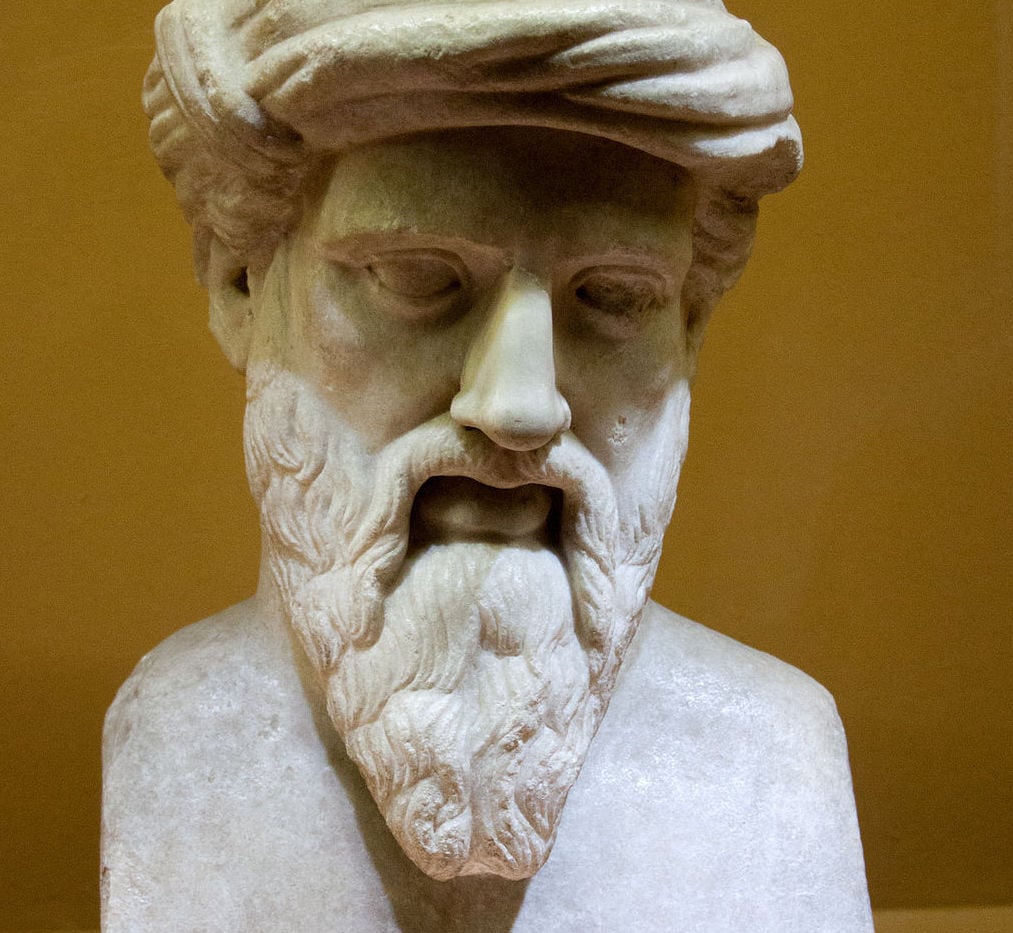
Abaris and his connection with the Pythagorean tradition
Abaris (from a- meaning “without” and baros meaning “weight,” thus “weightless”) was a Hyperborean priest who reportedly visited Greece during Pythagoras’ time. The ancient Neoplatonist philosopher Iamblichus suggests that Abaris was Pythagoras’ teacher.
Iamblichus states:
“This belief was not held lightly, for the first who declared it was no ordinary man but a god. One of the teachings asked: ‘Who are you, Pythagoras?’ They claimed he was Apollo the Hyperborean incarnate. Proof of this lay in an event at a contest where Pythagoras, rising, revealed his golden thigh. He hosted Abaris the Hyperborean and received from him a spear (arrow) with which he traveled through the ether.”
Continuing, Iamblichus adds:
“(Abaris) gifted Pythagoras an arrow taken from the temple, which proved invaluable during his extensive wanderings. Riding this arrow, he could traverse impassable terrains.”
The epithet Aitherobates (“one who walks the ether”) was given to Abaris because Apollo had gifted him a spear (arrow). This enabled him to cross vast distances by traveling through the air. This extraordinary ability is reminiscent of myths still circulating today.
Abaris was a mystical healer and seer, having learned divination directly from Apollo. The oldest traditions depict him riding through the air on a divine arrow bestowed by Apollo, according to the philologist Martin P. Nilsson. Herodotus notes that upon arriving in Greece, Abaris renewed his friendship and kinship with the inhabitants of Delos—a significant detail, given that Apollo was born there.
See all the latest news from Greece and the world at Greekreporter.com. Contact our newsroom to report an update or send your story, photos and videos. Follow GR on Google News and subscribe here to our daily email!

