



Most of us have heard of Athens, the birthplace of democracy, but how many of us know the intriguing details of how Cleisthenes and Isagoras shaped the creation of the system that still influences our lives to this day?
Democracy wasn’t a product of academic debate or intellectual discourse. It was born in the streets of Athens out of a bitter and violent struggle between two men. Their rivalry forced an entire city to choose its future, leading to one of humanity’s most important moments: the birth of democracy.
When the tyrant Hippias was finally overthrown in 510 BC, Athens couldn’t breathe a sigh of relief. On the contrary, the worst was yet to come. The mighty city was left without a proper government, and the question of what would happen next was on everyone’s minds. Would Athens slide back into the familiar story of an aristocratic elite ruling over everyone else based by bloodline, or would it take a step into the unknown, adopting a radical new idea that gave ordinary people political power? The answer to this question would go on to shape the West and, more broadly, the world forever.

The role of Isagoras and Cleisthenes in shaping democracy in ancient Athens
There were two men who viewed the chaotic moment as their opportunity to shine, but they both had radically different perspectives. On the one hand was Isagoras, a staunch aristocrat who wanted nothing more than to turn Athens back to its old habits and put his own elite class in charge of the city. He was willing to do anything to achieve that, even striking an alliance with Athens’ oldest and fiercest enemy.
That enemy was King Cleomenes I of Sparta. What Isagoras did next was almost unthinkable—he invited the Spartan army to settle a domestic dispute, letting the city’s arch-enemies impose a solution to Athens’ political crisis by force. His true aim was simple: to block his rival, Cleisthenes, who had begun laying the groundwork for a revolutionary idea, namely government by the people.
Cleisthenes was an aristocrat from the powerful but tarnished Alcmaeonid clan. Isagoras believed he had found the perfect weapon against his reformist ambitions in an ancient religious curse hanging over Cleisthenes’ family, and he used it to have him and hundreds of his supporters exiled.
He then attempted to dissolve the city’s council, the 400-member Boule, which was composed primarily of aristocrats. In its place, Isagoras installed 300 of his own men to rule, effectively turning Athens into an oligarchy dominated by the ruler’s allies (or friends). It was an astonishingly blatant power grab, propped up by Sparta’s military might—almost unimaginable for the ordinary Athenian.
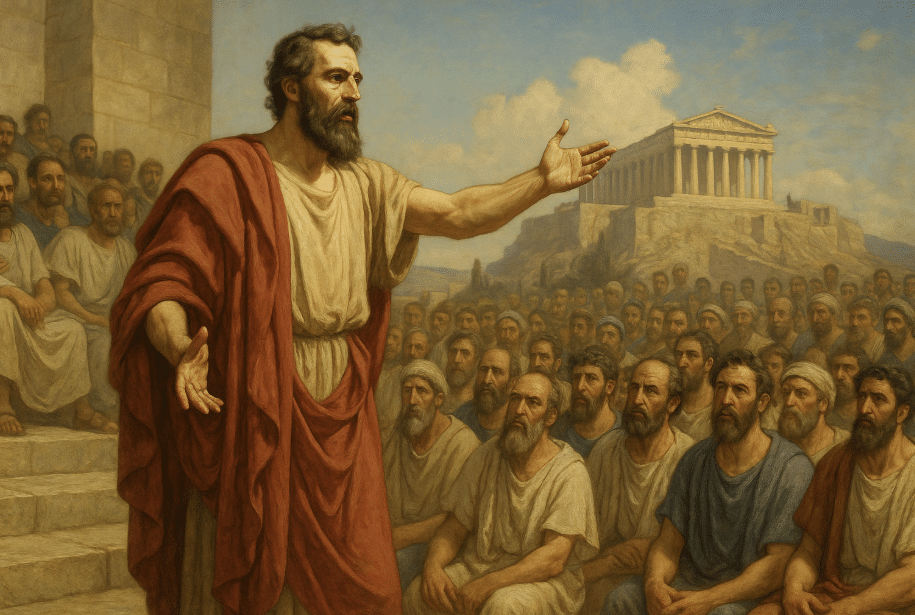
Isagoras faced the wrath of the Athenians
However, Isagoras had made a fatal miscalculation, forgetting that Athens was not just any city but one of Greece’s most powerful settlements, with citizens proud enough to recognize that this abomination would not be tolerated.
The demos—Greek for “the people,” the ordinary citizens—had already experienced some degree of influence, and they weren’t about to hand it back to an oligarch supported by a Spartan king. When Isagoras and his foreign backers tried to seize control of the city, the Athenians erupted. The Council of the 500 refused to be abolished and, as the historian Herodotus recorded, the people rose in unified rage against the coup.
Ordinary citizens swarmed the Acropolis, armed with the tools of their everyday labor, transforming the event into a momentous revolution. They trapped Isagoras and his Spartan supporters there, holding them captive for two days. The Athenians had successfully expelled a would-be tyrant and the army of their most formidable enemy.
Cleomenes, the now-humiliated Spartan king, was forced to cut a deal to get his men out of Athens alive. Isagoras’ local cronies weren’t so lucky, however; they were rounded up by the enraged Athenians and executed. The people had won—not with ballots but with sheer wrath. Their first act following these chaotic days was to call Cleisthenes home to Athens.
He returned to a city that had fought for the people’s rights, and he knew this victory couldn’t just be about him. It had to be about reforming the system for good and giving the people the voice they deserved. To ensure no one could ever provoke chaos like Isagoras had again, Cleisthenes dismantled every cohesive element that kept the aristocrats united and powerful in ancient Athens.

His solution was to completely redraw the map of Athenian society, abolishing the old clan-based system and organizing citizens into ten new tribes based solely on geography and residence. Suddenly, neighbors mattered more than distant, powerful cousins who had once been noblemen. This fundamental rewiring of Athens and its identity laid the foundations for a system that would revolutionize the world.
He then reformed and created a new council, this time with 500 members, chosen by lottery rather than aristocratic background: 50 people from each of the ten new tribes of the city. Power was no longer concentrated in the hands of the few but in the hands of the many.
In the end, the clash between Isagoras and Cleisthenes reveals a simple, brutal truth: democracy is almost never handed down by those in power. It’s usually seized from below, often through sheer force. While Cleisthenes is credited as its “father,” the true heroes may well be the thousands of nameless Athenians who stood on the Acropolis, refusing to let a few men decide their city’s future.
See all the latest news from Greece and the world at Greekreporter.com. Contact our newsroom to report an update or send your story, photos and videos. Follow GR on Google News and subscribe here to our daily email!

