



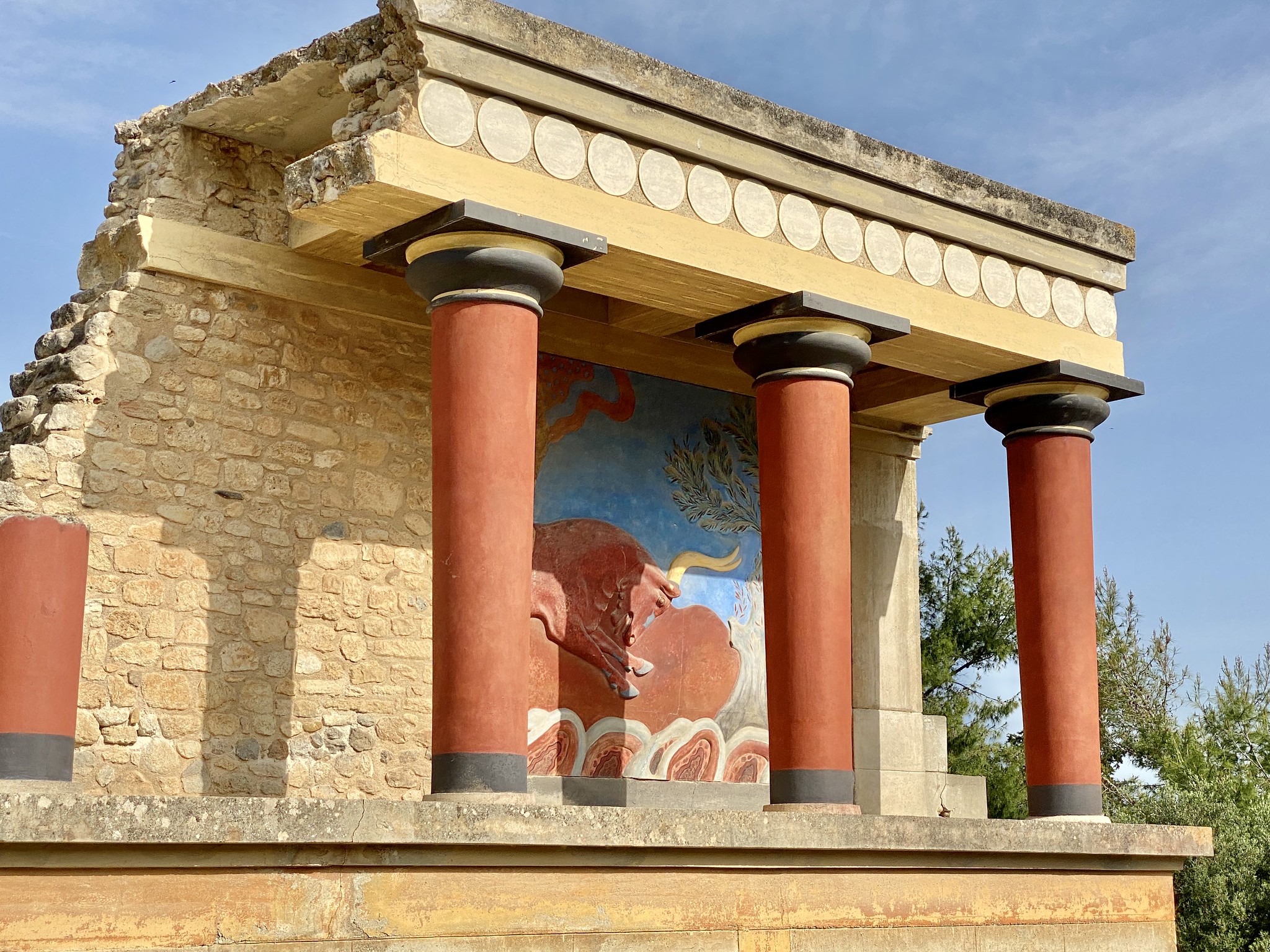
According to Greek mythology, King Minos was a powerful king of Crete in the distant past. He appears in some of the most famous Greek myths, such as the story of Icarus. Because of his name and the time and place during which he ruled, it is easy to assume that he was a Minoan king. Indeed, many modern sources confidently state that King Minos ruled over the Minoans. However, does the evidence really support that conclusion?
The connection between King Minos and the Minoans
The similarity between “Minos” and “Minoan” is not coincidental. British archaeologist Sir Arthur Evans (one of the first to investigate the Minoan civilization, after Greek archaeologist Minos Kalokairinos uncovered the first substantial evidence for the Palace of Knossos) specifically gave the civilization this name in honor of the legendary king of the island.
Given the power and prominence of King Minos in the legendary history of Crete, it was easy to assume that this newly-discovered mighty civilization must have been his. Thus, the civilization was given the name “Minoan” specifically in his honor.
Another factor that may have contributed to the assumption that King Minos must have been from this pre-Greek civilization is the fact that the legends present him as an enemy of Athens. This may, superficially, make it appear as if King Minos himself was not a Greek. In any case, Minos was assumed to belong to this Bronze Age Cretan civilization. Hence, this is why it came to be known as “Minoan.”
The issue with this connection
Despite this traditional connection, the evidence does not support the idea that King Minos was a Minoan king. Why might that be? The reason is that the Mycenaean Greeks conquered the island of Crete in the fifteenth century BCE.
While some modern scholars dispute such a conclusion, the evidence firmly supports it. In the fifteenth century BCE, there is evidence of widespread destruction of the main administrative centers of Crete. Mycenaean material culture appeared widely on the island at the time. The script of the island suddenly shifted from Minoan Linear A to Greek Linear B.
Therefore, the evidence is clear that from about the mid-fifteenth century BCE onwards, the Minoans were no longer supreme on Crete. Their civilization did continue for several centuries thereafter. However, the rulers of the main administrative centers, such as the prominent city of Knossos, were the Greeks from that point onwards.
Why Minos cannot have been a Minoan king
With this in mind, the question of when King Minos lived is vitally important. Did he live before the mid-fifteenth century BCE or after? Perhaps the easiest way of establishing the answer to this is by dating him relative to the Trojan War.
One of King Minos’ most prominent enemies was Theseus of Athens. Theseus, in turn, was the father of one of the kings of Athens at the time of the Trojan War. Therefore, King Minos was evidently of the generation prior to that event.
The traditional date of the Trojan War is c. 1200 BCE. Some researchers, such as Egyptologist David Rohl, place it as late as the ninth century BCE. In fact, there is even some evidence that it could have occurred as late as the century after that.
However, whatever the case, the Trojan War definitely occurred long after the Mycenaeans had conquered Crete. On this basis, King Minos would definitely have been a Greek king rather than a Minoan one. This is made especially clear by the fact that Minos is specifically associated with Knossos. His being the most prominent king over Crete also makes this certain.
See all the latest news from Greece and the world at Greekreporter.com. Contact our newsroom to report an update or send your story, photos and videos. Follow GR on Google News and subscribe here to our daily email!

