



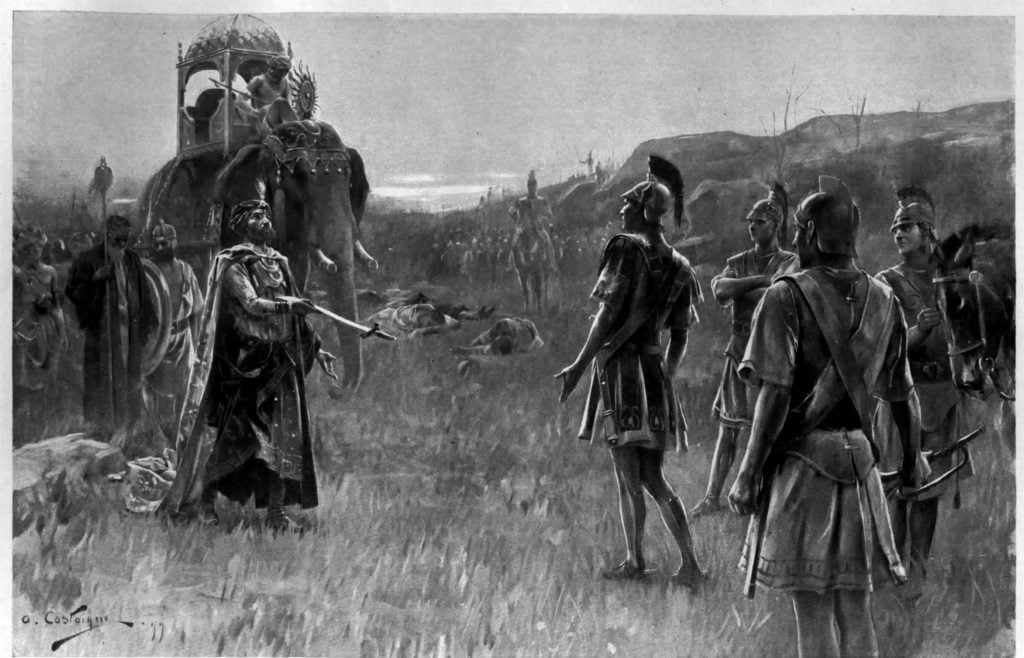
When Alexander the Great’s army reached the Hydaspes River in the Punjab in 326 BC, it found an Indian king waiting on the far bank with a line of war elephants. That king was Porus and the ancient historians who described the campaign agreed on one striking detail: he was an exceptionally large man who rode into battle on an elephant that suited his size.
The battle that followed was among the hardest of Alexander’s Asian campaign, and its aftermath produced one of the best-known scenes in his story.
Who was Porus?
Porus ruled the region between the Hydaspes and Acesines rivers, today the Jhelum and the Chenab, in what is now Pakistani Punjab. His realm is usually linked to the Paurava people.
Northwest India was not united when Alexander arrived. Its rulers were rivals, and some chose to deal with the invader. The ruler of Taxila, known to the Greeks as Taxiles, submitted and kept his throne. Porus chose to resist.
How tall was Porus, really?
The Greek and Roman writers measured Porus in cubits, a unit based on the length of the forearm. Arrian, who wrote in the second century AD and drew on accounts by Alexander’s officers Ptolemy and Aristobulus, says his stature “reached somewhat above five cubits.” Diodorus Siculus also gives five cubits and adds that his chest was twice as broad as those of his strongest soldiers. Plutarch, writing that “most historians agree,” gives a smaller figure: four cubits and a span, the span being the width of an outstretched hand.
The Roman historian Curtius Rufus gives no number, writing only that Porus was of rare size, almost beyond human scale, and that his towering elephant made him look bigger still.
Converting these figures is the problem. There was no single ancient cubit; its length varied by place and period. The editors of the standard Loeb translations reckon a cubit at a foot and a half, which makes five cubits about 7.5 feet and Plutarch’s figure about 6 feet 9 inches. Modern estimates such as 218 centimeters (about 7 feet 2 inches) rest on similar assumptions about which cubit the writers meant. Some scholars have argued that a shorter cubit was in use, which would bring the numbers down.
There is also reason for caution. A towering opponent made Alexander’s victory more impressive, and every surviving account comes from the winning side’s tradition, written centuries later. The fairest conclusion is that Porus was very likely an unusually tall and powerfully built man, but his exact height cannot be known.
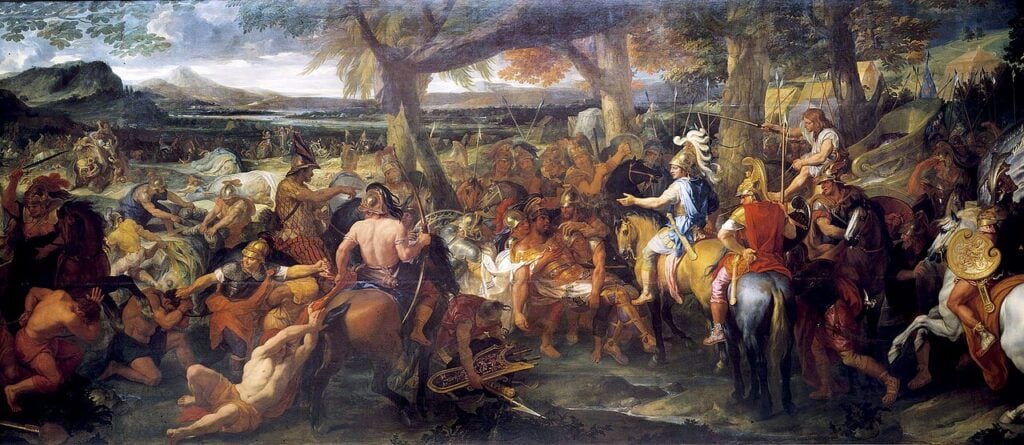
The Battle of the Hydaspes
Porus held the crossing with a large army. Arrian lists 4,000 cavalry, 300 chariots, 200 elephants and 30,000 infantry in the force he led into battle. Diodorus gives a larger infantry total and 130 elephants. Arrian explains that the river was running high, swollen by melting mountain snows and seasonal rains.
Alexander used repeated feints along the bank to wear down the watching Indians, then crossed with part of his army on a dark and stormy night. Plutarch, citing Alexander’s own letters, describes rain, thunder and a flooded channel that the troops had to wade through.
On the plain, Alexander’s tactics concentrated his attacks on the flanks while the phalanx held off the elephants massed in Porus’s center. Against these war elephants, the sarissa, the phalanx’s long pike, proved effective.
Porus did not flee when his army broke. Curtius describes him, already wounded nine times, still hurling javelins from his elephant. Arrian says Alexander first sent Taxiles, Porus’s rival, to urge surrender, and that Porus yielded only when an old friend named Meroes was sent.
The famous meeting
In Arrian’s version of the meeting that followed, Alexander asked how Porus wished to be treated, and Porus replied, “Treat me, Alexander, in a kingly way!” Plutarch gives the same answer in shorter form, “Like a king,” and adds that Porus said those words contained everything.
Curtius tells it differently. Porus says he had thought no one braver than himself until the battle proved otherwise, and, asked what the victor should do, tells Alexander to remember how quickly fortune can turn.
These scenes should be read with care. All four accounts were written roughly three to five centuries after the battle, and ancient historians often polished speeches. The sources do agree on the outcome. Alexander left Porus in power and added territory to his kingdom, and Plutarch says he gave him the title of satrap, or provincial governor.
Aftermath and legacy
Alexander’s horse, Bucephalus, died around this time, and Alexander founded a city named after him near the battlefield.
The Hydaspes also marked the edge of Alexander’s ambitions in India. At the Hyphasis River, now the Beas, the exhausted Macedonians refused to go further east. After the officer Coenus spoke for the troops, Alexander turned back. Porus remained in place as ruler under Macedonian authority.
His later fate is less clear. Diodorus records that after Alexander’s death in 323 BC, a Macedonian commander named Eudamus treacherously killed Porus and took his elephants. The exact date is uncertain, and modern estimates place it between 321 and 315 BC.
In the Greek tradition, Porus became the model of the noble opponent: brave in defeat and proud before the conqueror. Giant or not, he is remembered as the enemy Alexander respected most.
See all the latest news from Greece and the world at Greekreporter.com. Contact our newsroom to report an update or send your story, photos and videos. Follow GR on Google News and subscribe here to our daily email!

