



Few living organisms on Earth have witnessed as much history as the olive tree. Across Greece and the Mediterranean, ancient olive trees have survived wars, invasions, earthquakes, droughts, wildfires, and the rise and fall of civilizations. Some were already centuries old when the Roman Empire flourished, while others are believed to have been standing when classical Greece reached its height.
Their extraordinary longevity has fascinated scientists, historians, and farmers for centuries. Although determining the exact age of ancient olive trees is often difficult because their oldest wood gradually decays, researchers agree that olive trees are among the world’s longest-living fruit-bearing plants. Some specimens in Greece are widely estimated to be more than 2,000 years old—and they continue to produce olives today. So what makes the olive tree so remarkably resilient?
A master of survival
Unlike most trees, olive trees evolved in one of the world’s harshest agricultural environments. The Mediterranean climate is characterized by long, dry summers, poor rocky soils, and periodic droughts, conditions that would kill many other species.
Instead of growing quickly, olive trees grow slowly, investing their energy in developing exceptionally dense wood and an extensive root system that allows them to survive prolonged periods with little rainfall.
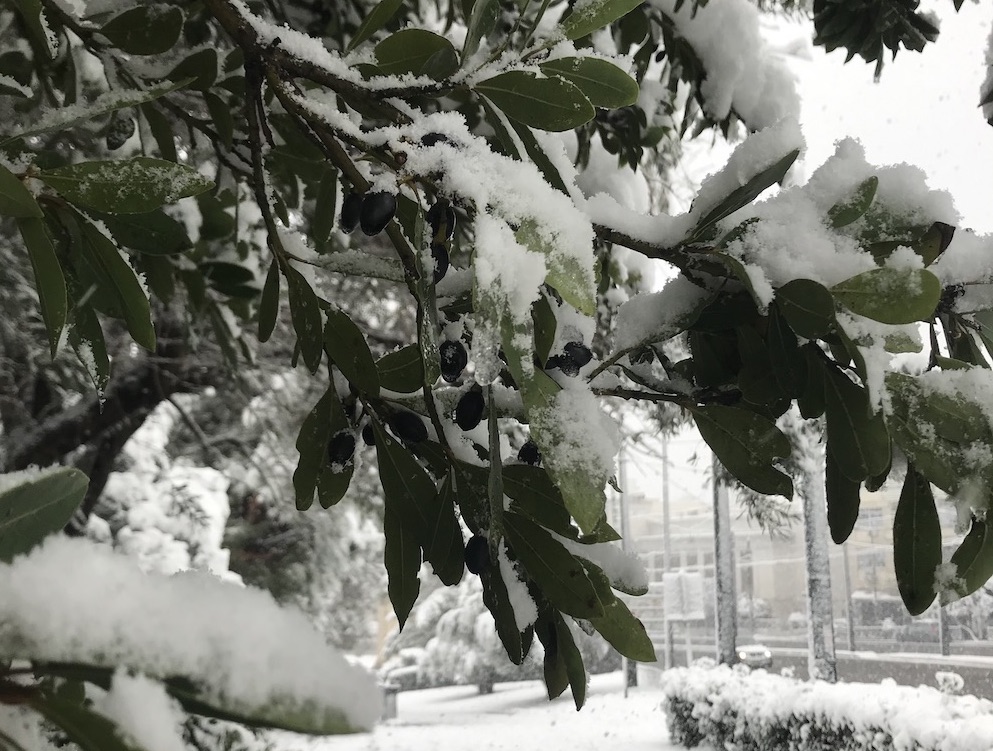
Their slow growth is one of the secrets to their longevity. Trees that grow rapidly often exhaust themselves earlier, while olive trees build strength gradually over centuries.
Olive trees rarely die completely
Perhaps the olive tree’s most remarkable adaptation is its ability to regenerate. Even when the trunk appears dead, new shoots can emerge from the roots or the tree’s base. In many cases, what appears to be a centuries-old trunk is actually part of a continuous cycle of renewal, with younger wood replacing older sections while the root system remains alive.
This regenerative ability allows olive trees to recover from storms, disease, severe pruning, and even devastating fires. The resilience of these ancient trees became evident during the catastrophic wildfires that swept across the Greek island of Evia in 2021. Although thousands of olive trees were scorched, many later showed signs of recovery as new shoots emerged from trunks that initially appeared destroyed. Greek Reporter previously documented how an ancient olive tree believed to have been lost in the fires began showing new life months later.
Fire is not always the end
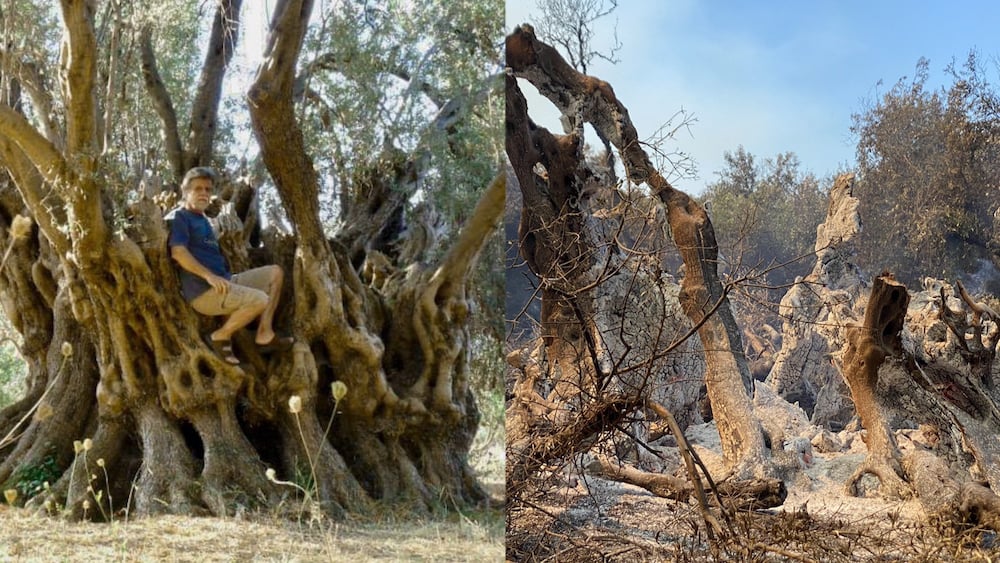
Wildfire has shaped Mediterranean landscapes for thousands of years, and olive trees have adapted accordingly. Their thick bark provides some protection against heat, while dormant buds hidden beneath the bark and underground can activate after fire passes.
Although severe fires can kill individual trees, many survive by producing vigorous new growth from the remaining living tissue. This remarkable ability explains why olive groves have persisted across southern Europe despite centuries of recurring fires.
A root system built for endurance
Much of an olive tree’s strength lies beneath the surface. Its roots spread widely through rocky ground in search of moisture, allowing the tree to survive long dry periods with minimal rainfall.
Unlike shallow-rooted species that depend on regular water supplies, olive trees can exploit tiny pockets of moisture deep within fractured limestone and other rocky soils common throughout Greece. Their roots also store energy reserves, enabling trees to recover after damage or environmental stress.
Nature’s own defense system
Olive trees possess another important advantage: natural resistance. The wood contains compounds that help defend the tree against fungi, insects, and decay. While olive trees are not immune to disease, they are considerably more durable than many other fruit trees.
The combination of dense wood, slow growth, and chemical defenses dramatically slows the aging process. Scientists continue studying these natural compounds, some of which also contribute to the health benefits associated with olive oil.
Why ancient olive trees are difficult to date
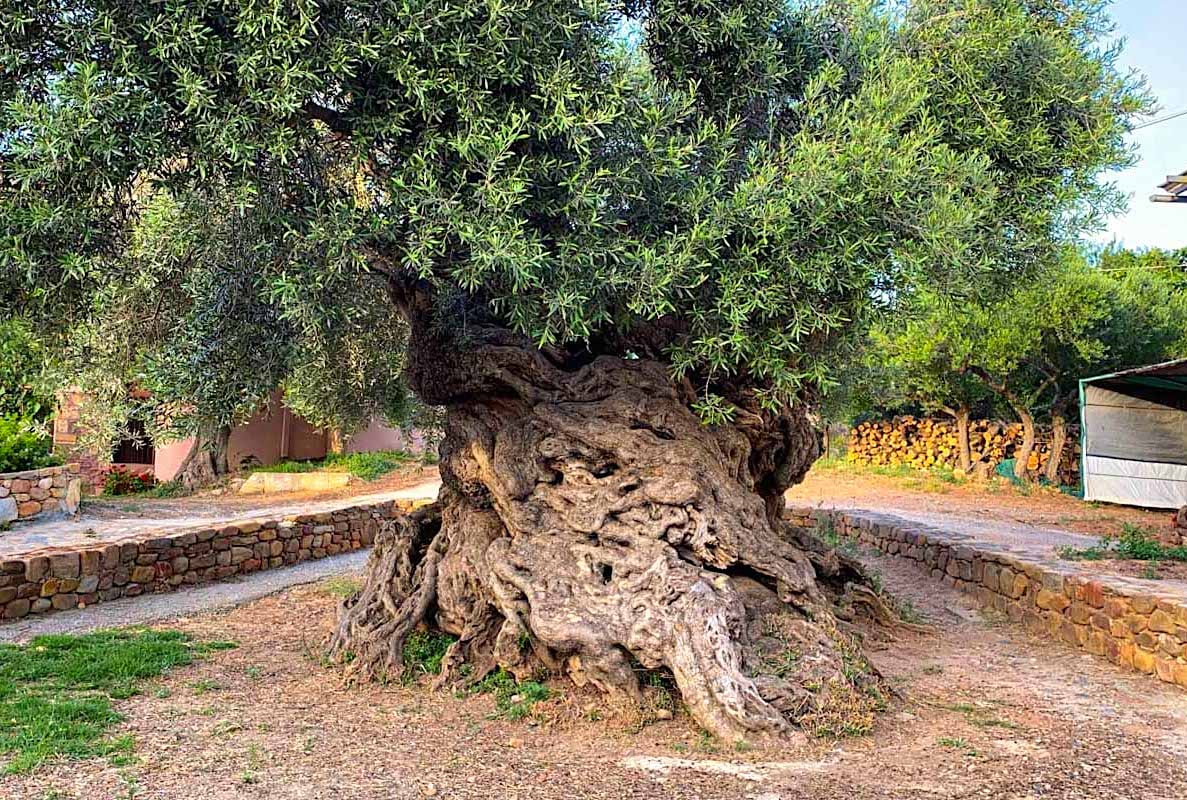
Determining the exact age of ancient olive trees is surprisingly complicated. Unlike oak or pine trees, olive trees gradually lose their central heartwood as it decomposes over time. This makes traditional tree-ring counting impossible for many ancient specimens.
Instead, researchers combine radiocarbon dating, historical records, growth modeling, and genetic analysis to estimate age. As a result, many famous olive trees are described as being estimated to be between 2,000 and 4,000 years old rather than assigned an exact age.
Even when scientists disagree on precise dates, they agree on one point: olive trees are among the oldest continuously productive fruit trees on Earth.
Greece’s extraordinary ancient olive trees
Greece is home to some of the world’s most remarkable olive trees. Among the best known is the Olive Tree of Vouves in Crete, widely regarded as one of the oldest living olive trees on Earth. Although researchers debate its precise age, estimates often exceed 2,000 years, and the tree still produces olives today. Greek Reporter recently explored the remarkable history of the ancient Cretan tree and the scientific efforts to understand its age.
Another remarkable survivor is Evdokia, a 1,200-year-old olive tree on the island of Corfu. Despite more than a millennium of storms, changing empires, and human history, the tree continues to bear fruit, demonstrating the extraordinary resilience that has made olive trees legendary throughout the Mediterranean.
These living monuments are more than botanical curiosities. They are witnesses to history, connecting modern Greece with generations stretching back to antiquity.
Sacred in Ancient Greece
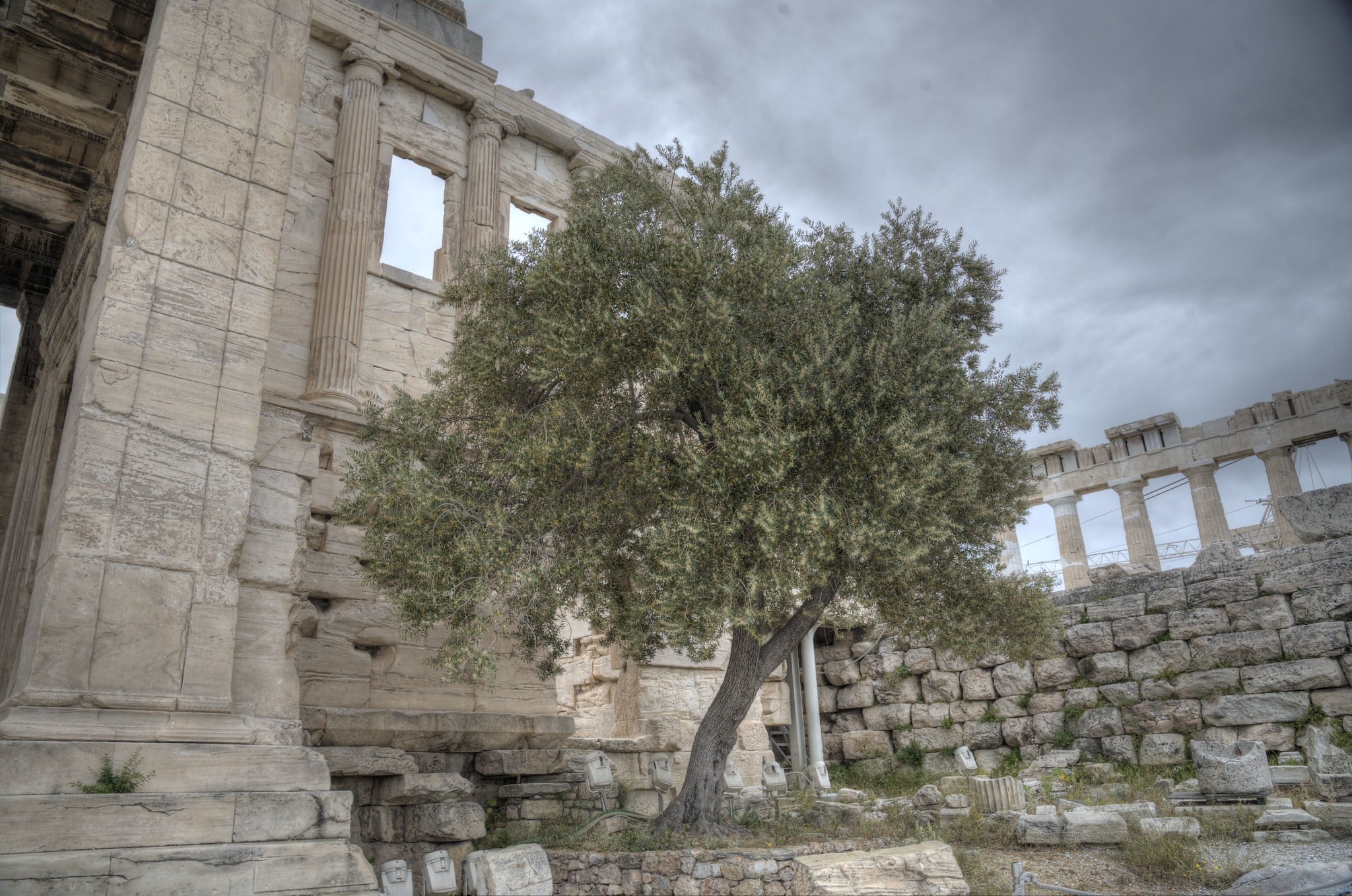
The olive tree occupied a unique place in ancient Greek civilization. According to mythology, the goddess Athena won the patronage of the city of Athens by presenting its people with the first olive tree, offering food, oil, wood, and prosperity. The Athenians considered the gift more valuable than Poseidon’s spring of saltwater, naming the city after the goddess.
The sacred olive trees of Athens, known as the Moriai, were protected by law, and damaging them carried severe penalties. Olive oil illuminated homes and temples, athletes were crowned with olive wreaths at the Olympic Games, and victorious competitors received amphorae filled with valuable olive oil as prizes.
The tree became a symbol of peace, wisdom, endurance, and prosperity—qualities that still define it today.
A tree built for the future
Scientists continue studying ancient olive trees not only because of their remarkable lifespan but also because they may offer insights into agriculture in a changing climate.
Their ability to tolerate drought, regenerate after fire, and remain productive for centuries has made them increasingly valuable as Mediterranean regions face rising temperatures and more frequent extreme weather.
Researchers are examining ancient olive genetics to better understand disease resistance, climate adaptation, and sustainable farming practices that could benefit future generations.
More than a symbol
The olive tree’s extraordinary lifespan is no accident. It is the result of millions of years of adaptation, allowing it to endure conditions that would destroy many other species.
Its slow growth, powerful root system, ability to regenerate, natural defenses, and remarkable resilience have enabled it to survive for centuries—and in some cases, millennia.
That is why some of Greece’s ancient olive trees continue producing fruit long after the civilizations that first cultivated them disappeared, standing today not only as symbols of Greek heritage but also as some of nature’s greatest survivors.
See all the latest news from Greece and the world at Greekreporter.com. Contact our newsroom to report an update or send your story, photos and videos. Follow GR on Google News and subscribe here to our daily email!

