



Throughout ancient times, assassinations often reshaped entire civilizations. A single blade could destroy dynasties, ignite wars, alter religions, and redirect empires. Ancient politics rarely separated power from violence. Kings, generals, and reformers constantly faced conspiracies from rivals, ambitious officers, or ideological enemies.
However, some assassinations changed far more than governments and actually transformed the future of the Mediterranean world itself.
Philip II among the world’s stories of ancient assassinations and the rise of Alexander
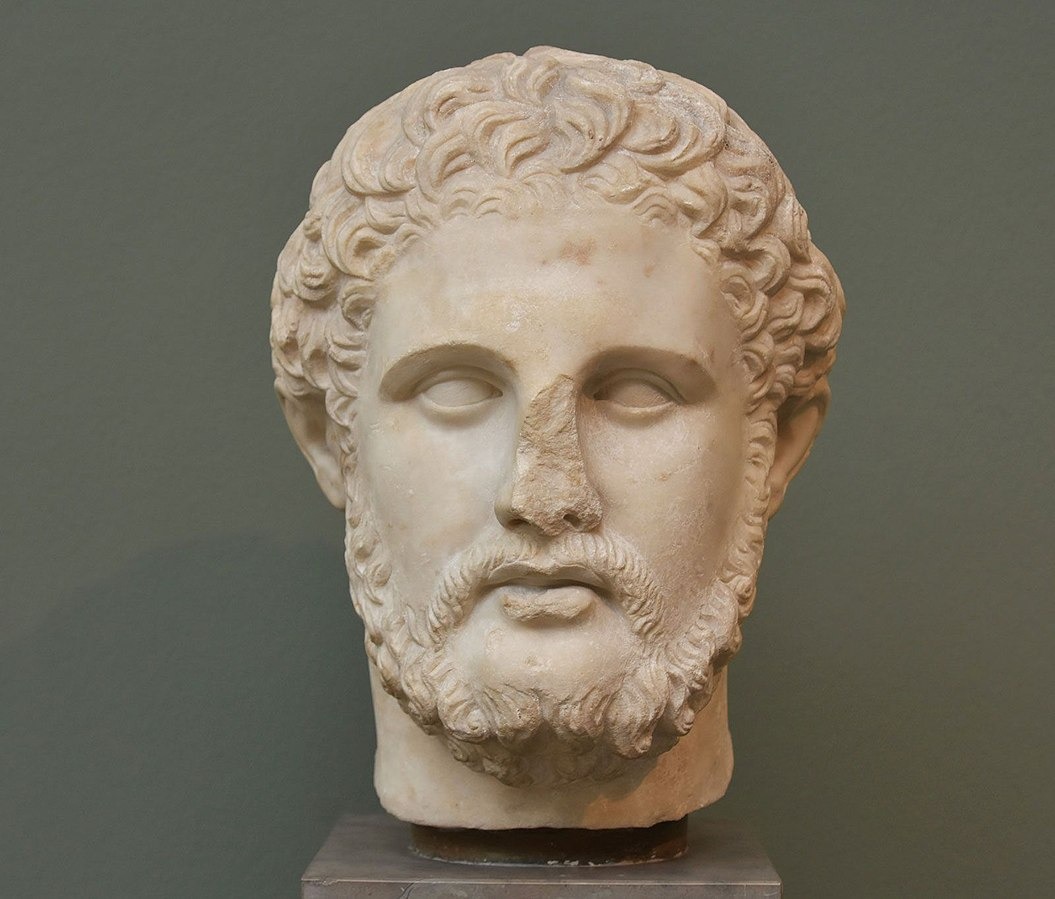
In 336 BC, Philip II of Macedon stood at the height of his power. Through military reforms, diplomacy, and conquest, he transformed Macedonia into the dominant force of Greece, defeating the Greek city-states at Chaeronea and establishing the League of Corinth under Macedonian leadership.
Philip also prepared a massive campaign against the Persian Empire. For the first time in history, a united Greek force planned to invade Asia under one command. However, before the campaign began, tragedy struck.
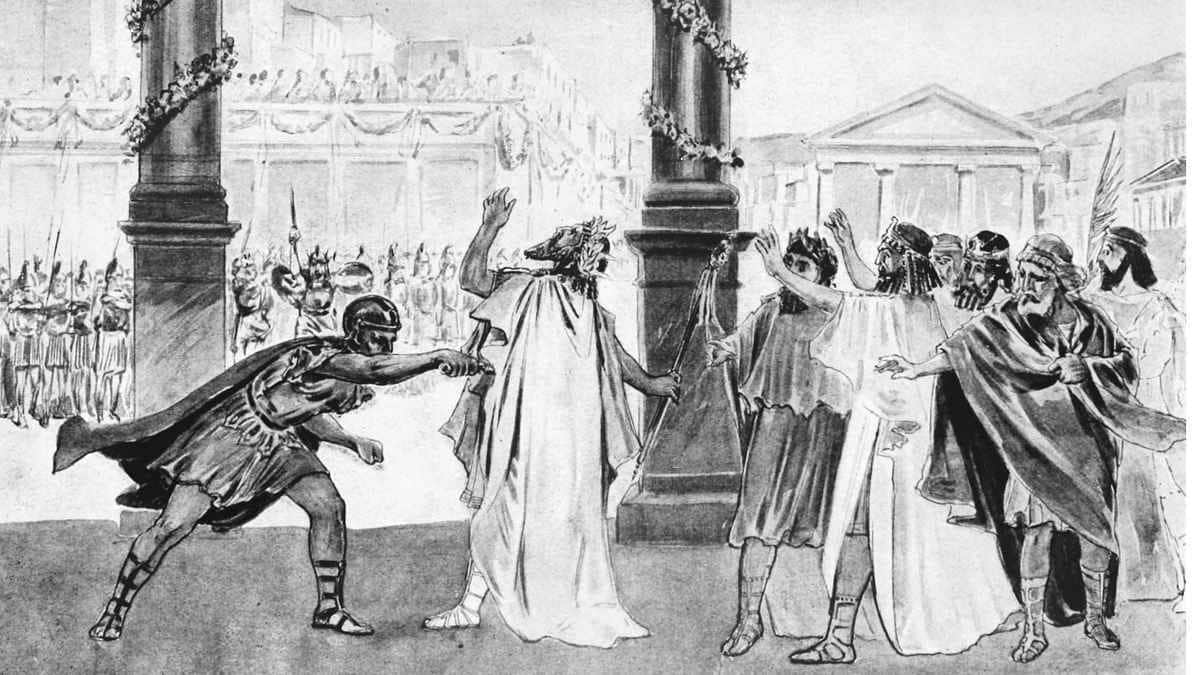
During celebrations at Aegae, the royal capital of Macedonia, the nobleman Pausanias assassinated Philip right before the assembled court. Ancient historians such as Plutarch still debate the deeper motives behind the murder. Some suspected personal revenge, while others suspected wider political conspiracies involving Olympias or even Alexander himself. Regardless of the motive, Philip’s death transformed world history.
Alexander III immediately inherited the throne. Many enemies expected the young king to fail. Instead, Alexander launched one of the greatest military campaigns in history. Within a decade, he destroyed the Persian Empire and spread Greek culture from Egypt to India. Without Philip’s assassination, Alexander’s rise may never have unfolded in the same way. Philip likely would have led the Persian campaign himself and shaped a very different Hellenistic world. Thus, a single murder led to the age of Alexander and the Hellenistic civilization that followed.
The assassination of Seleucus Nicator
After Alexander’s death, his generals divided the empire among themselves. Among the most successful successors stood Seleucus I Nicator. Through decades of warfare, diplomacy, and strategic brilliance, Seleucus established the vast Seleucid Empire, stretching from Syria to Mesopotamia and Persia. By 281 BC, Seleucus had become the most powerful surviving successor of Alexander.
However, victory soon turned into catastrophe. Ptolemy Ceraunus, a Macedonian prince seeking power, gained Seleucus’ trust after fleeing political struggles in Egypt. Seleucus welcomed him and treated him generously. Soon afterward, Ptolemy Ceraunus unexpectedly assassinated Seleucus. The murder shocked the Hellenistic world. Seleucus had nearly reunited Alexander’s empire after defeating Lysimachus. His death destroyed that possibility permanently.
Ptolemy Ceraunus briefly seized Macedon, yet his rule quickly collapsed during Celtic invasions. Meanwhile, the Seleucid Empire entered a long period of instability. This assassination therefore prevented the emergence of a renewed unified Hellenistic empire in the ancient world. Instead, fragmentation and dynastic conflict persisted across the Eastern Mediterranean.

Hipparchus and the fall of tyranny in ancient Athens
The assassination of Hipparchus in 514 BC resulted in significant political consequences for Athens. Hipparchus belonged to the Peisistratid dynasty, which ruled Athens following the tyranny of Peisistratus.
Although Ancient Greeks later celebrated Harmodius and Aristogeiton as tyrant-slayers, the situation proved more complex. Hipparchus himself did not rule alone. His brother Hippias remained the actual head of the regime. Nevertheless, the assassination deeply destabilized the Peisistratid government.
According to tradition, Harmodius and Aristogeiton killed Hipparchus during the Panathenaic festival after personal insults and political tensions. Athenians later transformed the pair into symbols of liberty and resistance against tyranny. After Hipparchus’ death, Hippias became increasingly harsh and suspicious. His regime lost support, and opposition intensified. Eventually, Spartan intervention expelled Hippias from Athens.
This political collapse opened the path for Cleisthenes and his democratic reforms. Cleisthenes reorganized the political structure of Athens, weakened aristocratic factions, and expanded civic participation. His reforms laid the foundation for classical Athenian democracy. The assassination of Hipparchus therefore indirectly helped establish the ancient Athenian democratic system that later shaped political thought.

Ancient Rome’s Julius Caesar
Few ancient assassinations influenced history more dramatically than that of Julius Caesar. By 44 BC, Caesar dominated Roman politics entirely. After defeating Pompey and winning the civil war, he achieved extraordinary authority. The Senate named him dictator for life, and many Romans feared the destruction of the Republic. A group of senators therefore organized a conspiracy against him.
Leaders of the plot included Brutus and Cassius, both of whom connected personally and politically to Caesar. On the Ides of March, the conspirators surrounded Caesar within the Senate house and repeatedly stabbed him. Although the assassins believed they had defended Roman liberty, they actually unleashed another devastating civil war, as Caesar’s death allowed his adopted heir Octavian (later Augustus) to rise to power. After defeating Antony and Cleopatra, he established the Roman Empire and ended the Republic permanently.
Ironically, the murder intended to preserve republican government accelerated its destruction. The consequences radiated far beyond Rome itself, and the Roman Empire later shaped European law, language, architecture, religion, and political culture for centuries. The assassination of Caesar hence altered the future of the entire ancient world.

The account of Julian the Apostate among stories of ancient assassinations
The death of Julian the Apostate in 363 AD transformed the religious future of the Roman Empire. Julian, nephew of Constantine the Great, rejected Christianity and attempted to restore traditional Greco-Roman religion. As a result of his efforts, later Christian writers labeled him “the Apostate.”
Unlike earlier pagan emperors, Julian pursued an organized intellectual and religious revival of Hellenism. He reopened temples, restored sacrifices, supported pagan philosophers, and attempted to weaken Christian political influence. Julian also admired Greek philosophy deeply, particularly Neoplatonism, and he envisioned a spiritual restoration centered upon ancient religious traditions and Hellenic culture. Nonetheless, during his Persian campaign, Julian suddenly passed away after suffering a fatal wound in battle.
Ancient sources disagree about the exact circumstances. Some traditions have even claimed that a Christian soldier quietly assassinated him. Others describe his death as a battlefield casualty. Regardless of the exact cause, Julian’s death ended the pagan revival almost immediately. His successors restored Christian dominance fully, and over the following decades, emperors increasingly banned pagan worship, closed temples, and suppressed traditional religious practices.
Christianity eventually became the sole official religion of the empire. Therefore, Julian’s death marked a turning point in religious history. Had he survived longer, the spiritual future of Europe and the Mediterranean may have evolved quite differently.
See all the latest news from Greece and the world at Greekreporter.com. Contact our newsroom to report an update or send your story, photos and videos. Follow GR on Google News and subscribe here to our daily email!

