



The Ancient Greeks used apples as part of a love language that could be expressed in surprisingly inventive ways, including through the fruit itself.
Before Valentine’s Day cards or poetry became the dominant expressions of affection, the Greeks had a peculiar and unexpectedly tender ritual of courtship: tossing an apple at someone they desired. Being struck by one or catching it was understood as a declaration of love, while tossing it back signaled acceptance.
At first glance, it may sound playful or even a bit absurd. Yet it was a courtship game that moved easily between the gymnasium and the orchard, far beyond a quaint village custom. Beneath the surface, however, it drew on layers of Greek mythology, symbolism, and social meaning that transformed the humble apple into one of the most emotionally charged objects in the Ancient Greek world.
Apples as symbolic of Eros among the Ancient Greeks
To understand why an apple could carry the weight of a marriage proposal, it is necessary to first grasp what the apple represented to the Greeks. It signified far more than an ordinary piece of fruit. The apple (melon, μήλον) was sacred to Aphrodite, the goddess of love and beauty. It was closely associated with fertility, desire, and the transition from girlhood to womanhood. When a young woman received an apple, she was receiving something that belonged to the divine realm of Eros itself.
This symbolism of apples appears repeatedly in Ancient Greek literature. In The Idylls of Theocritus, a lovesick shepherd laments that the girl he admires refuses to acknowledge his gift of apples. Sappho, meanwhile, evokes the image of an apple high on a branch—untouched, perfect, and just out of reach—as a metaphor for a bride on her wedding day.
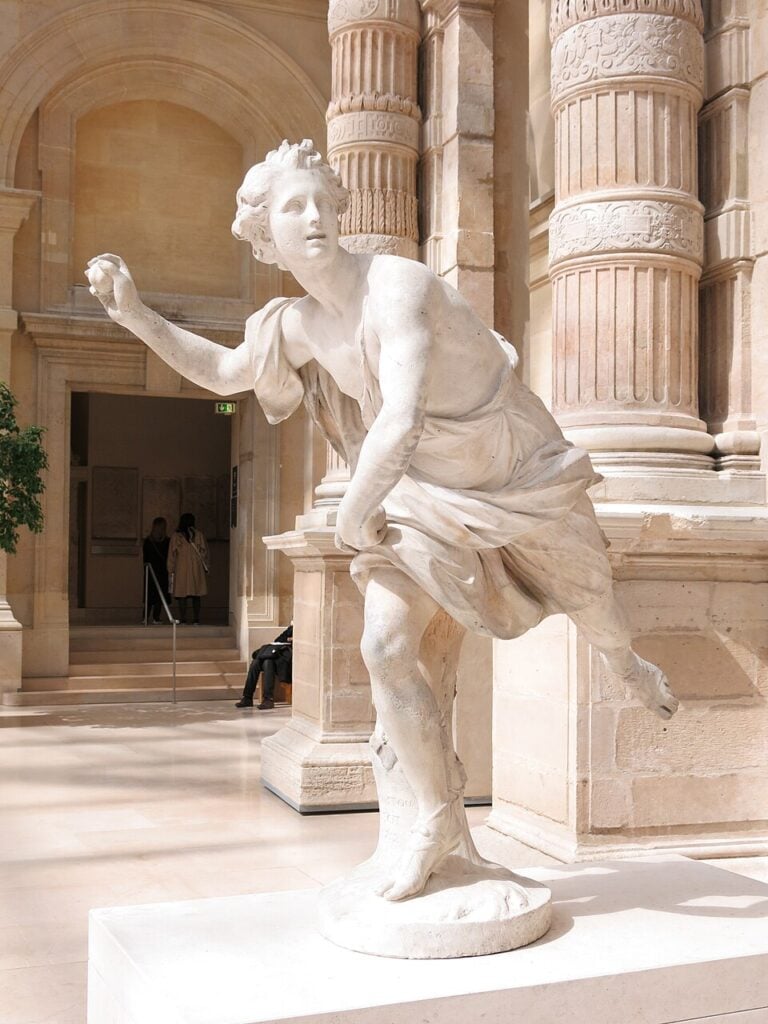
How did the Ancient Greeks use apples to propose?
The practice of using apples as a romantic gesture appears in several ancient sources, including the philosopher Theophrastus and Greek epigram poetry, where throwing an apple (ballein melon) functioned as a gesture of courtship or a subtle advance toward someone. It is important to note that this was not always literal. An apple placed at a woman’s feet or left at her doorway could serve the same purpose, making physical throwing unnecessary. What mattered was not the method but the shared understanding of the symbol itself.
In more formal settings, the exchange carried clear social weight. For a suitor to throw an apple to a woman in public was a recognizable declaration of intent, while her act of catching or returning it signaled acceptance. Refusing the apple was equally understood as rejection.
There is something strikingly elegant in this system. The Greeks established a form of communication in which both parties could respond without speaking, where a brief moment of motion and choice could determine the beginning of a shared life or its refusal. There were no words, no rings, no “I do” or “I don’t”—only an apple.
Atalanta, Paris, and the myth of the Golden Apple
The most famous apple-related episode in Greek mythology is also the most dramatic, namely the race of Atalanta. The swift-footed huntress vowed to marry only a man who could outrun her, with death as the consequence for failure. Hippomenes, with the help of Aphrodite, was provided with three golden apples from the Garden of the Hesperides. During the race, he rolled them across Atalanta’s path. Unable to resist stopping to pick them up, she fell behind and lost, allowing Hippomenes to win the race and claim her hand.
Another pivotal story is the Judgment of Paris in which an apple inscribed “for the fairest” was thrown into a divine banquet by Eris, the goddess of Discord. The ensuing rivalry between Hera, Athena, and Aphrodite led Paris to choose Aphrodite’s bribe, Helen of Sparta. This decision ultimately set the Trojan War in motion. A single piece of fruit, and the ancient world was never the same.
Together, these myths cemented the apple’s status as the ultimate object of desire in the imagination of the Ancient Greeks—beautiful beyond reason yet dangerous beyond measure. What the apple-tossing tradition, which has long since disappeared, ultimately reveals is that the Greeks understood something the modern world often forgets: objects can carry meaning that words sometimes struggle to convey.
See all the latest news from Greece and the world at Greekreporter.com. Contact our newsroom to report an update or send your story, photos and videos. Follow GR on Google News and subscribe here to our daily email!

