



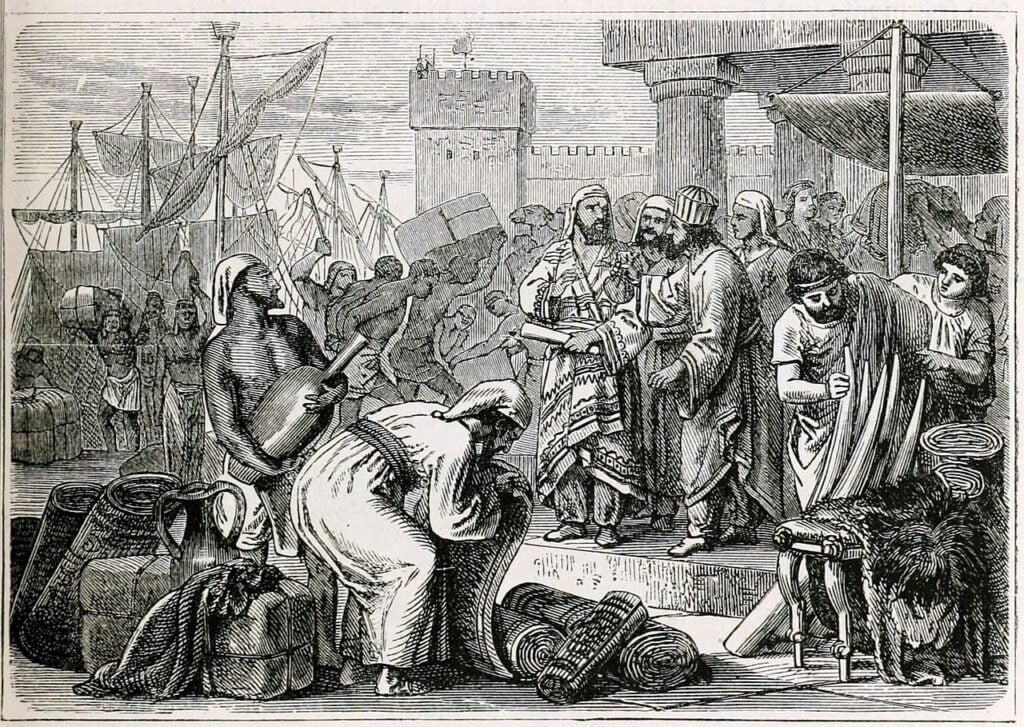
The ancient Greeks named the Phoenicians the “purple people” because of the rare purple dye they made out of snail shells, but they were much more than that: they were the Mediterranean seafarers who created the first alphabet
It was the Greeks who named the Mediterranean civilization Phoenicia (Φοινίκη) in the Late Bronze Age (1500-1200 BC). It was located in modern-day Lebanon and locals called their land Canaan and themselves Canaanites.
Herodotus described the Phoenicians as avid sailors, skilled merchants, technological innovators, and naval warriors. Homer’s literary depiction of them is that they were famous skilled sailors in the Mediterranean with posts reaching to modern-day Portugal and Spain and that they made beautiful textiles which they traded.
The Phoenicians were a Semitic people who originated in the Levant region, descendants from the Canaanite cultures that had existed there since at least 2000 BC. Their language, known as Phoenician, was closely related to Hebrew and Aramaic. Their major cities were Tyre, Byblos, and Sidon.
They were trading between Egypt, Mesopotamia, Anatolia and Greece. They traded timber, metals, and textiles across these regions. The Phoenicians established colonies throughout the Mediterranean, including Carthage in North Africa (modern Tunisia) and Gadir (Cádiz) on Spain’s Atlantic coast.
As skilled navigators and clever traders, the Phoenicians established colonies wherever they wanted. They traded with the Greek islands, across southern Europe, the Atlantic coast of Africa, and up to ancient Britain.
Their mastery of navigation allowed them to travel to distant ports and create an extensive trade network that enabled them to acquire goods from distant lands such as tin from Britain or gold from West Africa.
Developed City-States
Income from trade helped the Phoenicians build city-states and create an empire. Unlike other empires forged from wars, theirs was an empire built on trade. Phoenician city-states included Tyre which became prominent between the 9th and 6th centuries BC, and prestigious colonies around the Mediterranean Sea, such as Carthage and Leptis Magna.
Tyre came under Persian rule in 572 BC and was later conquered by Alexander the Great in 332 BC. The Roman historian Justin wrote that the original founders arrived from the nearby city of Sidon in search of a suitable place for a new harbor. Using the profits generated by trade, they overtook ambitious projects such as building a large temple complex dedicated to Melqart, the god of sea voyages.
Greek historian Herodotus, who visited Tyre in 450 BC, wrote in Histories that the priests told him the city was founded 2300 years earlier (in 2750 BC).

Byblos, located 30 km (19 miles) north of modern-day Beirut, is one of the oldest continuously inhabited towns in the world. It was occupied at least by the Neolithic Period (c. 8000–c. 4000 BC) and during the 4th millennium BC an extensive settlement developed there. It was the chief harbor for the export of cedar and other valuable wood to Egypt.
After the collapse of the Egyptian New Kingdom in the 11th century BC, Byblos became the foremost city of Phoenicia.
The Phoenician alphabet was developed at Byblos, and this is where almost all of the known early Phoenician inscriptions were found, most of them dating from the 10th century BC. By that time, the Sidonian kingdom, with its capital at Tyre, had become dominant in Phoenicia, and Byblos, though it flourished into Roman times, never recovered its former supremacy.

The Phoenician Alphabet’s Influence on the Greek Alphabet
The Phoenician alphabet was adopted and adapted by the Archaic Greeks in the 9th-8th century BC. It was picked up by the Phoenicians due to extensive commercial contacts between the two peoples.
The Phoenician alphabet, language, and culture were strongly influenced by Egypt, which controlled Phoenicia for an extensive period, as King Rib-Adda of Byblos admits in a letter to the pharaoh. The language is Canaanite and is related to Hebrew.
Before c.1000 BC, the Phoenician and Hebrew languages became distinct from the Aramaic spoken in Canaan. The Phoenician writing system was simple and easy to learn, and also very adaptable to other languages, quite unlike cuneiform or hieroglyphics.
Canaanite and Aramaic inscriptions have been discovered across the Mediterranean region. It became a hugely influential language, it was used to write the early Iron Age Canaanite languages such as Phoenician, Hebrew, Ammonite, Edomite, and Old Aramaic.
Its impact is partly due to its adoption of a regulated alphabetic script that was written from right-to-left, rather than in many directions. Its success is also in part due to Phoenician merchants using it across the Mediterranean world, which spread its influence outside the Canaanite sphere.

Only a few surviving texts written in the Phoenician language survive. Nevertheless, the Phoenician alphabet was adopted and adapted by various cultures, and eventually went on to become one of the most widely-used writing systems of the age.
See all the latest news from Greece and the world at Greekreporter.com. Contact our newsroom to report an update or send your story, photos and videos. Follow GR on Google News and subscribe here to our daily email!

