



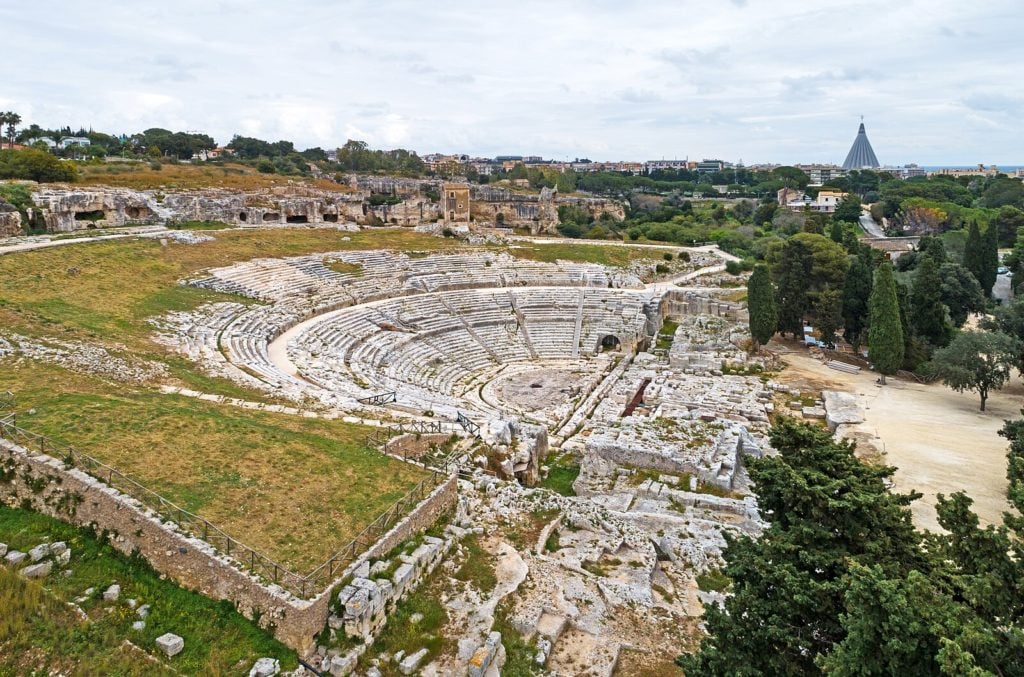
How could Euripides and a group of Athenian prisoners be tied to one of the greatest military disasters of Athens’ golden age? To understand it, we need to revisit one of Athens’ worst military catastrophes.
In 413 BC, in Syracuse, Sicily, that catastrophe unfolded in a single devastating stroke. A grand expedition to Magna Graecia, launched with the hope of expanding the Athenian empire and finally crushing Spartan resistance, was shattered against the rugged limestone cliffs of Syracuse. What was meant to be a masterful strategic move by the superpower of its time devolved into a graveyard for thousands of young men, leaving the remnants of a supposedly unstoppable armada to rot under the blazing Mediterranean sun.
The march to the quarries
The sheer scale of the disaster is difficult to overstate. The historian Thucydides famously described it as the most significant action of the war—glorious for the victors but absolute hell for the defeated. Following a disastrous final naval clash in the Great Harbor, the surviving Athenians were forced into a desperate retreat across the Sicilian interior. Hunted by Syracusan cavalry and baked by relentless heat, they were eventually captured. The victors then drove approximately seven thousand of these captives into the Latomiae, the deep, sheer-walled limestone quarries of Syracuse.
Inside, conditions were entirely hellish. Searing heat baked the prisoners by day, freezing chills set in at night, and the stench of unburied bodies permeated the air. With a daily ration of barely 250 milliliters of water and a handful of grain, the captives faced a grim reality. For most, the quarries became a slow, agonizing execution chamber.

The fascinating role of Euripides and the Athenian prisoners
What followed, however, took a remarkable and unexpected turn. While the Syracusans were brutal enemies, they were also deeply devoted to Greek culture, marked by a near-obsessive admiration for Athenian theater. In an era long before printed books, experiencing the latest tragedy from mainland Greece depended on oral transmission, often through fragments carried by merchants or sailors arriving from the East.
Among all the playwrights, Euripides was the undisputed favorite of the Syracusans. His dark, psychologically intense stories struck a profound chord with Sicilians, who lived on the edge of the Greek world but craved its sophisticated core. This cultural obsession created an extraordinary dynamic when guards standing over a pit of dying men realized a startling fact, namely that some of these starving prisoners knew the plays of Euripides by heart. Overnight, a soldier’s memory became vastly more valuable than his physical strength. The historian Plutarch recorded the remarkable phenomenon of men securing their freedom simply by reciting a few lines, possibly from Medea or a tragic monologue from Electra.
If an Athenian could perform these verses, Syracusan guards would pull them directly from the pit. Local families brought the captives into their homes, washing them and providing fresh clothes. Men who had recently been engaged in brutal warfare were suddenly sharing living rooms, united by a mutual appreciation for Greek poetry. In practice, some of these fortunate soldiers remained in Sicily for the rest of their lives. The most common occupation for them was as private tutors for wealthy families across Magna Graecia. Others were granted free passage back to Greece as a direct reward for their knowledge of Euripides’ works.
When the survivors eventually returned to Athens, tradition holds that they went directly to the home of Euripides. Falling at the elderly playwright’s feet in tears, they explained that his words, composed in the safety of his study, had served as their ransom in the darkest pits of the Mediterranean.
What is worth noting here is how shared culture can transcend geopolitical boundaries and enemy lines. The Sicilian disaster showed the ancient world how imperial overreach often ends in ruin. At the same time, it revealed how an appreciation of culture can occasionally overpower even the most ignoble instincts for revenge.
See all the latest news from Greece and the world at Greekreporter.com. Contact our newsroom to report an update or send your story, photos and videos. Follow GR on Google News and subscribe here to our daily email!

