



Long before caravels sailed the Atlantic and Europeans “discovered” America, ancient Greek philosophers had already traversed it in thought. They required neither compasses nor caravans. Instead, they relied on geometry, cosmology, and fearless reasoning. Through dialectical inquiry, they arrived at a striking conclusion: the world could not simply end at the western horizon.
For these thinkers, the Earth was a sphere. A sphere, by its nature, implies balance, proportion, and correspondence. If one inhabited region existed in one part of the globe, another must exist elsewhere—reason demanded it. In this way, centuries before Columbus, Greek philosophy had already conceptually opened the western ocean to the continent we now call America.
Plato and the geography of the “True Sea”
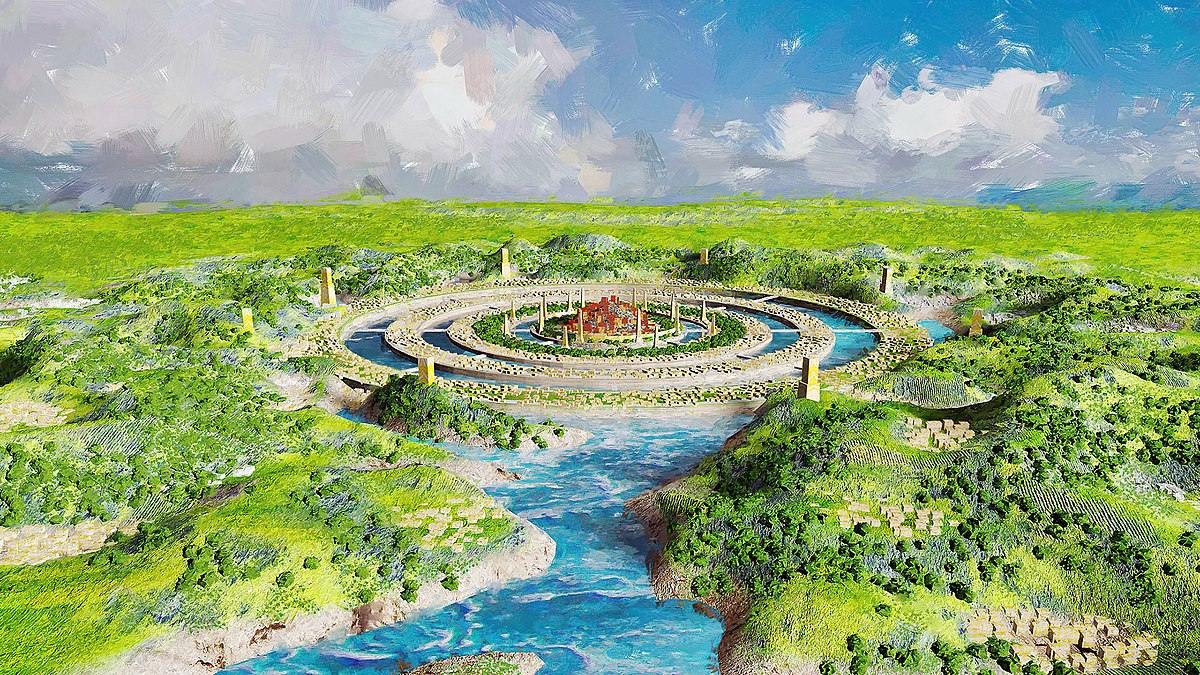
The most decisive passage appears in Plato’s Timaeus (24e–25a). In the dialogue, he describes a power that once advanced from the Atlantic Ocean against Europe and Asia. Plato explains that the Atlantic was navigable in antiquity. Before the strait known as the Pillars of Heracles, a vast island stood. From that island, travelers could reach other islands, and from those islands, they could access “the whole opposite continent” surrounding the “true sea.” The Greek text leaves little room for ambiguity:
“And from those islands one could pass to the entire opposite continent that surrounds that true sea.”
Plato clearly distinguishes the familiar Mediterranean from a much larger ocean. He differentiates between islands and a full continent, describing the latter as “opposite” (καταντικρὺ) to the known world. His language reflects structural reasoning rather than fantasy. Plato’s cosmology rests on the principle of spherical symmetry. In the Phaedo and other dialogues, he portrays the Earth as a rounded body suspended in perfect balance. Such a body requires proportional distribution. Land must correspond to land and ocean to ocean. The inhabited world cannot cluster irrationally in one corner.
By situating a vast continent beyond the Atlantic, Plato completes a geometric necessity. Atlantis functions as a mediator, a stepping-stone rather than a terminus. It does not exhaust the western horizon but opens it. In this sense, Plato is not speculating loosely. He integrates geography with metaphysics, and his reference to the “true sea” points to a scale far exceeding the confines of the Mediterranean.
Plutarch, the Cronian Sea, and Ogygia
In On the Face Which Appears in the Orb of the Moon, Plutarch offers a geographical account that warrants careful attention. His description unfolds in stages: Britain, Ogygia, three additional western islands, and finally, a vast mainland.
Plutarch locates Ogygia five days’ sail west of Britain, situating the island deep in the North Atlantic, far beyond the Irish Sea and into colder, remote waters. The name evokes antiquity and isolation, and its position aligns strikingly with what we now identify as Iceland. Beyond Ogygia, Plutarch describes three additional islands, evenly spaced and aligned with the summer sunset. According to researcher Minas Tsikritzis, this chain, following a logical westward progression, could correspond to Greenland, Baffin Island, and Newfoundland, forming a structured route toward the larger continental expanse beyond—the “opposite continent” that Plato had reasoned must exist.
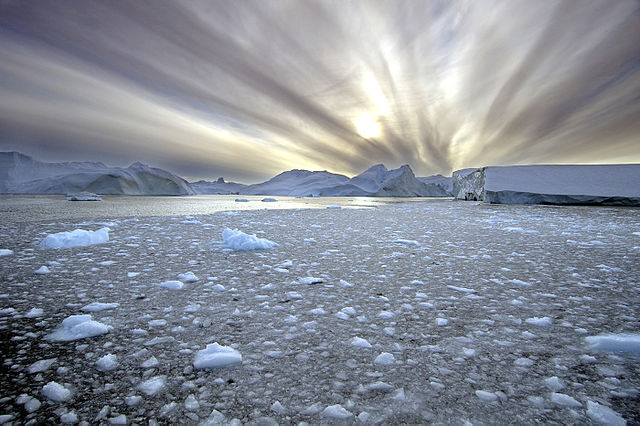
Plutarch then introduces the Cronian Sea, associating it with the god Cronos and situating it beyond the familiar Atlantic. He describes the waters as slow and muddy, caused by the heavy outflow of rivers from the great continent, which deposit sediment and complicate navigation. This description closely resembles the North Atlantic, influenced by Arctic currents and substantial continental river systems.
The Cronian Sea, therefore, points northward. Its mythic framing signals a liminal zone at the edge of the known world. In Plutarch’s account, Cronos sleeps bound in a cave of golden rock, attended by birds delivering ambrosia, filling the island with fragrance. This setting corresponds to a northern maritime region near the Arctic Circle. Given that the Ancient Greeks often associated Cronos with remote northern realms, the Cronian Sea strongly suggests the Arctic Ocean or its adjacent waters.
Comparison with Plato’s description
When comparing Plutarch with Plato, a clear convergence emerges. From Ogygia and the surrounding islands, travelers are said to reach a “great continent” encircled by a vast ocean. Plutarch emphasizes the immense scale of this landmass, noting its distance and the breadth of the surrounding waters. This continent is not depicted as a mere chain of islands; rather, it appears as a massive landmass beyond the Atlantic.
Similarly, in the Timaeus, Plato describes how one could travel from the Atlantic islands to the “entire opposite continent” around the “true sea.” Both Plato and Plutarch distinguish intermediary islands from the vast continent beyond, and both separate the Mediterranean from a larger ocean. Their geographical visions converge in remarkable ways.
The identification of this western continent with what we now call America rests on several cumulative markers. Both authors describe a continent rather than scattered islands and place it west of the Atlantic gateway. Both situate it opposite Europe and Asia. Plutarch even includes intermediary islands in the North Atlantic at distances consistent with Greenland and nearby regions.
Plutarch’s attention to ocean currents flowing from the great continent into surrounding seas also has geological resonance. North America discharges enormous volumes of freshwater into the Atlantic via major river systems. In this context, the slow, muddy waters that Plutarch describes align closely with Arctic and sub-Arctic maritime conditions, reinforcing the plausibility of a massive northern landmass in his account.
Olympiodorus and the logic of opposites
Late Neoplatonism further refined the cosmological argument. Olympiodorus, commenting on Plato, addresses the concept of the antipodes, stating: “He (Plato) contemplates the four divisions, since two of them are with us, Europe and Asia. Therefore, there are two others at the antipodes.”
The Neoplatonist Thomas Taylor preserved Olympiodorus’ commentary for modern readers, emphasizing that these “quarters” refer to inhabited zones within a larger planetary framework. If Europe and Asia occupy one inhabited region and Africa is already accounted for, then a corresponding quarter must exist on the opposite side of the globe.
This reasoning rests on spherical geometry. A sphere divides naturally into balanced sectors. Inhabitants cannot cluster arbitrarily. Symmetry requires correspondence, and the western quarter fulfills this geometric necessity. Importantly, this conclusion does not rely on sailors’ tales or anecdotal reports. It is a product of dialectical reasoning, proceeding from first principles: the Earth is a globe, a globe implies opposition, and opposition implies inhabited counterparts.
In Greek thought, metaphysics often informed geography. Cosmology shaped cartography, and philosophers relied on proportion and logic rather than rumor. They did not mechanically divide the Earth but described known inhabited regions within the context of a larger, balanced whole. Once Europe, Asia, and Africa were mapped, the remaining antipodal zone completed the planetary structure. The logic of symmetry left no gaps—the globe required balance.
Crates of Mallus: The Perioeci and the Antipodes
Crates of Mallus, a Stoic philosopher, developed a geographical vision that strongly reinforces the antipodal model. According to the geographer Strabo, Crates constructed what is considered the earliest known terrestrial globe, insisting that accurate geography must reflect the Earth’s spherical shape. He divided the planet into climatic zones, placing the torrid equatorial band within an encircling ocean, with additional temperate zones lying beyond, parallel to known regions.
In these opposite regions, Crates reasoned, other inhabited lands must exist—populations dwelling across Oceanus just as Ethiopians occupied the southern reaches of the known world. His globe depicted not only the Oecumene (Europe, Asia, and North Africa) but also three corresponding landmasses: the Perioeci, the Antipodes, and the Antioeci.
This arrangement followed geometric necessity. By extending spherical symmetry into cartography, Crates transformed the theoretical concept of antipodes into a concrete physical model of the Earth. In doing so, he visualized the same structural logic seen in Plato and later Neoplatonist thought: a balanced globe divided by oceanic bands, containing inhabited continents beyond the limits of Mediterranean knowledge.

Antipodal cosmology and the Western continent beyond the Atlantic
Taken together, this structural logic strengthens the argument for a western continent. Greek cosmology assumed a spherical Earth, and sphericity implies antipodal balance. If Eurasia and Africa occupy one hemisphere, then a corresponding landmass must logically exist on the opposite side. Later Neoplatonists, such as Olympiodorus, explicitly articulated this antipodal reasoning, asserting that inhabited regions must exist according to geometric symmetry.
What makes this intellectual tradition particularly striking is the contrast with the historical “discovery” of America. When Columbus sailed westward in 1492, he empirically encountered the New World but remained unaware of its true scale, believing he had reached the Indies.
By contrast, ancient Greek philosophers and their Neoplatonist successors had already conceptualized a fourth continent—not through voyages or maps but through reasoned logic, spherical cosmology, and geometric symmetry. Their insight demonstrates that knowledge need not always rely on direct observation. Through careful deduction, the mind could anticipate lands that later explorers would only encounter millennia afterward.
When one connects Plato’s opposite continent, Plutarch’s great mainland, the North Atlantic island chain, and the Cronian Sea near the Arctic Circle, a coherent western geography emerges. This pattern aligns with Greenland, the North Atlantic islands, and the North American continent beyond them.
Ultimately, this identification rests not on superficial resemblance but on textual detail, geographic sequencing, cosmological symmetry, and maritime reasoning. In this way, the Greek philosophical tradition presents a layered Atlantic cosmography, culminating in a great continent beyond the islands—a landmass we today recognize as America.
See all the latest news from Greece and the world at Greekreporter.com. Contact our newsroom to report an update or send your story, photos and videos. Follow GR on Google News and subscribe here to our daily email!

