



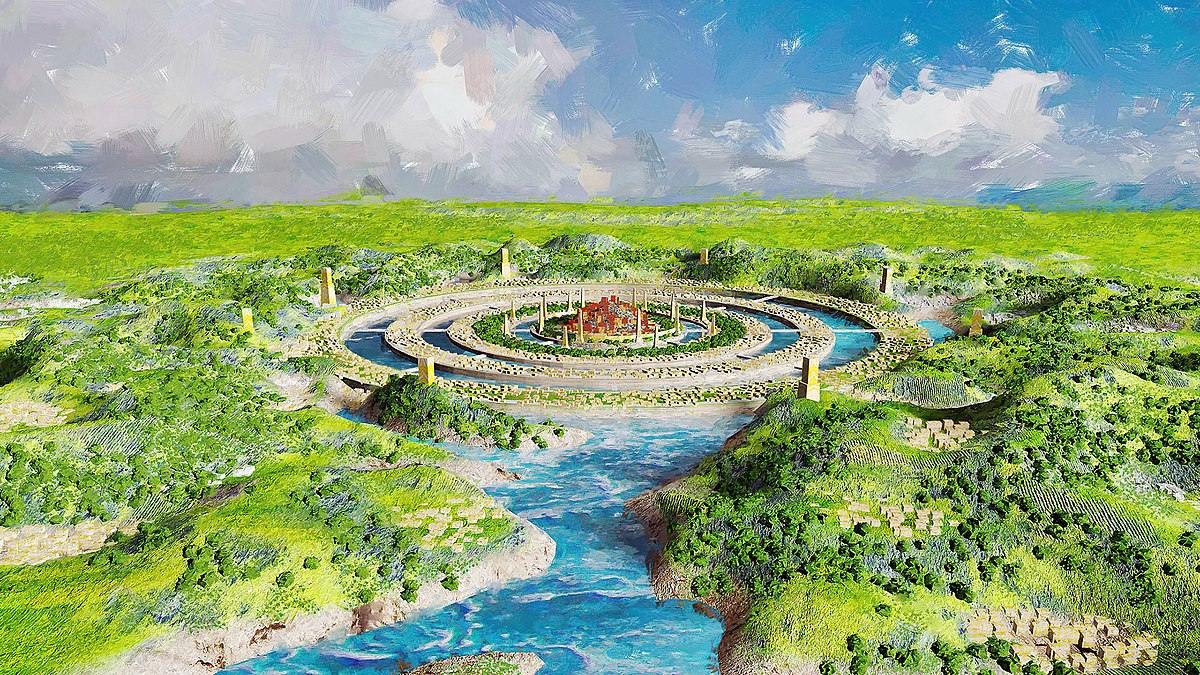
The legend of Atlantis has enticed researchers for generations. Was it a real place, or just an allegory? If it was real, where exactly was its location? Countless theories have been proposed over the years. Here are all the best theories about where Atlantis might have been.
Allegory for the Persian Empire
The story of Atlantis comes from Plato, a philosopher writing in the fourth century BCE. One particularly popular theory among scholars is that Plato’s account of Atlantis was just his way of creating an allegory about the Persian, or Achaemenid, Empire.
Prior to Plato’s time, the Persians had gone to war against the Greeks. They had a mighty empire, occupying a huge portion of Asia. They were also a very rich and advanced society. Therefore, many scholars argue that Atlantis, with its large empire and rich society, was an allegorical version of the Persian Empire.
In the legend, Athens manages to defeat Atlantis. This, supposedly, is Plato’s version of when Athens historically defeated the Persians.
One problem with this theory is that it does not seem to fit the context of the story of Atlantis. In Plato’s Timaeus dialogue, Socrates says that he has talked enough about the ideal state, Athens, as a concept. Now he wants to hear from someone else about its effectiveness in the real world.
Critias then speaks up with the story of Athens defeating Atlantis. It is difficult to see how an allegory would be helpful in this case. Elsewhere, Plato made use of real history or existing legends whenever it served his purpose.
Tartessos
One popular theory is that Atlantis was identical to the civilisation of Tartessos. This was a civilisation on the Iberian Peninsula which thrived from about the eleventh century BCE until about the sixth century BCE. It was very rich and was involved in trade all over the Mediterranean. In fact, it appears to be the source of much of King Solomon’s silver.
The center of the Tartessian civilisation was beyond the Strait of Gibraltar. This appears to match Plato’s reference to Atlantis as being in front of the Pillars of Heracles, since the Strait of Gibraltar was the standard location of those pillars in Plato’s time.
Although Plato refers to Atlantis as an island, the Greek word that he uses (‘nesos’) could sometimes refer to a peninsula. Therefore, this arguably matches the Iberian Peninsula. Furthermore, Plato refers to a large plain surrounded by mountains on the island of Atlantis. Proponents of this theory argue that this matches the Baetic Depression, the main valley through Andalusia.
However, the Baetic Depression through Andalusia is much longer than it is wide, and it only has a single river flowing through it. This does not match what Plato wrote about Atlantis.
Additionally, there is the crucial fact that there is no evidence that the Tartessian civilisation existed as far back as the Bronze Age. In contrast, Plato’s story of Atlantis is definitely set before the end of that historical era. There is also no evidence that Tartessos ever fought against the Greeks.
In the Atlantic Ocean

A traditional theory about Atlantis is that it was a real continent out in the Atlantic Ocean. Supposedly, this matches Plato’s geographical description. He says that Atlantis was in front of the Pillars of Heracles and in the Atlantic Sea. This appears to correspond to a location in the Atlantic Ocean, beyond the Strait of Gibraltar.
Proponents of this theory argue that Plato’s account of Atlantis disappearing into the sea in a dramatic disaster is historically accurate. According to them, the Azores Islands are small traces of what was previously a much larger landmass. They are allegedly the tips of some of the mountains of Atlantis.
Evidence for this supposed landmass in the middle of the Atlantic Ocean is the fact that many myths and practices can be found on both sides of the Atlantic. For example, there are flood myths everywhere, which proponents of this theory interpret as memories of the destruction of Atlantis.
One big problem with this theory about Atlantis is that plate tectonics have definitively disproven it. Scientists now know that South America and Africa used to be connected, as their coastlines still show. Less obvious but just as valid connections are found between North America and Europe.
Hence, there is simply no space for a massive continent between South America and Africa, or between North America and Europe. The Azores Islands, for their part, used to be lower thousands of years ago, not higher. We know this because of raised beaches dating to the Pleistocene era, some of them as high up as 250 meters above sea level.
Richat Structure
A theory about Atlantis that has surged in popularity in recent years is the theory that connects it to the Richat Structure. According to this, Atlantis was actually the Richat Structure, or Eye of the Sahara. This is an unusual natural feature in Mauritania, northwest Africa, made up of several concentric ridges and depressions.
If the northwest corner of Africa was at sea level, then the depressions would become filled with water. This would give it a very similar appearance to Plato’s description of the metropolis of Atlantis, which was made up of a series of concentric rings of land.
Supposed evidence for the former presence of water is the fact that the depressions are apparently filled with salt. Furthermore, proponents of this theory claim that ancient maps associate this region of Africa with the name ‘Atlantes’, which is another form of ‘Atlantis.’
In reality, there are many issues with this theory about Atlantis. For one thing, if this corner of Africa was formerly at sea level, hence explaining the salt in the depressions of the Richat Structure, then we would also expect to find salt covering the surrounding area too. Yet, we do not. This shows that the salt has a different origin, not related to the ocean.
Additionally, the name ‘Atlantes’ actually comes from Herodotus and refers to a people, not a place. They were named in honour of Atlas, since they lived next to Mount Atlas. Contrary to the claims of this theory, this is very far away from the Richat Structure. Also, Atlas was first associated with that region of Africa after Homer’s time, which is long after the story of Atlantis supposedly reached the Egyptians.

Sardinia
Another popular theory about Atlantis, which is much more convincing than the Richat Structure theory, is that Atlantis was actually Sardinia. Based on modern archaeology, scholars now know that Sardinia was the center of a wealthy trading civilisation that was active all over the Mediterranean.
Unlike in the case of Tartessos, the civilisation of Sardinia was active in the Bronze Age. Its culture was known as the Nuragic. Interestingly, there is evidence of bull worship at some of the temples. This fits what Plato wrote about the Atlanteans.
One particularly notable aspect of this theory about Atlantis is that there is evidence that the people of Sardinia fought a war against nations in the Eastern Mediterranean in the Bronze Age. The Egyptians famously referred to the attacks of the Sea Peoples, and one of these peoples were the Sherden. Many scholars agree that the Sherden were from Sardinia.
Eventually, the Sherden and the other Sea Peoples were defeated, just as Atlantis was defeated in Plato’s story.
While this is an attractive theory, it is also very selective. For example, it is true that bull worship was present on Sardinia in the Bronze Age. However, bull worship was widespread. There is nothing specific about the Sardinian bull worship which fits Atlantis.
Even more crucially, Egyptian records show that the Sherden and the Greeks were both involved in the Sea People attacks, fighting together against the Egyptians. This does not fit the story of Atlantis at all, where the Greeks and Atlanteans fight each other.
Additionally, there is no evidence for Sardinia suffering a major natural disaster in the Bronze Age.
The Theory that Atlantis was the Minoan Civilisation
By far the best theory, and one which does have a reasonable amount of academic support, is that Atlantis can be identified with the Minoan civilisation. According to this theory, the main island of Atlantis was Crete, while the metropolis was the island of Santorini.
Santorini, in the Bronze Age, was made up of a ring of land with an island in the centre. This is very reminiscent of how Plato described Atlantis. Furthermore, there was one passage from the sea to the central island, just as described by Plato.
Another similarity is the simple fact that the Minoans were the dominant traders of the Mediterranean in the Bronze Age. Although they did not have a military empire, they did have colonies on various islands and parts of the mainland, including in Palestine, Anatolia, and even Libya.
Even more striking is the fact that the Minoans really did fight a war against the Greeks in the Bronze Age, and the Greeks really did defeat them. This is a correspondence which no other theory appears to definitively have.
Furthermore, various aspects of the Minoan civilisation match what Plato wrote about Atlantis. For instance, they constructed colourful buildings using red, white and black stones. They also engaged in bull worship which involved a type of bull fighting in a temple dedicated to Poseidon, exactly as Plato said.
The main objection to this theory is that the Minoan civilisation was inside the Mediterranean. However, modern research indicates that such a location is, in fact, consistent with Plato’s geographical references.
See all the latest news from Greece and the world at Greekreporter.com. Contact our newsroom to report an update or send your story, photos and videos. Follow GR on Google News and subscribe here to our daily email!

