



In a world increasingly dominated by artificial intelligence, one can’t help but wonder how Socrates would react. Would he marvel at its efficiency or recoil at its implications for the human mind? Long before modern technology, he recognized the danger of tools that create the illusion of understanding without true thought.
Socrates warned that writing could erode memory and understanding, resulting in a spectacle of knowledge divorced from genuine learning. Reading a thought, he argued, is not the same as generating it; true knowledge must be spoken, examined, and wrestled with.
The generation effect: Struggle, dialogue, and the formation of understanding
This principle aligns with modern research on the generation effect, first identified in 1978. Psychologists found that when individuals attempt to produce information themselves, rather than merely consuming it, for instance through reading, retention increases dramatically. In one key experiment, participants studied flashcards with word pairs. Those who simply read the pairs recalled almost nothing, while participants who generated part of the word themselves retained the information far better.
It was the struggle to produce the answer rather than passive reception that allowed knowledge to become salient. Subsequent studies have shown that this effect extends beyond words to ideas, actions, and problem-solving. Just as Socratic questioning builds the mind, generation leads to the construction of neural circuits necessary for genuine comprehension.
Long before the establishment of this theory, the Soviet psychologist Lev Vygotsky observed that thinking develops through speech. We first converse with others and then internalize these dialogues as inner speech. Infants babble, experiment with sounds, and gradually produce words and sentences. This active engagement trains the brain to generate thought rather than simply absorb it.
Similarly, many religious traditions use dialogue as a crucible for understanding. The oral Torah relies on discussion and regeneration across generations; the Talmud encodes debate rather than fixed answers. Buddhist koans challenge students to wrestle with questions rather than memorize solutions. Knowledge, in these traditions, emerges only through struggle and reflection. In this sense, spiritual practices and Socratic teaching share a core principle: learning is not delivered—it is earned through effort, practice, and the active generation of understanding.
Platonic recollection and the oral transmission of knowledge
The Pythagorean philosophers and Plato, a student of Socrates, shared a similar understanding of early learning. They emphasized that struggle was essential even for children, believing that the effort required to explore, play, and experiment forged both the mind and character. Play and games were central to Plato’s pedagogy because they promoted creativity, problem-solving, and the disciplined exercise of imagination.
The experiment with the flashcards echoes what Plato, through the voice of Socrates, demonstrated centuries earlier in his dialogue Meno. By questioning a slave with carefully chosen prompts, Socrates guided him to arrive at sufficient answers without direct instruction, suggesting that learning is not the transmission of new knowledge but the recollection of what the soul already knows. In this sense, there is no teaching in the strictest sense—only the activation of latent knowledge through guided inquiry.
What modern psychology describes as the “generation effect” aligns closely with this Platonic insight: understanding emerges through the effort to generate answers rather than passively receiving information. While thinking may appear to generate something novel, Plato would argue that this is, in fact, recollection—not of sensory impressions but of eternal ideas that manifest in the material world over time. This view finds its metaphysical foundation in the Phaedo, where Plato attempts to show that the soul pre-exists the body and thus carries knowledge prior to embodied experience.
In the Phaedrus and the Seventh Letter, Plato argues that philosophy can be transmitted only orally, because it cannot be properly expressed through written language. This raises the question of whether Platonic dialogues capture his true philosophy or whether we must seek the “unwritten doctrines”—the views he never recorded but taught orally to his students.

Socrates on speech, writing, and the guidance of the soul
According to the myth in the Phaedrus, the Egyptian king Thoth demonstrates that writing does not make human beings wiser. Socrates identified three key disadvantages of written language: it is static and unchanging, it cannot defend what it presents, and it cannot select or guide its reader. By contrast, spoken discourse avoids these limitations.
However, spoken discourse is effective only under conditions that allow it to transmit philosophical knowledge properly. Without these conditions, speech can become problematic, making written records preferable.
True philosophy, Socrates argues, occurs between teacher and student. Through dialectic, they formulate arguments, test their validity, and examine whether they hold. Philosophical discourse is effective when the student is motivated to learn and cultivate the soul. For this reason, philosophy is psychagogia—the “guidance of the soul.”

Oral wisdom and the defects of writing
In his Seventh Letter, Plato explains that he has written nothing about the essence of beings because this subject can be expressed neither in writing nor in speech. Philosophy is a difficult journey through concepts that cannot be fully captured in words. Therefore, the most profound subject—the essence of beings—cannot be articulated verbally.
Knowledge is generated in the soul through the relationship between teacher and student via the dialectical method. This psychic interaction cannot be adequately described in writing. For this reason, Plato did not systematically record the fundamental elements of his philosophy, nor did he present them fully in speech. Yet, human beings can express themselves vividly through spoken language and transmit knowledge to others.
The philosopher Pythagoras functioned similarly. According to Iamblichus, Pythagoras evaluated the character of prospective students, observing behavior, relationships, and temperament. Candidates underwent years of silence and communal discipline to cultivate self-control and reflection. The homakoi, referring to the inner circle of Pythagoras’ followers, listened without seeing, absorbing teachings indirectly, while their moral and intellectual qualities were continuously tested. Knowledge, for Pythagoras, was not mere instruction but transformation through disciplined experience.
Like Socrates, he recognized that true learning occurs through effort, dialogue, and reflection rather than passively receiving external answers. In a modern sense, one might imagine Socrates warning that reliance on artificial intelligence for ready-made answers risks bypassing this essential struggle and replacing the cultivation of understanding with convenience.
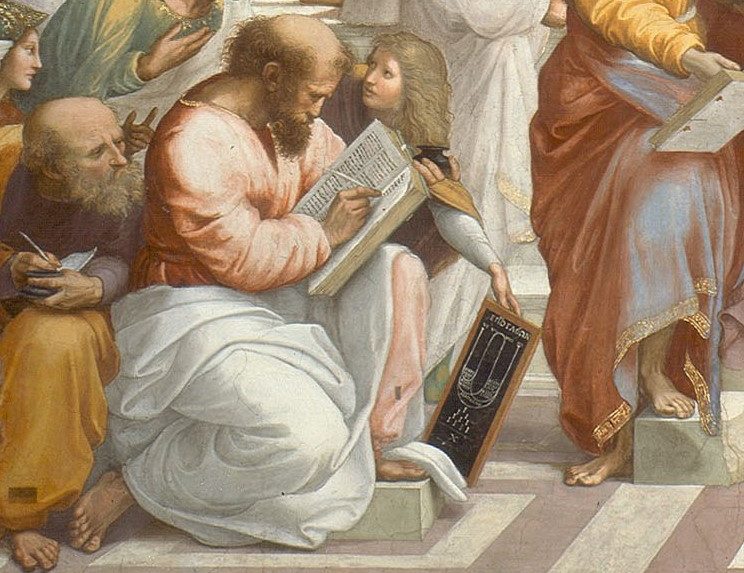
Artificial intelligence and the risk to human thought: Socrates’ warning
This ancient wisdom frames the modern challenge of artificial intelligence. Creative tasks such as drawing or coding benefit from active generation. Tracing or copying produces only superficial learning, whereas starting from a blank page engages problem-solving, planning, and fine motor skills—all of which reinforce knowledge and skill retention. Copying lacks what the Stagirite philosopher Aristotle called “actual intellect” (nous energeia).
Artificial intelligence can generate outputs, produce essays, create music, or even simulate conversation. Yet it cannot engage in the struggle that produces genuine knowledge in humans. AI excels at pattern recognition, convergent thinking, and the continuation of existing thought, functioning in the way Aristotle would call “passive mind” (nous pathetikos). It cannot generate truly novel ideas from experience and lacks curiosity, desire, and moral engagement—the qualities that seed unique human pathways through thought. Experiments with students using AI assistants confirm this: brain activity decreases when people rely on AI for solutions, memories fade, and skills atrophy. By outsourcing thinking to a machine, humans risk replacing the machinery of thought with a simulation of it.
Socrates would not fear artificial intelligence itself but humans who stop thinking for themselves. He would fear students who no longer struggle with questions, writers who no longer wrestle with ideas, and thinkers who accept ready-made answers without reflection. Socrates would perceive of artificial intelligence as a test of the mind’s resilience. In other words, if humans continue to cultivate dialogue, struggle, and reflection, AI remains a tool. If humans surrender thought to AI, the soul risks atrophy.
What would be Socrates’ fear of artificial intelligence?
The paradox of technology, as Socrates might observe, lies in its dual nature. Tools accelerate progress by performing work for us, yet they can simultaneously prevent us from truly understanding how results are achieved. In a society that relies excessively on artificial intelligence—whereby collective thought narrows while originality diminishes—Socratic and Pythagorean pedagogy emphasizes struggle, reflection, and creativity. These are the very qualities that sustain diverse and meaningful human thought.
In a world where answers are cheap and abundant, questions gain infinite value. Socrates understood this well, and this is why he would fear artificial intelligence dominating human thinking. The real danger does not lie in AI itself but in forgetting the processes that cultivate understanding. Socrates would recognize that artificial intelligence can assist but only if humans actively struggle, generate, and self-reflect. Surrendering these tasks entirely risks the very faculties that define wisdom.
Socrates would fear a society that no longer wrestles with knowledge. If he feared anything, it was the illusion of wisdom without effort. Yet he would also see hope in anyone willing to ask questions, struggle with answers, and generate thought from scratch. The challenge of artificial intelligence is not the machine itself but whether we remain active participants in the cultivation of the mind.
See all the latest news from Greece and the world at Greekreporter.com. Contact our newsroom to report an update or send your story, photos and videos. Follow GR on Google News and subscribe here to our daily email!

