



Hecataeus of Miletus (c. 560–480 BC) occupies a significant position in the intellectual history of ancient Greece. He was a pioneering geographer and historian who bridged the eras between Homer’s epic poetry to the historical accounts of Herodotus.
While the epics of Homer included actual peoples and locations, they were not historical accounts but poetry with rich mythical elements and heroes. The Iliad and The Odyssey painted an Ancient Greece with human heroes and human-like gods, so vivid that in Homer’s times and to later readers sounded like history.
It was after Homer that Hecataeus of Miletus appeared as a geographer, genealogist, traveler, historian and prose writer, who contributed to the development of historical inquiry before the time of Herodotus, who was in turn traditionally celebrated as the “Father of History.”
Living during a period of expanding geographical knowledge, political transformation, and cultural exchange, Hecataeus attempted to organize the world through observation, geographical description, and critical examination of traditional accounts. His scant surviving writings reveal an intellectual who sought to move beyond inherited mythology, towards a more systematic understanding of the past and the lands inhabited by different peoples.
Although his original works have largely disappeared, fragments preserved by later writers demonstrate the importance of his achievements. His geographical survey, Periegesis (touring), and his genealogical work, Genealogies, established foundations for subsequent historical and geographical scholarship.
Hecataeus, therefore, was not simply a predecessor of Herodotus, but as one of the earliest Greek thinkers to approach history and geography as subjects requiring investigation, organization, and rational explanation.
The intellectual world of Miletus
Hecataeus was born in Miletus, an influential Greek city on the western coast of Asia Minor, in present-day Turkey. During the 6thth century BC, Miletus flourished as a center of maritime commerce, philosophical speculation, and cultural exchange. Its geographical position connected the Greek world with Egypt, the Near East, the Black Sea, and the eastern Mediterranean.
These connections encouraged the development of geographical knowledge and exposed Milesian intellectuals to traditions different from their own. Merchants, sailors, and travelers brought information about distant countries, unfamiliar customs, and different political systems.
Hecataeus belonged to this intellectual movement. He is frequently associated with Anaximander, the philosopher traditionally credited with producing an early map of the inhabited world. Although their precise relationship remains uncertain, Hecataeus appears to have developed ideas on geography associated with the earlier Milesian tradition.
According to the modern historian Peter Hunt, Hecataeus was a prominent intellectual of the Ionian Enlightenment whose writings represented an important prose antecedent to Herodotus. His achievements consequently belong to a broader transformation in Greek thought, when mythology, philosophy, geography, and political knowledge increasingly became subjects of systematic examination.
Hecataeus the geographer
One of Hecataeus’ greatest achievements was his geographical work, commonly known as the Periegesis (tour of the Earth), or Description of the Earth. The work presented geographical information concerning the regions and peoples known to the Greeks. It was divided into two principal sections, Europe and Asia, with Asia including geographical areas that modern classifications would place in Africa.
Hecataeus described coastlines, settlements, rivers, islands, mountains, and different populations. His geographical arrangement followed a largely coastal itinerary, reflecting the importance of maritime travel and the practical knowledge accumulated by Greek navigators.
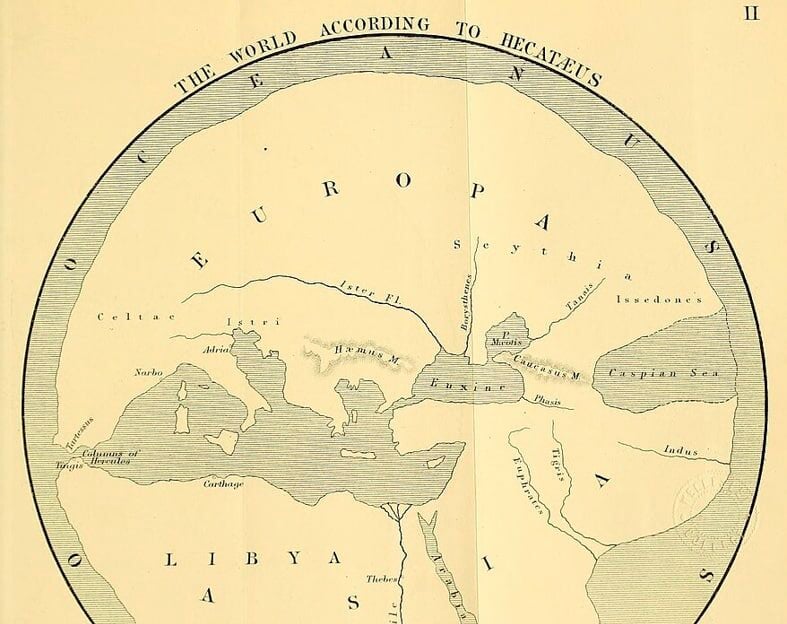
His work was accompanied, or closely associated, with a map of the world. This map represented the earth according to the geographical understanding of his time. The inhabited world was conventionally depicted as a circular landmass surrounded by Oceanus, the great outer river or ocean.
Although this conception was inaccurate by modern standards, its importance lies in the attempt to organize geographical information into a coherent representation.
Hecataeus improved upon Anaximander, by incorporating additional descriptions and information about the lands represented. His contribution was therefore not merely cartographic. He attempted to explain the places shown on the map through written accounts.
The surviving geographical fragments demonstrate considerable knowledge of the Mediterranean and Black Sea regions, including Asia Minor, Egypt, North Africa, Greece, and territories extending towards Persia and India. His geographical survey organized knowledge of the inhabited world into a systematic description.
Ethnography
Hecataeus’ work also included information about different peoples and their customs. Geography, for Hecataeus, was therefore closely connected with ethnography: the study of populations, their identities, and their ways of life.
The importance of this achievement is considerable. Rather than treating geographical knowledge as a collection of isolated stories, Hecataeus organized it into a systematic description of the inhabited world.
His work provided an important foundation for later Greek geographical scholarship, including the traditions represented by Herodotus and subsequent writers.
The Genealogies and the investigation of the past
Hecataeus’s second major achievement was his genealogical work, generally known as the Genealogies. This work examined the ancestry of Greek heroes, royal families, and legendary figures. It attempted to organize the complicated traditions surrounding the mythical past into a more coherent structure.
Greek communities preserved numerous stories concerning their origins. These traditions connected families and cities with gods, heroes, and legendary ancestors. They were important sources of identity and political legitimacy.
However, the traditions frequently contradicted one another. Different communities could claim descent from different heroes, while genealogical accounts often contained inconsistencies. Hecataeus sought to organize these traditions through genealogical relationships and rational explanation.
His approach is particularly significant because it represents an early attempt to impose order upon mythical history. A famous fragment preserved by the later writer Demetrius of Phalerum gives the opening of his genealogical work:
“Hecataeus of Miletus speaks thus: I write these things as they seem to me to be true; for the stories of the Greeks are many and ridiculous, as they appear to me.”
This translation is commonly associated with the surviving introductory fragment, although the precise wording varies between editions.
The statement reveals an important intellectual attitude. Hecataeus did not simply accept traditional stories because they had been transmitted by earlier generations. He recognized that inherited accounts could contain exaggerations, contradictions, and implausible claims.
Rational judgement
His criticism was not necessarily a rejection of mythology as a whole. Rather, he attempted to distinguish between traditions that could be organized into a credible account and those that appeared unreasonable.
The Genealogies consequently represent an important stage in the development of Greek historical thinking. Hecataeus treated the mythical past as something that could be examined, classified, and subjected to rational judgement.
Although only fragments survive, modern scholars regard the work as an important contribution to the development of historiography.
Hecataeus and his travels
Hecataeus was also associated with extensive travel. Ancient traditions describe journeys through different parts of the Mediterranean and the Black Sea regions, including Egypt.
His geographical writings suggest familiarity with information gathered from different communities, although it is difficult to determine which descriptions resulted from personal observation and which depended on reports from other travelers.
Egypt was particularly important to the intellectual development of Greek historians. Its ancient civilization possessed traditions of writing, religious knowledge, and royal chronology that appeared extraordinarily old to Greek visitors.
Herodotus’ account of Hecataeus’ travels
Herodotus later preserved a famous account of the Greek geographer’s encounter with Egyptian priests at Thebes.
According to Herodotus’ Histories 2.143, Hecataeus presented his genealogy and claimed descent from a god in the 16th generation. The Egyptian priests responded by showing him a succession of statues representing generations of high priests, demonstrating a much longer human lineage.
Herodotus writes:
“The priests showed me the statues, numbering three hundred and forty-five.”
The episode is important because it illustrates the difficulties involved in reconstructing the past from inherited genealogical traditions. Hecataeus’ Greek genealogy, despite its impressive ancestry, was challenged by Egyptian historical memory.
The encounter also demonstrates the importance of cultural comparison. Greek historians increasingly recognized that the past could not be understood exclusively through Greek traditions.
Modern scholars have been cautious treating Herodotus’ account as a straightforward historical transcript. Ian S. Moyer has emphasized that the episode also reflects the literary and cultural relationship between Greek and Egyptian traditions of antiquity.
Nevertheless, the story reveals the intellectual significance of Hecataeus’ investigations into ancestry and historical chronology.
Hecataeus and the Ionian Revolt
Other than a scholar, the Greek geographer and historian also participated in the political affairs of Miletus. During the Ionian Revolt against Persian rule, which began in 499 BC, he became involved in discussions concerning the rebellion and its prospects.
Herodotus provides an important account of his political advice in Histories 5.36. When Aristagoras of Miletus considered resisting the Persian Empire, Hecataeus reportedly warned against the undertaking. He described the strength and resources of the Persian Empire and argued that the Ionians lacked the necessary power to defeat it.
Herodotus states:
“Hecataeus, son of Hegesander, the historian, first advised them not to revolt.”
The translation varies slightly between editions, but the passage establishes Hecataeus’ role as an adviser. He reportedly suggested that the Ionians should consider their limited military resources and the extent of Persian power before beginning the revolt.
When his warning was ignored, he recommended that the Milesians strengthen their naval forces. Nevertheless, the rebellion failed and Hecataeus also appears to have undertaken diplomatic efforts on behalf of the defeated Ionians. These episodes demonstrate that his geographical and historical knowledge was closely connected with practical political concerns.
Hecataeus appears to have had an understanding of the Persian Empire, its territories, and its resources, so his advice was well informed. Therefore he represents an early example of an intellectual whose scholarship could influence political decision-making.
Herodotus and Hecataeus
Hecataeus’ greatest historical significance emerges through comparison with the great historian. Herodotus, writing during the 5th century BC, developed a more extensive historical narrative that combined political events, geographical descriptions, ethnographic observations, and investigations into the causes of conflict.
The Greek geographer and historian had already established important foundations for this approach. His geographical descriptions provided information about different peoples and territories. His genealogies demonstrated an interest in reconstructing the past through systematic investigation. His criticism of traditional stories encouraged the examination of inherited accounts.
Herodotus also refers to Hecataeus directly and preserves information about his political activities and geographical ideas. However, Herodotus was not simply a follower. He questioned earlier geographical assumptions and sometimes criticized the limitations of inherited maps.
For example, in Histories 4.36, Herodotus rejects the idea that the earth should be represented as a circular landmass surrounded by Oceanus. This criticism demonstrates the development of geographical inquiry beyond the conventions associated with earlier Ionian cartography.
The relationship between the two writers is therefore best understood as one of intellectual continuity combined with critical development. Hecataeus helped establish the methods and interests that Herodotus expanded into a more comprehensive historical narrative. He deserves recognition as one of the most important intellectual pioneers of Ancient Greece. His legacy lies in the transition from traditional storytelling towards a more systematic and critical understanding of history.
See all the latest news from Greece and the world at Greekreporter.com. Contact our newsroom to report an update or send your story, photos and videos. Follow GR on Google News and subscribe here to our daily email!

