



The ancient city of Troy is the subject of some of the most famous tales from Greek mythology. Yet, it was also a real place. Extensive archaeological research since the 19th century has significantly increased our understanding of this ancient city. Based on the findings of archaeologists, what do we really do about Troy? Furthermore, how does its true history relate to the writings of Homer and ancient Hittite records?
Overview of the excavations
Let us begin with a brief overview of the excavations that have occurred at Troy. There is wide agreement that Troy was at the site of Hisarlik in northwest Turkey. In the 1870s and 1880s, Heinrich Schliemann conducted extensive excavations at Hisarlik.
Unfortunately, due to his methods (which involved explosives), he destroyed much of the city. Nevertheless, his research revealed that Hisarlik was the site of numerous settlements which had been built on top of each other over the millennia.
William Dörpfeld directly succeeded Schliemann. While the former had been mostly interested in some of the very earliest layers of the city, Dörpfeld focused his attention mainly on the layers of Troy that corresponded to the Late Bronze Age.
After Dörpfeld came Carl Blegen, who originally worked alongside the former. He conducted his excavations between 1932 and 1938. Blegen helped to establish and clarify the distinct layers of Troy, concluding that nine distinct cities stood on the site. Furthermore, he divided these nine cities into numerous sublayers.
Manfred Korfmann conducted the next major series of excavations, which occurred between 1988 and 2005. His excavations produced significant results, revealing probable evidence of a war in the Late Bronze Age and demonstrating the existence of a vast lower city adjacent to the main citadel.
The most recent excavations are being carried out by Çanakkale Onsekiz Mart University, led by Rüstem Aslan. These researchers have clarified our understanding of Troy 0, a layer even older than Troy I.
The history of the origins of Troy
Let us now see what the archaeology shows. According to archaeologists, the earliest traces of Troy date to c. 3500 BCE. The settlement of Troy 0 was quite small and was located near the entrance of Troy II. The archaeologists found evidence of pottery and wooden beams from this earliest layer.
Troy I was the start of Troy as a notable settlement. This layer, although still much smaller than the later city, was much more substantial than Troy 0. There is evidence of strong stone walls that protected the small settlement. The inhabitants appeared to have regularly repaired these walls.
Archaeologists have also uncovered many houses from Troy I. These houses were attached and were constructed from mudbrick and stone. Some of them had a large hall within them. The inhabitants of this early city used objects made of copper, rather than bronze and iron from later eras.
One of the most fascinating finds from this early period is a large stone stele depicting a warrior.
Troy as a powerful Bronze Age city
Troy II, which archaeologists date to c. 2500 BCE, was twice the size of the previous settlement. It was at this stage that the inhabitants built a lower city. What appear to be large public buildings also appear at Troy. One of these buildings in particular, which archaeologists call Megaron IIA, is the largest known example in the Aegean-Anatolian region from that era.
Therefore, the evidence shows that Troy had become a powerful city in the Early Bronze Age. Treasure hoards from this era harmonize with this viewpoint. It was by being so rich and imposing that Schliemann misidentified this as the Troy of Homer’s Iliad.
The citadel had two ramps leading into it. Due to the small size of the citadel, it appears that one of these ramps was ceremonial, again showing the powerful state of Troy in this era.
Very little survives of the layers of Troy III-V because of Schliemann’s destructive techniques. Nevertheless, the available evidence indicates that this was a poorer period for the city.
Troy VI was built c. 1750 BCE and continued until c. 1300 BCE. It was during this era that its large and imposing walls, bigger than the previous ones, were built. The lower city also thrived in this period. It had a large ditch all around it, as well as a wooden palisade for extra protection.
Eventually, Troy VI was destroyed in c. 1300 BCE.
The history of Troy in the Bronze Age Collapse
Troy VII continued directly on from Troy VI. The imposing walls remained part of the city’s defenses, and continued to thrive as an important Bronze Age city with its strategic position at the entrance of the Hellespont.
Nevertheless, Troy shows evidence of decline and trouble during this period. Large storage containers called pithoi may indicate that the inhabitants were preparing for war.
The Hittites, in the 13th century BCE, refer to a conflict concerning Troy (called Wilusa in their records). The ancient Greeks also called Troy Ilion (or Ilios), a name believed to derive from an earlier form Wilios, which is linguistically close to Wilusa. Many researchers see this connection as supporting a historical basis for the legendary Trojan War. However, the document in question states that this conflict was settled amicably, and the timing of this event does not match any known destruction layer.
Several decades later, Troy was destroyed once again. This destruction layer dates to c. 1180 BCE. Archaeologists have found a large quantity of sling stones from this era, which appear to have been abandoned before being used. This is indicative of warfare.
Interestingly, immediately after this destruction layer, archaeologists have found evidence of pottery from the Balkans.
This might suggest that inhabitants from the Balkans were responsible for its destruction, and not the Mycenaean Greeks, as researchers often claim to link it to the famous Trojan War.
The history of Troy in the Dark Ages
What do we know about the history of Troy after its destruction at the end of the Bronze Age Collapse? After this destruction, Troy continued to exist. It was not abandoned. As we saw earlier, Balkan pottery appears in the layer immediately after the destruction of Troy VIIa.
Nevertheless, Troy VIIb appears to have been much less powerful than its predecessor. The population appears to have declined, and large parts of the city were abandoned. Nevertheless, it continued to exist and evolve.
We find evidence of a cultural shift occurring in Troy during this period, which may be evidence of further impact from Balkan immigrants. This would tie in to legends about the Phrygians migrating from the Balkans into western Anatolia.
Cultural changes include the use of upright stones in construction projects, as well as a type of pottery characterised by the presence of bumps or knobs (known by archaeologists as Buckelkeramik).
Eventually, in c. 950 BCE, this city was destroyed by fire. The circumstances surrounding this are unknown, but it was almost certainly an attack from an outside force. The city was almost completely abandoned thereafter.
How Troy grew again in the Iron Age
Previously, archaeologists believed that there was a complete cessation of habitation at Troy between c. 950 and 700 BCE. More recent archaeological research has shown this to be incorrect.
In reality, the site may have never been completely abandoned. If so, it was only for the brief period between 950 and 900 BCE. By the end of that era, there is evidence for a small resurgence of habitation at Troy by Greek settlers.
Toward the end of the ninth century BCE, around the year 800, there is evidence of a surge in construction work, indicating that Troy began rebuilding after minimal activity since c. 950 BCE. Additionally, during this period, a temple to Athena was constructed.
Around the middle of the eighth century BCE, the inhabitants performed repair work on the grand stone walls from the Bronze Age, which were still standing.
Troy had become a notable city again; otherwise, it would not have had the manpower to restore such enormous walls.
Furthermore, there is strong evidence of widespread trade in this era. Towards the end of the eighth century BCE or the beginning of the seventh, Troy produced a distinctive type of pottery called G2/3 Ware. Archaeologists have found this pottery on numerous islands of the Aegean Sea and also in the Black Sea.
This shows that Troy had once again become a regionally important centre of trade. This was Troy VIII. However, before long, Troy suffered destruction yet again. The entire city was destroyed in an event probably in the first half of the seventh century BCE. This was followed by a period of abandonment.
The history of Greek Troy
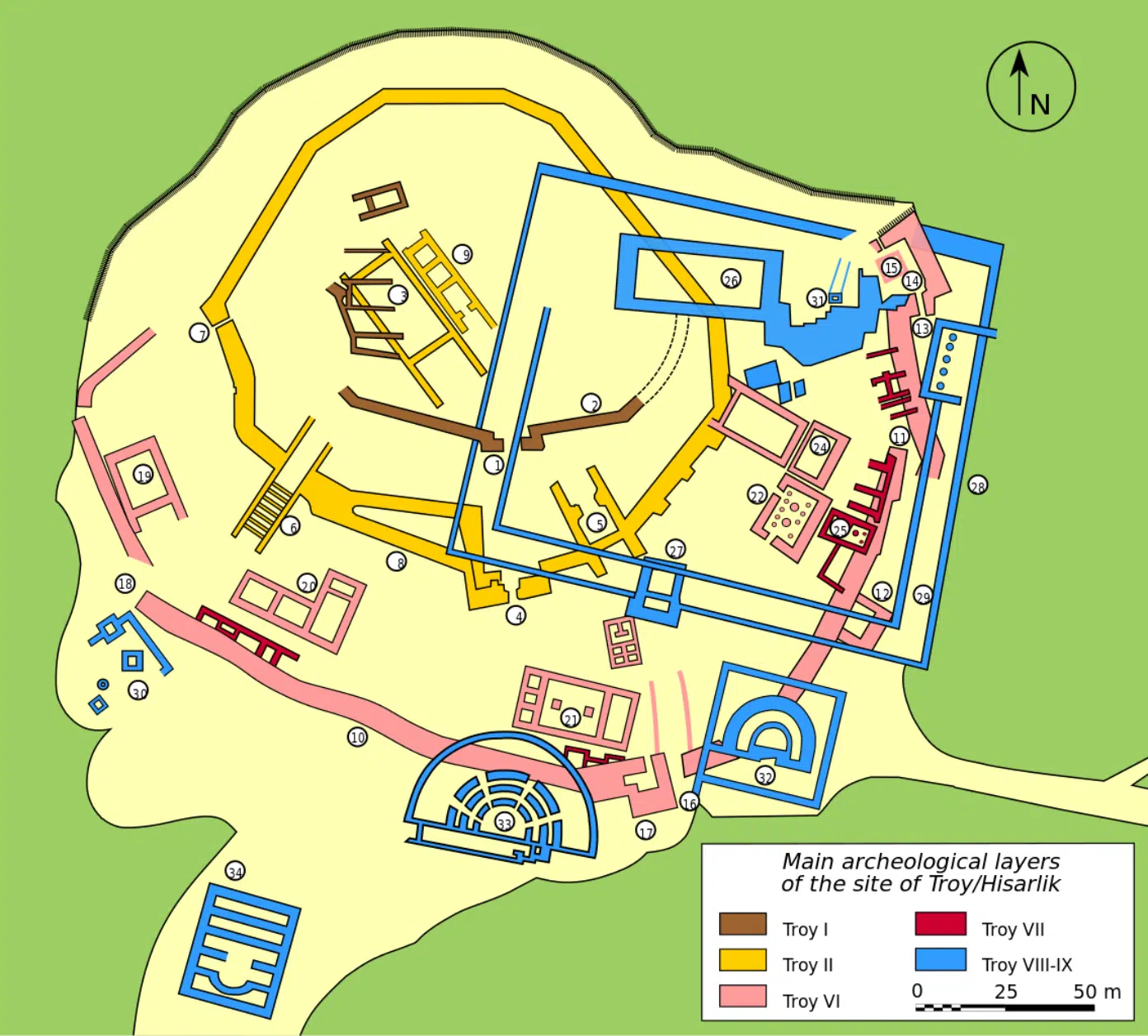
In c. 625 BCE, Troy was restored. It was at this point in the history of Troy that the city became a true Greek colony. This colony is sometimes referred to as Classical and Hellenistic Troy. During this period, Troy was no longer an important regional trading center. However, due to the Iliad, it had become famous as a place of legend and heroes.
As a result, it became a popular tourist destination. Even important figures, such as King Xerxes of Persia and Alexander the Great of Greece, visited Troy. At that time, it was called Ilion.
In fact, Alexander the Great admired Troy so much that he arranged for the construction of a massive new temple in the city dedicated to Athena. His successors, such as Lysimachus and the Seleucid kings of Syria, eventually carried out this intention. This era also saw Troy expand once more, with the Greeks constructing a town hall and a theatre within it.
The history of Roman Troy
In the year 85 BCE, the First Mithridatic War destroyed Troy VIII. The Romans then rebuilt it as Troy IX, in which time it was known as Ilium. Since the Romans identified themselves as descendants of the Trojans, they gave great respect to Troy.
Hence, this part of Troy’s history saw yet another resurgence of habitation and prosperity. It was specifically Roman Emperor Augustus who ordered for Troy to be restored. The Romans built an odeon at the site, which was a type of theatre.
It became even more of a tourist destination than it had been in the Classical and Hellenistic Eras, with even the coins of Troy referencing the legendary Trojan War. It continued to grow throughout later centuries. The Romans built public baths and an aqueduct there.
However, two earthquakes in c. 500 CE eventually led to the downfall and complete abandonment of Troy IX. After this, it was slowly but surely buried by nature.
How does Homer’s Troy match the archaeology?
With all this knowledge of the archaeological history of Troy, what can we say about Homer’s description of Troy in his Iliad? How does this correspond to the archaeological evidence?
Homer refers to the grand stone walls of Troy. He calls it “well-built Troy”. This refers to the grand Bronze Age walls that characterized Troy throughout most of its history. However, this does not necessarily mean that he was describing the Bronze Age city. As we have seen, these walls were used well into the Iron Age.
Another important part of Troy in Homer’s Iliad is the Temple of Athena. There is no evidence for this temple in the Bronze Age, but this would match Troy VIII. Furthermore, the general character of Troy and the Trojans in the Iliad is decidedly Greek, as scholars have long noted.
For this reason, Homer appears to have been primarily describing Troy VIII, the Troy of his own time, or a little before. This is consistent with the fact that the general geopolitical world of Homer’s poems corresponds to the Archaic Era. While previous generations of scholars tried to match the Iliad to the Bronze Age world, most Homeric scholars today recognise that Homer’s descriptions are thoroughly Archaic.
As to what this means for the Trojan War itself, there is still considerable debate on this topic. Was the destruction of Troy that Homer referred to the 1180 BCE destruction event? Or instead, could it have been the 950 BCE destruction event, or even the destruction of c. 675 BCE?
We cannot be certain, but we can say that Homer’s Troy aligns with the archaeology of Troy VIII.
See all the latest news from Greece and the world at Greekreporter.com. Contact our newsroom to report an update or send your story, photos and videos. Follow GR on Google News and subscribe here to our daily email!

