


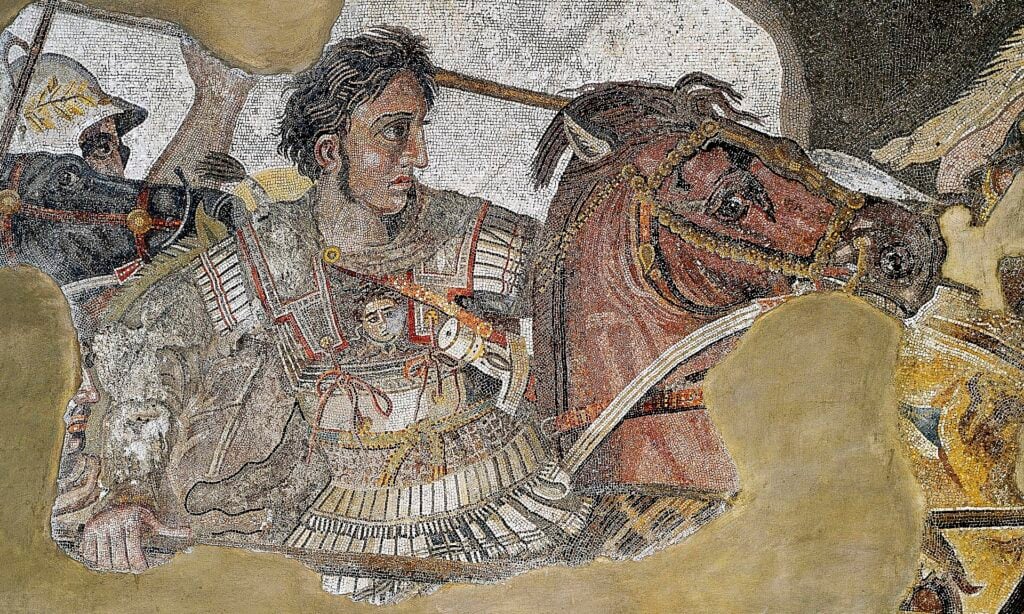
What happens when an army’s instinct to survive conflicts with the need to hold the line? In the brutal theater of ancient warfare, commanding officers constantly wrestled with this psychological dilemma. By 331 BC, Alexander the Great had led his Greek forces of the kindom of Macedon deep into the Persian Empire, embarking on relentless eastern campaigns that pushed human endurance to its breaking point.
Under immense pressure, discipline was everything. To ensure his men never turned their backs on the enemy, Alexander supposedly enacted one of the most drastic and psychologically devastating measures in military history: he deliberately stripped them of their rear armor, ensuring that retreat meant certain death.
What did Alexander do to his soldiers’ armor?
The primary source for this legendary tactical shift comes to us from Polyaenus, a Macedonian author who penned his Stratagems of War roughly four centuries after Alexander’s death. According to his account, the armor change was born out of a commander’s frustration. Following a battle where a detachment of Macedonians broke rank and fled in a panic, Alexander decided that standard disciplinary measures were insufficient. He needed a structural, inescapable change to the way his men fought.
His solution was the introduction of the hemithorakion, or “half-cuirass.” He ordered his troops to discard their standard full-torso protection and replace it with armor that covered only the chest and abdomen. The genius of the hemithorakion was that it functioned as a psychological trap. If a soldier boldly faced forward and pressed the attack, he was fully protected against enemy weapons. But if he gave in to the primal urge to run away, he carried dead weight on his chest while leaving his bare back entirely exposed to a rain of arrows, spears, and cavalry swords. Polyaenus delivered a dramatic conclusion to this anecdote: the Macedonians never fled from battle again, realizing that cowardice was no longer an avenue to safety, but a guarantee of destruction.
The reality behind a possible myth
Yet, as compelling as Polyaenus’s tale of psychological warfare is, it obscures a much harsher environmental reality. When this armor shift actually took place, Alexander’s army was not fighting on the flat, predictable plains of the Mediterranean. They were navigating the Zagros Mountains, a rugged, brutal, and towering range near modern-day Iran.
In this environment, the traditional Macedonian phalanx, a tightly packed formation of heavily armored men carrying massive eighteen-foot pikes, was severely disadvantaged. The steep, rocky, and uneven terrain favored guerrilla-style ambushes by local mountain tribes. Alexander’s men were exhausted, suffering in the heat, and struggling to maneuver their heavy bronze equipment up sheer inclines. They desperately needed mobility.
Modern historians now widely agree that the introduction of the hemithorakion had nothing to do with punishing cowardice. Instead, it was a brilliant, pragmatic logistical reform. By literally halving the amount of bronze a soldier had to carry, Alexander significantly reduced the weight of their gear. This allowed his infantry to execute faster marches, preserve their stamina, and gain the necessary agility to fight nimble mountain warriors on their own terms. When Polyaenus wrote his account hundreds of years later, he likely took this genuine historical reform and dressed it up with a moralizing narrative about Macedonian discipline and bravery.
Ultimately, the duality of the hemithorakion perfectly encapsulates how military history is recorded. The historical reality of the Zagros Mountains shows us Alexander the masterful logistician, capable of adapting his traditional forces to conquer impossible terrain. Yet, it is Polyaenus’s mythmaker version that fascinates people. Even if the true motivation for the half-cuirass was purely practical, the legend survives because it perfectly captures the ruthless, brilliant, and uncompromising mythology surrounding one of history’s greatest commanders.
See all the latest news from Greece and the world at Greekreporter.com. Contact our newsroom to report an update or send your story, photos and videos. Follow GR on Google News and subscribe here to our daily email!

