



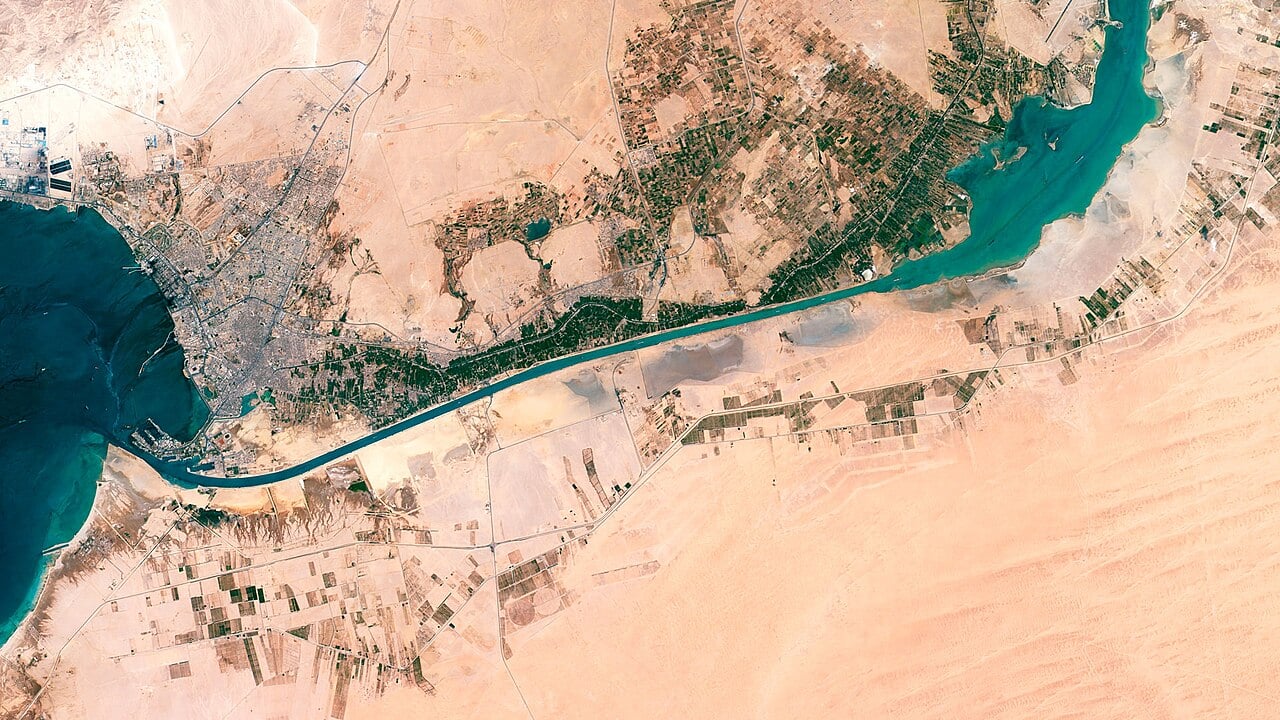
On November 17, 1869, the opening of the Suez Canal transformed international shipping, creating a direct maritime connection between the Mediterranean and the Red Sea and fundamentally changing trade between Europe and Asia.
For Greece, a country with a long maritime tradition, the new waterway brought both opportunities and challenges, helping reshape the commercial environment in which Greek shipowners would eventually build one of the world’s largest merchant fleets.
The canal’s inauguration, attended by European royalty and international dignitaries, marked the completion of a decade-long engineering project led by French diplomat Ferdinand de Lesseps. Before its construction, ships traveling between Europe and Asia generally had to sail around the Cape of Good Hope at the southern tip of Africa, adding thousands of miles to their journeys.
The new passage reduced distances and travel times, encouraged the expansion of steam-powered shipping and strengthened the Mediterranean’s position in international commerce. Its influence extended far beyond Egypt, affecting ports, shipping companies and maritime communities throughout Europe.
For Greeks, the connection was particularly significant. Thousands had participated in constructing the canal, while Greek merchants and shipowners were already expanding their activities across the Mediterranean and Black Sea regions.
The Greeks who helped build the Suez Canal
Construction began in April 1859 and continued for ten years, employing large numbers of Egyptian laborers alongside workers from several Mediterranean countries. Among the foreign workers, Greeks formed an important part of the workforce.
Research by historian Angelos Dalachanis indicates that approximately 5,000 of the 7,000 foreign workers involved in construction were Greeks, with an estimated 3,000 originating from the small Aegean island of Kasos.
Other workers arrived from islands including Kastellorizo, Astypalea, Patmos, Rhodes and Samos, seeking employment in one of the nineteenth century’s most ambitious infrastructure projects. Their working conditions were frequently harsh. Laborers faced extreme heat, difficult living conditions and the threat of infectious diseases, while Egyptian workers bore a particularly heavy burden during the canal’s construction.
Greek participation extended beyond the excavation work. Many settled permanently in the surrounding cities, particularly Port Said, Ismailia and Suez, where they established businesses, worked in maritime services and contributed to the development of local commercial communities.
According to historical research, Greek diplomatic reports from the nineteenth century recorded thousands of Greeks living in the canal region. Their presence helped establish a lasting Greek community in Egypt, which would grow considerably during the following decades.
The canal officially opened on November 17, 1869, with a ceremonial procession of ships led by the French imperial yacht L’Aigle, carrying Empress Eugénie. The inauguration represented a major diplomatic and commercial event, attracting international attention to Egypt’s newly constructed maritime corridor.
Its completion transformed the geography of international trade. Steamships could travel between the Mediterranean and Indian Ocean without undertaking the long voyage around Africa, improving access to Asian markets and strengthening the importance of Mediterranean ports.
However, the benefits were not distributed equally. Steam-powered vessels were especially well suited to the canal, while traditional sailing ships faced difficulties navigating the narrow passage and competing with increasingly efficient steamship services.
For Greek shipowners, whose fleets still depended heavily on sailing vessels, the transformation created pressure to modernize.
From Mediterranean merchants to a global shipping power
Greek maritime commerce had expanded significantly before the opening of the Suez Canal. During the eighteenth and nineteenth centuries, merchants and shipowners from islands such as Hydra, Spetses, Chios and Syros developed extensive commercial networks linking the eastern Mediterranean, the Black Sea and western European markets.
Following Greek independence in 1830, these networks continued to expand. Greek vessels transported grain, cotton, wool and other commodities, often serving international markets rather than relying exclusively on Greek imports and exports.
According to research by maritime historian Gelina Harlaftis, the carrying capacity of the Greek merchant fleet increased from approximately 60,000 tons in 1838 to nearly 530,000 tons in 1913, an almost ninefold expansion.
By the final decades of the nineteenth century, Greek entrepreneurs were increasingly investing in steamships, often purchasing secondhand vessels from Britain. These ships enabled them to compete more effectively in international bulk transportation, particularly in the profitable grain trade connecting the Black Sea with western Europe.
Historian Vassilis Kardasis has identified the Black Sea grain trade as a crucial source of capital for the expansion of Greek steam shipping. Profits accumulated through international maritime commerce allowed shipowners to acquire new vessels and develop increasingly sophisticated commercial operations.

Over the following century, Greek shipowners expanded into ocean-going cargo transportation, eventually establishing a dominant position in the global tanker and bulk-carrier markets.
That position continues today. According to the Union of Greek Shipowners’ 2025–2026 annual report, Greek interests controlled approximately 5,800 vessels with a combined carrying capacity exceeding 458 million deadweight tons, representing 19.1 percent of global fleet capacity under the association’s methodology.
The canal itself remains central to world trade, although disruptions in the Red Sea have repeatedly demonstrated the vulnerability of international shipping to geopolitical tensions.
In 2024, the World Trade Organization reported that rerouting vessels around the Cape of Good Hope increased the average distance of voyages between Asia and Europe by more than 55 percent, adding an average of approximately 17 days to transit times compared with the more direct Suez route.
More than a century and a half after its inauguration, the Suez Canal continues to shape the economics of global shipping.
See all the latest news from Greece and the world at Greekreporter.com. Contact our newsroom to report an update or send your story, photos and videos. Follow GR on Google News and subscribe here to our daily email!

