



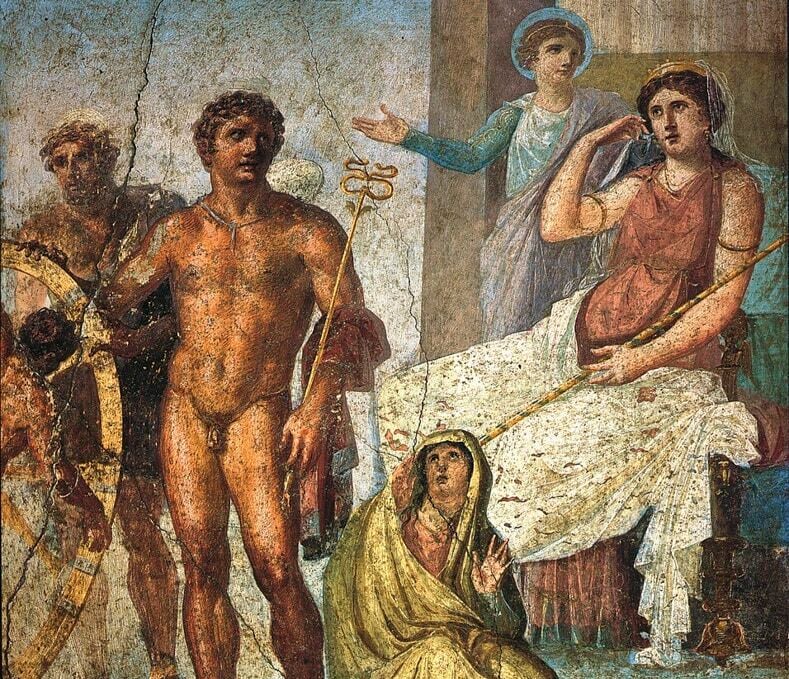
The impious King Ixion, who attempted to seduce Hera, queen of the gods, incurred the wrath of Zeus, who condemned him to one of the cruelest eternal punishments in Greek mythology.
The myth of Ixion is one of the many cautionary tales of Greek mythology and one of the most powerful examples of hubris. Unlike mythical figures whose downfall comes through ignorance, misfortune, or fate, Ixion consciously violated the sacred boundaries governing the relationship between mortals, gods, and society. After receiving extraordinary mercy and kindness from Zeus, his attempt to seduce Hera transformed him into a lasting symbol of betrayal, arrogance, and divine punishment.
The story reflects the ancient Greek belief that hospitality (xenia, ξενία), gratitude, and respect for divine authority were essential virtues, while excessive pride (hubris, ὕβρις) inevitably led to destruction.
Τhe impious King Ixion and Zeus
Ixion was the king of the Lapiths in Thessaly. Yet even before his encounter with Zeus, he had already committed serious crimes. According to most versions of the myth, he murdered his father-in-law, Deioneus, after refusing to pay the promised bride-price for marrying Deioneus’ daughter, Dia. The act was especially shocking because it violated both family bonds and the sacred customs of hospitality. In ancient Greek society, kinship and guest-friendship were considered institutions protected by the gods themselves. As a result, no one was willing to purify Ixion of his blood-guilt.
It was Zeus himself who chose to pardon Ixion out of profound pity, as no mortal was willing or able to purify him for such a crime. Zeus invited him to Mount Olympus, granting him a privilege almost no human ever received. This act revealed Zeus not only as the ruler of the gods but also as a figure who embodied justice and mercy. However, instead of responding with gratitude, Ixion allowed ambition and lust to overpower reason. He became consumed by desire for Hera, the wife of Zeus and queen of Olympus.
The Roman mythographer Pseudo-Apollodorus briefly described the episode on Olympus: “Ixion fell in love with Hera and attempted to seduce her; but Zeus, knowing his intentions, fashioned a cloud in the likeness of Hera.” Rather than immediately punishing Ixion, Zeus decided to test him. He created Nephele, a cloud formed in the exact image of Hera. Mistaking the illusion for the goddess herself, Ixion embraced the cloud and believed he had succeeded in seducing the queen of the gods.
By some accounts, this union produced Centaurus, the ancestor of the race of Centaurs. The deception revealed Ixion’s true intentions beyond any doubt. His crime was not that he had actually violated Hera but that he willingly attempted to betray Zeus’ generosity and challenge the sanctity of divine marriage.
Hubris
For the ancient Greeks, Ixion’s offense represented a perfect example of hubris. However, hubris meant far more than excessive pride. It referred to the deliberate violation of the limits placed upon human beings by the gods. Classics professor and author of works on Greek mythology Edith Hamilton explains that Greek myths repeatedly warned against this form of dangerous arrogance: “The Greeks believed that overweening pride, hubris, was the greatest of human sins because it challenged the order established by the gods.”
Ixion’s actions perfectly embodied this pattern. After escaping punishment for murder through Zeus’ extraordinary mercy, he responded not with humility or gratitude but with even greater ambition. His desire for Hera represented an attempt to claim something that belonged solely to Zeus. His crime therefore combined ingratitude, adultery, and rebellion against divine authority.
Walter Burkert, one of the leading modern scholars of Greek religion, argues that myths such as the story of Ixion emphasize the importance of respecting the boundaries between mortals and immortals. He observes that Greek mythology repeatedly demonstrates how “the crossing of divinely established limits inevitably leads to catastrophe.” Ixion’s fate reflects this very principle. Rather than accepting his restored place among humanity, he attempted to rise above his mortal status and seek equality with the gods themselves.

Zeus’s eternal punishment for Ixion
Zeus responded to Ixion’s hubris with one of the most memorable punishments in Greek mythology. He ordered Hermes to bind Ixion to a fiery, winged wheel that spun endlessly through the heavens—or, in later accounts, through the Underworld. The wheel never ceased turning, condemning Ixion to perpetual motion without rest or any hope of escape. Unlike punishments that eventually came to an end, Ixion’s suffering was eternal because his offense represented a lasting violation of divine law.
The symbolism of the wheel has drawn considerable attention from scholars. Rather than functioning merely as an instrument of torture, it represents the endless consequences of moral transgression. Its circular motion suggests that Ixion remains forever trapped within the cycle created by his own desires. His inability to escape mirrors his failure in life to control his passions and impulses.
Classicist Robert Graves interpreted the myth as preserving elements of ancient religious symbolism, suggesting that the revolving wheel may have originally represented a solar or ritual symbol before later becoming associated with punishment in Greek tradition. Although modern scholars continue to debate this interpretation, the image of the endlessly spinning wheel remains one of the most enduring symbols of eternal retribution in classical mythology.
The Roman poet Virgil also places Ixion among the great sinners of the Underworld in the Aeneid. His presence there serves as a warning to all who witness the punishments awaiting those who defy divine justice. Likewise, later writers such as Ovid preserved the story as a powerful example of the dangers of uncontrolled desire and disloyalty.
The importance of hospitality
In Greek mythology, the story of Ixion also emphasizes the importance of xenia, or sacred hospitality. Zeus was regarded as the divine protector of both guests and hosts. By welcoming Ixion to Olympus despite his past crimes, Zeus honored this sacred obligation with extraordinary generosity. Ixion, however, repaid that kindness with betrayal. Classicist Richard Buxton, a scholar of Greek mythology, notes that hospitality was often portrayed as “a fundamental social and religious institution whose violation threatens the stability of both human and divine order.” Ixion therefore violated not only personal trust but also one of the central moral principles of ancient Greek society.
Another key theme of the myth is the danger of uncontrolled desire. Throughout Greek mythology, passion itself is not condemned. Rather, desire becomes destructive when it disregards justice, loyalty, and moral restraint. Ixion’s attraction to Hera crossed these boundaries because it represented an attempt to possess what was forbidden. His desire ultimately led to his downfall because it was inseparable from arrogance and ambition.
Modern readers may also interpret the story from a psychological perspective. Ixion received forgiveness, privilege, and a second chance, yet he proved unable to transform his character. His circumstances improved, but his inner flaws remained unchanged. The myth suggests that true redemption requires moral transformation rather than simply escaping punishment. Zeus offered Ixion mercy, but he ultimately squandered that gift through his own choices.
See all the latest news from Greece and the world at Greekreporter.com. Contact our newsroom to report an update or send your story, photos and videos. Follow GR on Google News and subscribe here to our daily email!

