



The city of Crotone, a historic jewel of Magna Graecia, is embracing its Greek heritage with the addition of a new, imposing statue of Zeus, further enriching its cultural landscape.
This tribute to the king of the Olympian gods serves as a powerful reminder of Crotone’s deep-rooted connection to ancient Greece when the city thrived as a prominent Hellenic colony.
The statue was made by local sculptor Francesco (Franco) Nicotera and will be placed on a three-meter base. Although the exact location of its placement has not yet been revealed, the work is part of a broader project of cultural enhancement that aims to transform Crotone into a real “open-air museum.”

Crotone and its Greek origins
Crotone is particularly proud of the city’s Greek origins, which was the ancient Greek settlement of Kroton, one of the first Greek colonies to be founded in southern Italy.
Part of the flourishing colony of ”Magna Graecia,” Kroton was established by Greek settlers who left the region of Achaea, just opposite it on the other side of the Ionian Sea, way back in 710 BC.
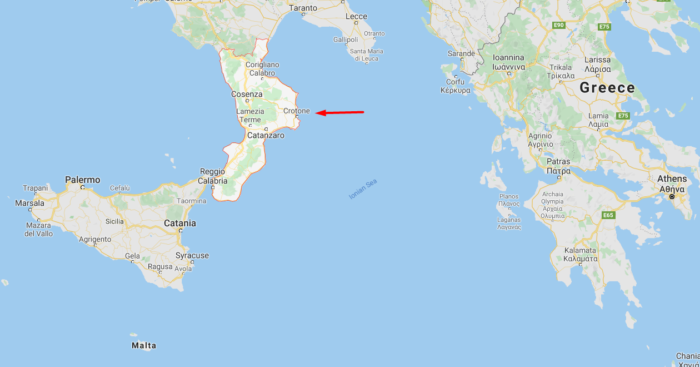
To the ancient Greeks, their land was not confined to Greece and nearby islands as we know it today. Aside from Asia Minor, which had many Greek cities, a large portion of Italy was also theirs.
The ancient Romans referred to the southern part of Italy as Magna Graecia, literally meaning “Great Greece.” Dozens of Greek cities were scattered throughout the “foot” of Italy. There were also Greek cities all over Sicily, which were closely connected to those within Italy itself.
There exists today a tiny enclave of Greek-speaking people in the Aspromonte Mountain region of Reggio Calabria that seems to have survived millennia. Their language is known as Griko. They have survived empires, invasions, ecclesiastical schisms, dictatorships, nationalistic-inspired assimilation, and much more. Griko is a variety of the Greek language that has been separated from the rest of the Hellenic world for many centuries.
Crotone links to ancient past with Zeus statue
The Choice of Zeus is not random: Crotone, with its rich heritage from Great Greece, is deeply tied to classical mythology.
The cult of Hera Lacinia, revered in the famous sanctuary of Capo Colonna, represented a central element for ancient Kroton, and the connection to Zeus further emphasizes the historic and symbolic significance of these divine figures. This new initiative follows other recent works, such as the bronze statue of Hera Lacinia made by Antonio Affidato and placed on the city promenade.
The aim is to strengthen the cultural identity of the city through contemporary art, connecting past and present. The works, in addition to celebrating historical memory, offer new points of interest for citizens and tourists, paying tribute to the greatness of Magna Graecia.
The statue of Zeus is not only a tribute to mythology but a symbol of the cultural and artistic rebirth of Crotone.
Related: Italian Football Team FC Crotone Is Uniquely Proud of Its Greek Origins
See all the latest news from Greece and the world at Greekreporter.com. Contact our newsroom to report an update or send your story, photos and videos. Follow GR on Google News and subscribe here to our daily email!

