



Most of us don’t think twice about the handshake, but this everyday gesture has roots that go back to the Ancient Greek world.
What makes its origin story especially fascinating is that it likely began out of fear. In the ancient world, extending an open hand was a way of showing that no weapon was hidden and no sudden attack was intended.
The earliest known handshake
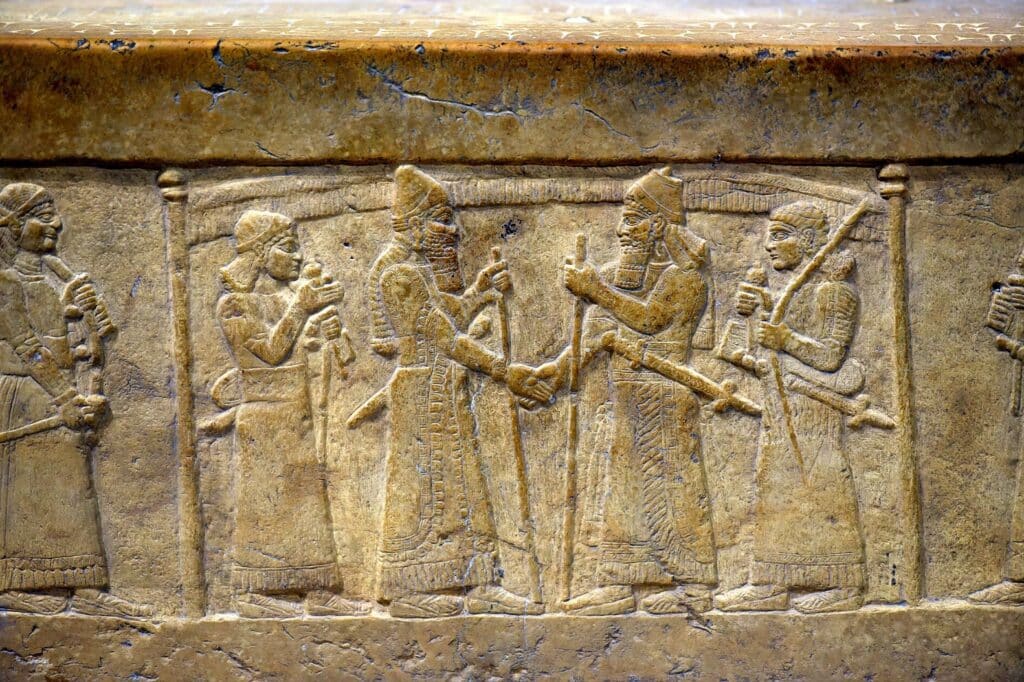
The earliest known depiction of a handshake appears on a 9th-century BC Assyrian stone relief from Mesopotamia. The artwork shows the Assyrian King Shalmaneser III shaking hands with a Babylonian king to seal a military alliance.
Carved onto the throne base of Nimrud, the image was intended to represent a mutual pact of peace and cooperation, showing that the gesture functioned as a tool of diplomacy thousands of years before it became a casual everyday greeting.
The weapon hand and the Ancient Greek handshake
In the Ancient Greek world, and across much of the wider Mediterranean, approaching a stranger could be genuinely risky. The right hand, often understood as the weapon hand, was the one used to draw a sword, grip a spear, or conceal a dagger. Hence, when a Greek traveler extended his empty right hand toward someone, he was making a clear, deliberate statement. Without saying a word, he was essentially signaling: I could hurt you, but I will not.
This voluntary act of vulnerability was, in its own way, a form of courageous politeness. It meant temporarily setting aside your primary means of attack and trusting that the other person would do the same. The Ancient Greeks took this practical gesture of the handshake and gave it deeper meaning. They called it dexiosis (δεξίωσις), from the word dexios (δεξιός), meaning “right” or “right-handed.” In practice, however, it came to represent far more than its literal sense.

The handshake ran the Greek world
As Ancient Greek civilization flourished, dexiosis became a physical seal of trust between people. Greek city-states used the handshake to cement alliances, merchants used it to close deals, and it even appeared in marriage ceremonies as a symbol of the joining of two families.
The Greeks considered the gesture to be so significant that they carved it into stone. A well-known 5th-century BC relief from Athens depicts Athena, representing the city of Athens, and Hera, representing Samos, clasping hands in a representation of a real political alliance between the two powers. The handshake, immortalized in marble, left a lasting record of its importance in Ancient Greek political life.
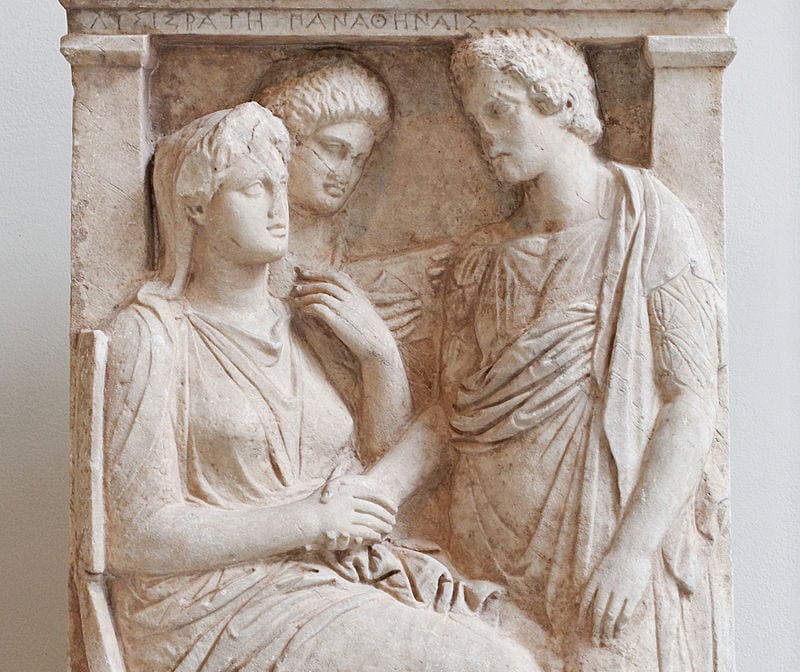
Perhaps the most moving examples of dexiosis in the Ancient Greek world are not found on treaties or civic monuments, but on funerary steles. These marble gravestones, now displayed in museums and archaeological sites across Greece, were among the most common memorials families left for their loved ones.
Time and again, these carvings portray the same scene of a deceased person seated in calm dignity while clasping the right hand of a standing spouse, parent, or child. Here, the gesture has nothing to do with weapons or politics. Instead, it serves as a final farewell. In these images, the Ancient Greeks expressed the belief that the bond between the living and the dead could not simply be severed by death itself. Love, as they seemed to understand it, did not end when someone crossed into the Underworld.
From Greece and Rome to your next handshake
The Romans, ever practical, adopted dexiosis and the gesture of the handshake from the Greeks wholesale, renaming it dextrarum iunctio, meaning the joining of right hands. They stamped the image on coins and embedded the gesture into legal contracts as a symbol of fides, or loyalty.
Then came the Middle Ages and a subtle shift. Knights and nobles, who had a habit of concealing daggers in their voluminous sleeves, began vigorously pumping the clasped hands up and down just in case anything dangerous might fall loose. That shaking motion, born from medieval suspicion, is essentially what we still do today, participating in an unbroken chain of human behavior that stretches back thousands of years.
See all the latest news from Greece and the world at Greekreporter.com. Contact our newsroom to report an update or send your story, photos and videos. Follow GR on Google News and subscribe here to our daily email!

