



A new study of ancient written records shows that multilingual societies thrived across Hellenistic Central Asia for nearly a thousand years, with scribes regularly switching between languages and scripts to serve whichever empire happened to be in power.
Rachel Mairs, a researcher at the University of Reading, published the findings in “Writing in the Ancient World.” The study examines surviving texts from regions now known as Afghanistan, Pakistan, Uzbekistan, and Tajikistan, covering the period from roughly the fifth century BC to the second century CE.
Mairs identifies four main written languages in the region: Aramaic and Elamite under the Achaemenid Persian Empire, Greek under Macedonian rule, and Prakrit under the Mauryan Empire from India.
Moreover, she argues that none of these were actually the spoken languages of most local people, who likely communicated in Iranian languages that went largely unwritten for centuries.
Clay tablets and Aramaic texts revealed the Persian rule’s reach
The physical evidence is remarkable in its variety. A tiny Elamite clay tablet found at Old Kandahar, measuring just over five centimeters, proves the Persian bureaucratic system reached deep into what is now southern Afghanistan.
A collection of 48 Aramaic documents from northern Afghanistan, dating to the 350s to 320s BC, shows instructions flowing from a satrap named Akhvamazda to a local governor.
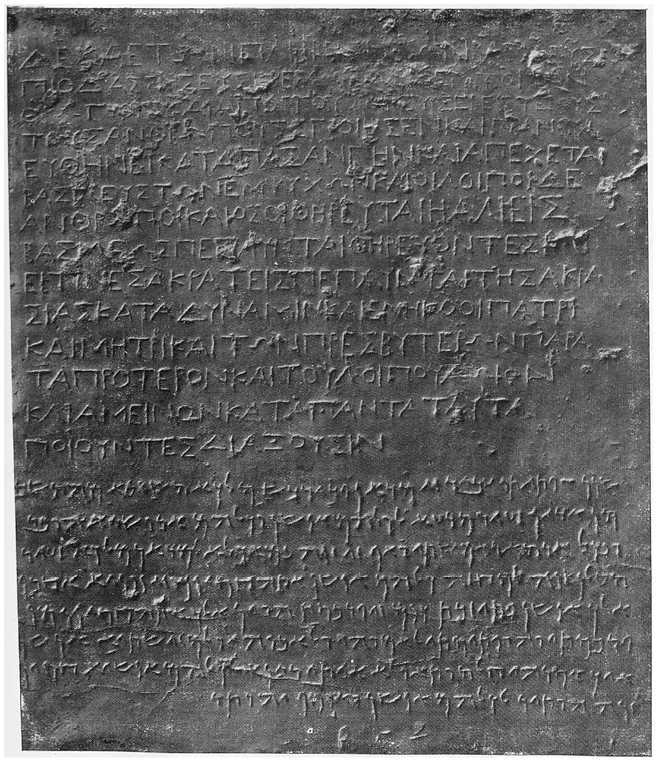
Some of these texts contain so many Iranian loanwords that more than a third of the vocabulary in certain documents is not Aramaic at all.
Mairs notes that scribes across the empire received identical training regardless of location. The handwriting in Bactrian Aramaic documents matches documents produced in Egypt during the same period, pointing to a highly organized imperial system of scribal education.
Asoka’s inscriptions at Kandahar combined three written languages
When the Mauryan emperor Asoka set up inscriptions at Old Kandahar in the third century BC, he used Greek, Aramaic, and Prakrit side by side. The Greek translator did not simply convert the text word for word.
Instead, the translator used the Greek word “eusebeia,” meaning piety, to convey the Indian concept of “dharma,” showing genuine cultural interpretation rather than mechanical translation.

At the Greek city of Ai Khanoum in northern Afghanistan, Mairs finds evidence of a full literary culture. A philosophical dialogue in the tradition of Plato survived as an imprint in hardened mud. A fragment of dramatic verse suggests the city’s large theater hosted actual performances.
An elaborate verse epitaph by a man named Sophytos, who carried a non-Greek name but celebrated a Greek cultural education, demonstrates how deeply Greek literary traditions had taken root far from the Mediterranean.
Greek outlived its rulers in multilingual Hellenistic Central Asia
Bilingual coins minted by Indo-Greek kings in the second century BC carried legends in Greek and Prakrit, allowing communities across the Hindu Kush to recognize the currency in their own script.

Even after Greek political power ended, its traces lasted. Buddhist reliquary inscriptions from Gandhara carry Greek administrative titles like “meridarch” as late as the second century CE. Greek calendar month names appear in dated inscriptions even later.
The study ends with the Kushan king Kanishka explicitly stating in his Rabatak inscription that he replaced Greek with Bactrian as the official language, marking the formal end of Greek’s administrative role in the region.
See all the latest news from Greece and the world at Greekreporter.com. Contact our newsroom to report an update or send your story, photos and videos. Follow GR on Google News and subscribe here to our daily email!

