



The celebration of Saint George on April 23 is one of the most important feasts in Greece and particularly in Arachova, where the saint is the town’s patron.
For days, this town in Central Greece prepares for a local festival or paniyiri, which can be traced back to Byzantine times. The tradition that survived the Ottoman occupation draws thousands of visitors each year.

Men and women dress in traditional clothes, sing and dance, and repeat the Easter tradition of roasting lambs on the streets of Arachova.
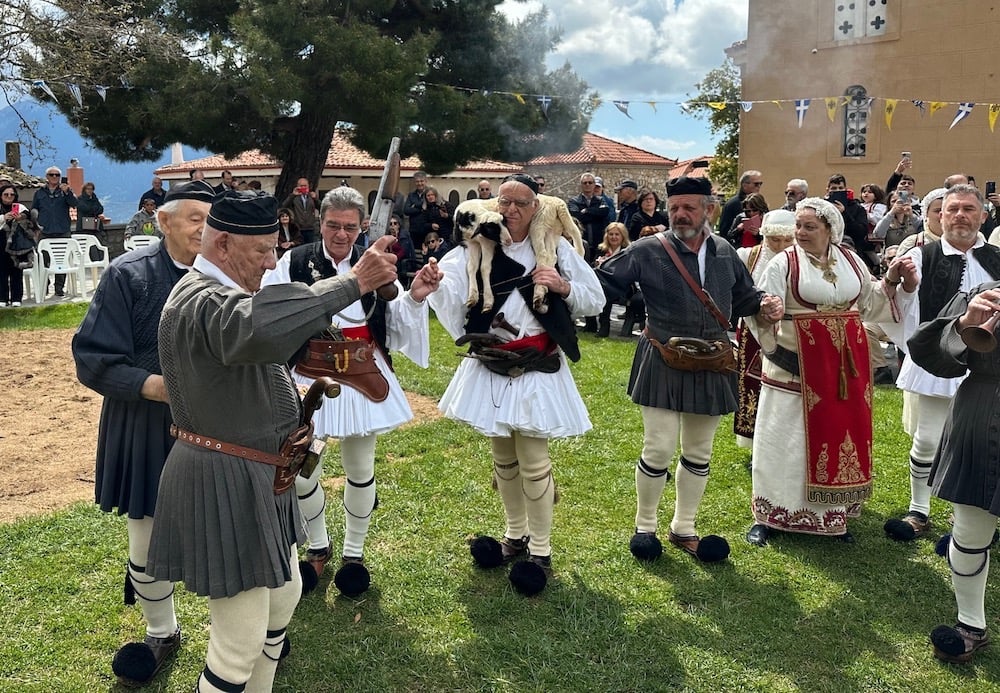
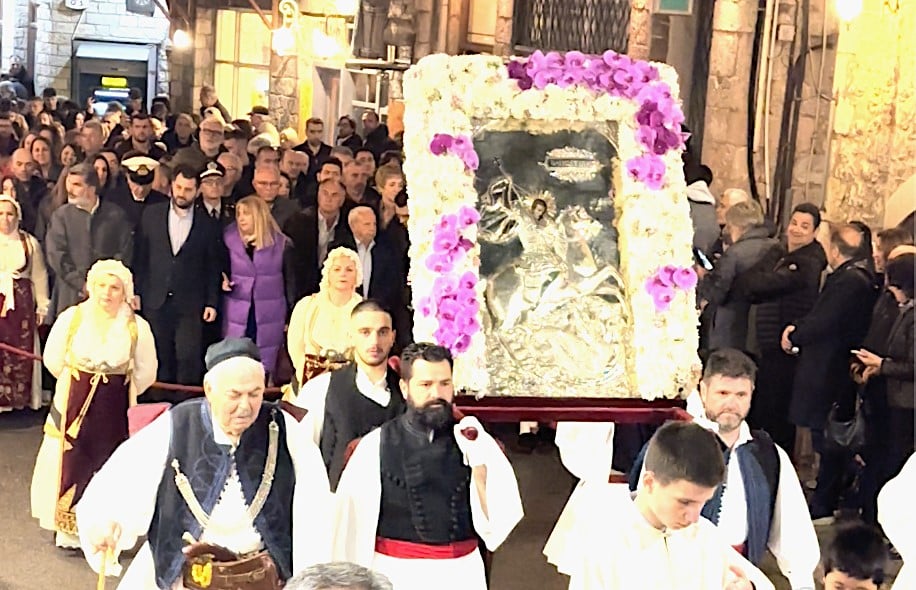
A procession carrying the saint’s icon parades around the village and winds uphill to the church. Villagers dressed in colorful traditional clothing follow the icon procession while dancing troupes entertain the crowd.
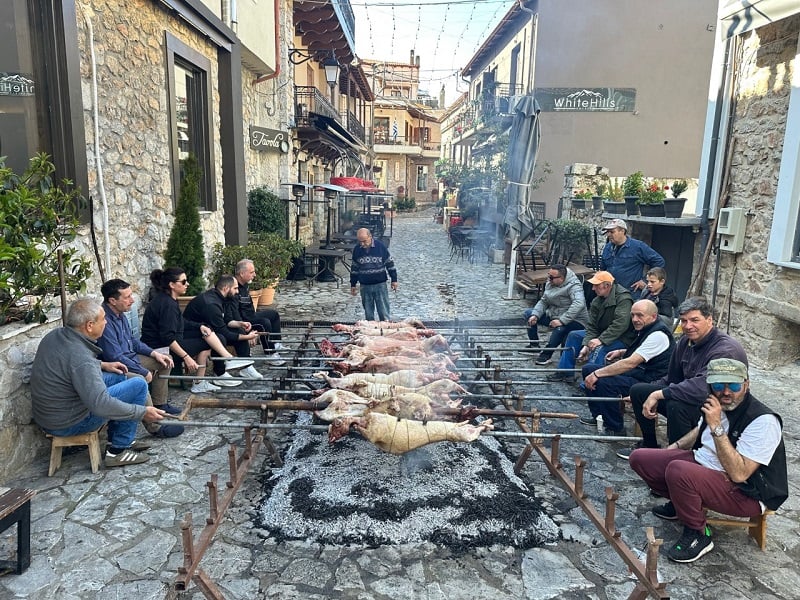
Arachova, the winter Mykonos of Greece, knows how to celebrate its patron saint.
Almost all Greek households have someone called Georgios or Georgia among close or distant relatives or friends.
Saint George was a Roman officer of Greek descent from Cappadocia
Very little is known about St George’s life, but it is thought he was a Roman officer of Greek descent from Cappadocia who was martyred in a pre-Constantinian persecution. There are two main versions of the legend, a Greek and a Latin version, which can both be traced to the fifth or sixth century.
In the Greek tradition, George was born to Greek Christian parents in Cappadocia. His father died for the faith when George was only fourteen, while his mother returned with George to her homeland of Syria Palaestina.
A few years later, George’s mother died. He then traveled to the capital, Nicomedia, and joined the Roman army. George was persecuted for his faith by a man called Dadianus. In later versions of the Greek legend, this name is rationalized as Diocletian, and George’s martyrdom is placed in the Diocletian persecution of 303 AD.
George was executed by decapitation before Nicomedia’s city wall, on April 23, 303. A witness to his suffering, Empress Alexandra of Rome became a Christian, joining George in martyrdom. His body was returned to Lydda for burial, where Christians soon came to honor him as a great martyr, or hieromartyr—not only one who dies for the faith but whose heroic death leads others to convert to Christianity.
The Latin Passio Sancti Georgii (in the 6th century) follows the general course of the Greek legend, but Diocletian here becomes Dacian, Emperor of the Persians. According to this tradition, George lived and died in Melitene in Cappadocia. His martyrdom was greatly extended to more than twenty separate incidents of torture throughout seven years.
Over the course of his martyrdom, 40,900 pagans converted to Christianity, including the empress Alexandra. When George finally died, the wicked Dacian was carried away in a whirlwind of fire. In later Latin versions, the persecutor is the Roman emperor Decius, or a Roman judge named Dacian serving under Diocletian.
See all the latest news from Greece and the world at Greekreporter.com. Contact our newsroom to report an update or send your story, photos and videos. Follow GR on Google News and subscribe here to our daily email!

